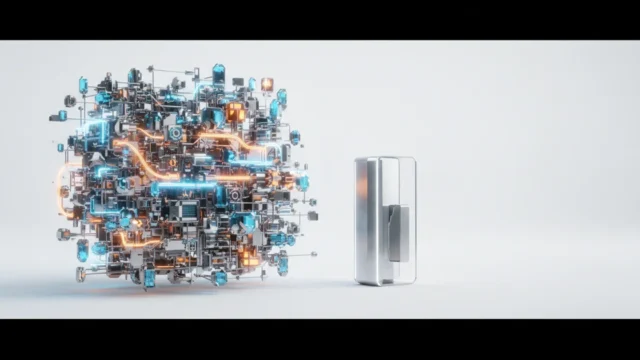
The Black Box Problem AI Has Always Had
Large language models have always operated behind a one-way mirror. Researchers and engineers could feed inputs into systems like Claude and observe the outputs those systems produced, but everything happening in between — the actual computational reasoning — remained invisible. Anthropic’s own researchers faced this wall every day they worked on one of the most powerful AI systems ever built.
This opacity isn’t a minor technical inconvenience. It sits at the core of every serious AI safety and alignment debate. You cannot audit a decision-making process you cannot observe. You cannot verify that a model reasons the way its designers intend if the reasoning itself is inaccessible. For years, AI interpretability researchers have argued that deploying systems without this visibility is a fundamental risk — not a future problem but a present one.
The challenge compounds as model capabilities grow. Claude Opus 4.6 can write code, analyze legal documents, and hold extended reasoning chains across complex tasks. Yet until Anthropic developed the Jacobian lens technique, no one outside — or inside — the model could directly observe what concepts the system was internally processing before generating a response. Outputs were the only window into a system doing increasingly consequential work.
Mainstream AI coverage rarely treats this interpretability gap as the central issue it is. Benchmark scores, parameter counts, and capability comparisons dominate headlines. The harder question — whether humans can meaningfully oversee what these neural networks are actually doing — gets far less column space. That imbalance matters because the gap between what an AI system produces and what it internally processes is precisely where alignment failures, deceptive behavior, and hidden biases can live undetected. The black box problem isn’t background context for the J-space discovery. It’s the reason the discovery exists at all.
What the Jacobian Lens Actually Found
Anthropic researchers built the Jacobian lens — a novel interpretability tool — and applied it to Claude Opus 4.6, the version of the company’s flagship large language model released in February. What they found was a previously undetected internal space operating beneath the model’s visible outputs, which they named J-space.
J-space functions as a kind of pre-verbal reasoning layer. It contains individual words semantically connected to whatever the model is about to generate, surfacing the conceptual territory Claude is navigating before a single token appears in its response. Think of it as catching the model mid-thought — the mental workspace it occupies during inference, invisible to anyone reading the final output.
Before this discovery, the internal mechanics of how large language models process and resolve meaning during a query were effectively opaque. Researchers could study inputs and outputs, probe activation patterns, and run ablation experiments, but the moment-to-moment conceptual work happening inside the network remained hidden. The J-lens changed that. Anthropic describes it as the clearest window yet into what is actually occurring inside an LLM as it formulates a response.
The significance here extends beyond neural network architecture. For AI interpretability research, J-space represents a concrete, mappable layer where abstract model behavior becomes legible. Instead of inferring intent from outputs alone, researchers can now observe what concepts are active and competing before the model commits to language. That has direct implications for AI alignment work, model auditing, and any safety framework that depends on understanding what a model is actually doing — not just what it says it is doing.
The technical achievement is real. But the more consequential question is what J-space reveals when researchers look closely at its contents — and that answer is where Anthropic’s own language shifts from confident to cautious.
The ‘Mundane to Unnerving’ Range — What That Phrase Is Hiding
The widely quoted description of the J-space findings as ranging from “mundane to unnerving” is a carefully chosen phrase that most coverage has let slide without scrutiny. The mundane end is easy to dismiss — a language model pre-loading contextually relevant words before producing output sounds like a plausible extension of how autocomplete works. The unnerving end is where the conversation needs to go, and almost nobody is going there.
The core problem is what the J-space actually contains. When Anthropic’s researchers used the Jacobian lens to examine Claude Opus 4.6’s internal processing, they did not find a clean mapping of input to output. They found a conceptual workspace — a hidden layer where the model appears to be representing ideas, relationships, and associations that were never explicitly programmed into it. That distinction matters enormously. A system that surfaces emergent internal representations of concepts has a fundamentally different profile than a reactive text predictor, and the safety and regulatory frameworks currently governing large language models are built almost entirely around the latter assumption.
The “puzzling” framing Anthropic uses is not accidental. It implies active cognitive work happening before any token is generated — an internal process that precedes the visible response. If that characterization is accurate, it collapses the standard defense that AI models are simply sophisticated pattern-matchers with no intermediate reasoning states. That defense has been load-bearing for years in debates about AI consciousness, AI deception risk, and the feasibility of model oversight.
Neural network interpretability research has long struggled with the opacity of transformer-based architectures. The J-space discovery does not resolve that opacity, but it does confirm that something structured is happening inside these systems between input and output. What that structure represents, how stable it is across different prompts, and whether it can be monitored in real time — those are the questions that define whether meaningful AI oversight is actually possible. Anthropic has opened a door, though it has been explicit that finding a functional analog to a global workspace does not confirm Claude is conscious or has subjective experience — a caveat much of the coverage has skipped. The unnerving part is not knowing what’s standing behind it.
Why This Matters for AI Safety Right Now
AI safety researchers have spent years arguing that interpretability tools — methods for auditing what happens inside a model’s internal states — are a prerequisite for responsibly deploying frontier AI systems at scale. Anthropic’s J-lens is exactly that kind of tool, and its arrival matters precisely because it came after Claude Opus 4.6 was already in users’ hands.
That sequence is the problem. Opus 4.6 launched in February, and the J-space was discovered afterward. Anthropic is hardly alone in this pattern — the entire industry routinely ships models before researchers fully understand their internal representations — but the gap between deployment and comprehension remains one of the most serious unresolved issues in AI development. You cannot govern what you cannot see.
What the J-lens offers is a mechanism to change that. By exposing hidden word-level representations that reflect what the model is processing before it generates a response, the tool creates a window into latent model behavior that outputs alone never reveal. That distinction carries real weight for AI alignment and model transparency work. Outputs can be deceptive or misleading while internal states tell a different story entirely. A model could produce perfectly reasonable-sounding text while its internal representations signal something misaligned with its training objectives.
The practical implication for AI oversight is significant. Researchers who can read internal model states in near-real time gain the ability to detect unintended goal formation, emergent deception, or behavioral drift before those tendencies surface as harmful outputs. That shifts safety work from reactive — catching failures after they happen — to proactive. Neural network interpretability research has long chased exactly this capability, and J-lens represents a concrete step toward making it operational rather than theoretical.
The unnerving findings Anthropic described are not a reason to pull back. They are a reason to accelerate this line of research and to treat internal model auditing as a standard part of the deployment process, not an afterthought that follows product launches.
What Most Coverage Is Getting Wrong
Most headlines are treating the J-space discovery as a pure engineering triumph — a window finally cracked open inside the black box of large language models. That framing buries the more consequential story.
Start with scope. The Jacobian lens research applies specifically to Claude Opus 4.6. Anthropic has not demonstrated that J-space is a universal feature of transformer architectures or that the same interpretability technique works on models built by OpenAI, Google DeepMind, or Meta. Whether this hidden reasoning layer exists across the broader LLM landscape, or whether it is an artifact of Anthropic’s particular training approach, remains an open question. Treating one model’s internal structure as a general truth about AI cognition is a significant inferential leap.
Then there is the institutional conflict of interest that most coverage has ignored entirely. Anthropic occupies an unusual position here: the company both developed J-lens and stands to gain the most reputationally from the narrative that AI internal states are mappable and therefore manageable. Anthropic has built its brand around safety-first AI development, and a discovery that says “we can see what Claude is thinking” lands perfectly within that story. Independent replication by outside researchers — academics, rival labs, government-funded AI safety institutes — is not optional. It is the minimum standard before the field draws firm conclusions.
The governance dimension is the most underreported angle. If internal reasoning spaces like J-space are real and can be accessed through tools like the Jacobian lens, then AI auditors and regulators need access to equivalent interpretability instruments. Right now, they don’t have them. Policymakers debating AI oversight frameworks in the EU and the United States are doing so largely blind to what is actually happening inside deployed models. The discovery doesn’t just raise questions about machine cognition — it exposes a structural gap between what AI developers can observe about their own systems and what external oversight bodies can verify. That gap is the real story.
What Comes Next — and What Should
Anthropic built the J-lens and ran it on Claude Opus 4.6 internally. That’s one lab, one model, one research team. Before the technique earns real weight in policy or safety conversations, independent researchers need to replicate it across different model architectures, different training regimes, and different tasks. Interpretability methods have a history of looking robust inside one lab and fragmenting under outside scrutiny. The J-lens deserves the same stress-testing.
Policymakers working on AI oversight frameworks should be paying close attention regardless. Governments and regulatory bodies have struggled with a fundamental problem: no one could open the black box. The J-space finding changes the terms of that conversation. If tools that make internal model states legible can be standardized and verified, they stop being research curiosities and start being candidate requirements — the kind that could appear in audit standards, model certification processes, or mandatory disclosure rules. The EU AI Act and emerging US federal guidelines are both grappling with how to assess high-capability systems. A validated version of J-lens-style analysis gives regulators something concrete to work with beyond benchmark scores and developer self-reporting.
For everyday users, the implications are more immediate than they might appear. The dominant assumption has been that large language model reasoning is fundamentally unknowable — a position that conveniently shields AI developers from demands for genuine transparency. The J-space research chips away at that assumption directly. Peering into hidden representational states during inference, watching concepts activate before a response is generated — these are the early mechanics of genuine AI transparency, not a polished explainability dashboard built for public relations.
The shelf life of the “unknowable AI” framing is shrinking. As neural network interpretability research matures, the technical barriers to reading internal model states will keep falling. Users, regulators, and civil society groups now have grounds to push harder: transparency is becoming feasible, and feasible means it can be required.