The Three Walls Every AI Video Tool Keeps Hitting
The current generation of AI video tools shares three crippling limitations that no amount of hype has fixed.
The first is duration. Tools like Runway, Sora, and Kling produce clips measured in seconds — typically four to ten — before quality degrades or coherence collapses. That ceiling isn’t a minor inconvenience. Narrative storytelling requires setup, tension, and resolution. You cannot build any of that in eight seconds of generated footage. Independent creators who want to produce short films, serialized content, or even structured explainers are left stitching together disconnected clips and hoping the seams don’t show. They always show.
The second wall is consistency. Ask any current AI video generator to maintain the same character across multiple scenes and the results are unpredictable at best, unusable at worst. A protagonist’s face shifts between cuts. A room’s lighting changes without motivation. A costume detail disappears. Each inconsistency pulls the viewer out of the story, and once that suspension of disbelief breaks, it rarely recovers. For creators building anything longer than a single-take product demo, this is a structural barrier, not a bug to patch in the next update.
The third failure is the most telling: the entire field built around visuals and ignored everything else. A finished video is a script, a shot list, a sound design, a pacing decision, a narrative arc. Most AI video tools handle exactly one of those things. Creators still write their own scripts, record or license their own audio, make their own editing decisions, and then use the AI tool only to generate a clip that fits into a workflow it was never designed to support. The tool acts as a visual renderer, not a production partner.
These three problems — short clips, inconsistent characters, and a narrow visual-only scope — define the ceiling of what AI video has been able to deliver. They also define exactly where ViMax chose to start building.
What ViMax Actually Does Differently
Most AI video tools operate as sophisticated clip generators. You feed them a prompt, they produce a few seconds of footage, and the creative burden of turning that clip into something coherent stays entirely with you. ViMax, developed by HKUDS, is built on a different premise entirely.
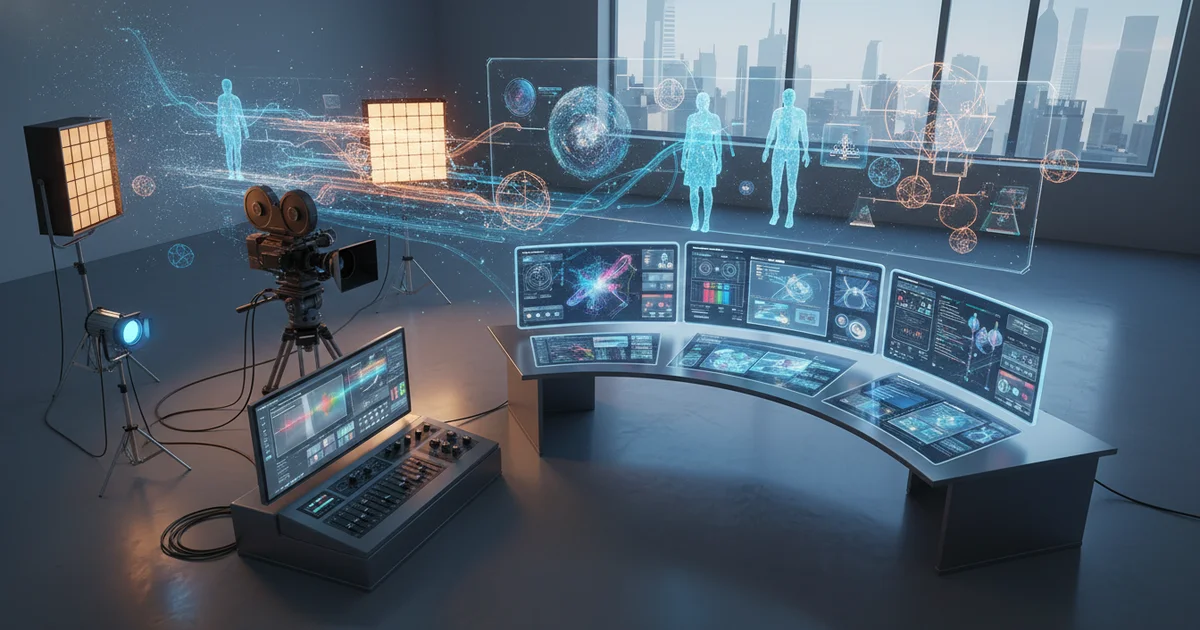
The system functions as an agentic pipeline — meaning it doesn’t just generate video, it orchestrates the entire production sequence autonomously from a single concept input. Type in a raw idea, and ViMax handles scriptwriting, storyboarding, character creation, and final video generation without requiring a human to hand off work between stages. The project’s own framing makes the ambition explicit: director, screenwriter, producer, and video generator, collapsed into one coordinated workflow.
That word — agentic — carries real technical weight that most coverage skips past. A one-shot generation model produces output in a single pass. An agentic system makes sequential decisions, where each step informs the next. ViMax builds a script before it builds a storyboard. It defines characters before it renders them. Those upstream decisions constrain and shape what comes downstream, which is exactly how human production pipelines work. The result is a system that maintains narrative and visual consistency across scenes rather than treating each frame as an isolated generation task.
This directly addresses three failures that have made AI video largely unusable for storytelling at scale: clips that last only seconds, characters that change appearance unpredictably between shots, and output that is purely visual with no underlying narrative structure. ViMax targets all three simultaneously rather than optimizing for any one in isolation.
For independent creators, the practical implication is significant. The traditional production pipeline requires either a team of specialists or an enormous amount of personal context-switching — from writer to director to editor. ViMax compresses that sequence into a single input-to-output workflow. Whether the execution fully delivers on that architecture is a separate question. The architecture itself represents a genuine structural shift in what AI video systems are designed to attempt.
The Missing Context: Why ‘Agentic’ Is the Key Word Here
Most coverage of AI video tools fixates on pixels: frame rate, resolution, how convincingly a generated face moves. That framing misses what makes ViMax structurally different from every other tool in the conversation.
The word that matters is agentic. An agentic AI system doesn’t wait for a human to hand it the next instruction — it plans a sequence of tasks, executes them in order, and adjusts as it goes. That paradigm has already reshaped coding (GitHub Copilot Workspace) and research (deep research agents from OpenAI and Perplexity). Applying it to creative production is newer, messier territory, because storytelling isn’t a linear problem with a verifiable correct answer.
ViMax treats video production as exactly that kind of multi-step autonomous task. The system takes a raw concept and runs it through scriptwriting, storyboarding, character design, and final video generation — in sequence, without a human directing each handoff. The architecture assigns distinct roles inside that pipeline: director, screenwriter, producer, and video generator function as separate agents coordinating toward a single output. That’s not a feature list. That’s a production workflow rebuilt as software.
This puts ViMax in a different category than Sora or Runway. Those tools are generators — sophisticated ones, but generators. They accept a prompt and return footage. ViMax accepts a concept and returns a production. The distinction is architectural. Sora competing with ViMax is like comparing a paint sprayer to a construction crew: one produces a surface, the other builds the structure underneath it.
For independent creators, the implication is specific: the bottleneck has never been the final render. It’s been everything upstream — the script, the shot list, the consistent character design across scenes. ViMax targets those bottlenecks directly, which is why its significance is structural rather than visual. The output quality matters less than the question it’s actually answering: can AI hold the full creative context of a production from concept to screen, without a human stitching the pieces together?
What This Means for Independent Creators Right Now
For a solo creator who currently juggles a half-dozen separate tools — one for scripting, another for storyboarding, a third for footage generation — ViMax collapses that entire chain into a single input prompt. Type a concept, and the system autonomously handles scriptwriting, character design, storyboarding, and final video generation. That compression of workflow is the practical headline. A one-person channel or indie studio no longer needs to budget for a writer, a storyboard artist, and a video editor to produce a coherent narrative piece.
The open-source structure of the HKUDS project amplifies this further. Because the pipeline lives on GitHub, independent developers can read the underlying code, modify individual agents — the “director,” “screenwriter,” or “producer” components — and build specialized versions tailored to specific genres or formats. That transparency is a direct contrast to closed commercial platforms, where the production logic is a black box and customization stops at whatever sliders the company decides to expose.
The ceiling, though, is real and should not be glossed over. Agentic ambition — the ability to orchestrate a multi-stage creative process autonomously — does not automatically translate to broadcast-ready output. The HKUDS team built ViMax explicitly to address consistency problems that plague current AI video tools: characters that shift appearance between frames, scenes that drift in style, footage locked to a few seconds of usable length. Whether the pipeline fully solves those problems at professional quality is a separate question from whether it attempts to. Creators who adopt ViMax expecting finished, distribution-ready content will likely need to treat the output as a strong draft rather than a final product.
The honest framing for independent creators right now: ViMax meaningfully lowers the entry cost for narrative video production, and its open codebase gives technically capable users genuine room to push the tool further. The gap between “agentic pipeline” and “professional output” still exists — but it is closing, and ViMax marks one of the clearer boundary posts on that path.
The Bigger Picture: AI Moving Up the Creative Stack
For most of AI’s video history, the technology operated at the asset layer — generating a clip here, an image there, a sound effect on demand. ViMax, developed by HKUDS, marks a deliberate step past that ceiling. By combining a director, screenwriter, producer, and video generator into a single agentic pipeline, it positions AI not as a tool inside a production workflow but as the workflow itself.
That distinction matters more than it might first appear. When AI handles only rendering or visual generation, human creators still own the structural decisions — narrative arc, character continuity, scene pacing. When AI takes over scriptwriting, storyboarding, and production orchestration simultaneously, the locus of creative labor shifts. The bottleneck moves from technical execution to conceptual input. A creator’s primary contribution becomes the idea, not the craft of translating it.
For independent creators, that shift is significant. YouTube channels, short-form studios, and solo content producers currently compete against teams. A pipeline like ViMax — even in its current research state — suggests a near-future where a single person with a strong concept can generate structured, consistent, long-form video content without a crew, an editor, or a post-production budget.
HKUDS frames ViMax explicitly as a research exploration rather than a finished product. The GitHub repository describes the project as “exploring a future” and positions its multi-agent architecture as a proof-of-concept designed to push the field’s thinking. That framing signals intent: this is a stake in the ground about where agentic video generation should go, not a polished commercial release competing with Runway or Sora today.
That distinction makes it worth tracking closely. Academic research labs have a consistent record of shipping the conceptual blueprints that commercial products later execute at scale. HKUDS’s open research approach means the architecture, the agent coordination model, and the pipeline logic are available for others to build on — which accelerates the timeline from proof-of-concept to production-ready faster than proprietary development cycles typically allow.
The creative stack is moving upward. ViMax shows what it looks like when AI claims the top of it.