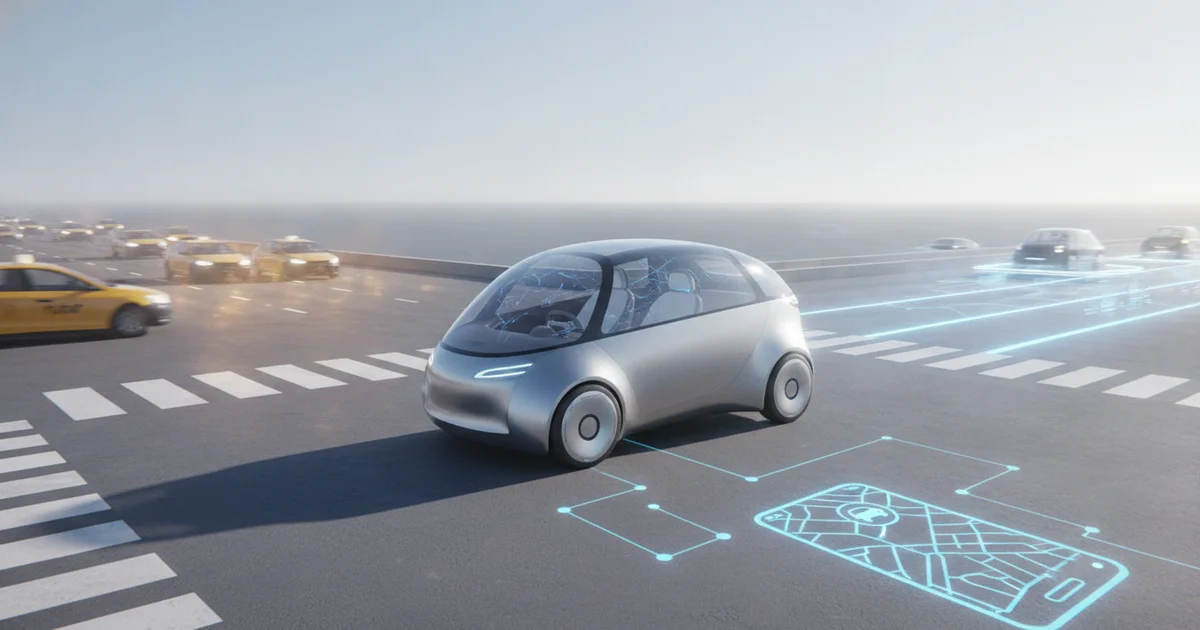
From Existential Threat to Strategic Pivot: How Uber Changed Its AV Tune
Travis Kalanick didn’t mince words about autonomous vehicles when he ran Uber. He called AVs an existential threat — not a future opportunity, but a potential extinction event for a company built entirely on paying human drivers to move people around. His logic was blunt: if self-driving technology matured and Uber wasn’t controlling it, a competitor with a driverless fleet would gut Uber’s unit economics overnight. “What would happen if we weren’t a part of that future?” Kalanick told Business Insider. “Then the future passes us by.”
So Uber charged in. It built an internal autonomous vehicle division, ran robotaxi pilots in Pittsburgh and San Francisco, and spent billions chasing full self-driving capability. Then it sold the entire unit — what became Waymo’s competitor Aurora absorbed key assets — and walked away from owning the technology stack altogether.
What replaced that ambition was something structurally smarter, at least for Uber’s balance sheet. Current CEO Dara Khosrowshahi reframed the company’s entire relationship with autonomous mobility. Rather than build and operate self-driving cars, Uber positioned itself as the commercial distribution layer that robotaxi operators need to reach riders at scale. “We think there are going to be many AV players around the world, and we want to be the go-to commercial platform for all of them,” Khosrowshahi told investors in 2024.
The numbers back the pivot’s momentum. Uber has signed partnerships with more than 25 robotaxi and autonomous vehicle operators globally. The company no longer absorbs the capital expenditure of LIDAR arrays, vehicle fleets, or safety driver programs. Instead, it collects platform fees when a Waymo, a May Mobility, or any other AV operator fulfills a ride booked through Uber’s app.
This repositioning transforms Uber’s identity. It is no longer trying to be a transportation company in any traditional sense. It is a marketplace — the ride-hailing equivalent of how app stores distribute software without writing the code. The existential threat Kalanick feared didn’t disappear; Uber simply engineered a version of the autonomous vehicle future where it sits above the hardware, skimming value from whoever wins the robotaxi race rather than betting everything on winning it themselves.
The Missing Context: Why ‘Partnering’ With AV Companies Suits Uber’s Interests — For Now
When Uber CEO Dara Khosrowshahi told investors in 2024 that the company wants to be “the go-to commercial platform” for autonomous vehicle operators everywhere, most coverage treated the statement as a bold vision for the future. The sharper read is that it’s a defensive business strategy dressed up as innovation leadership.
Uber has now signed partnerships with more than 25 robotaxi companies. The mainstream narrative frames this as Uber embracing the self-driving revolution. What it actually represents is Uber racing to become structurally indispensable to AV operators before those operators realize they don’t need Uber at all. Companies like Waymo already have functional consumer-facing apps. The moment any major robotaxi provider builds sufficient brand recognition and rider volume in a market, the commercial logic for routing trips through Uber’s platform weakens considerably. Uber’s partnership blitz is a preemptive move to lock in dependency before that calculation shifts.
The leverage argument Uber is quietly making runs like this: no single AV company will dominate every city, every geography, or every use case. That fragmentation means riders will still need one app to access multiple autonomous ride-hailing providers — and Uber is betting its existing demand network is the asset AV manufacturers simply cannot replicate quickly. That may be true in the short term. But it’s a bet on AV fragmentation persisting, not on AV technology accelerating.
That creates a tension Uber has no incentive to advertise. Its current revenue model depends on human drivers completing trips and generating margin through service fees. Every quarter that full-scale autonomous ride-sharing deployment stays limited to a handful of cities is a quarter Uber collects fees from millions of gig workers worldwide. A rapid, city-by-city robotaxi expansion that bypasses Uber’s platform entirely would be catastrophic for that model. Slow, partnership-mediated AV rollout — where Uber controls the consumer relationship — is the version of the future that actually benefits Uber financially. The company’s public enthusiasm for autonomous mobility and its private financial incentives point in opposite directions.
What This Means for Uber Drivers: The Group With the Most to Lose
Uber’s roughly 4 million active drivers worldwide power every quarter of profitable growth the company reports — and they are also the workforce Uber’s own long-term strategy is designed to make obsolete. CEO Dara Khosrowshahi has been explicit with investors: Uber wants to be the dominant commercial platform connecting riders to autonomous vehicles from any of the 25-plus robotaxi partners it has already signed. That is not a driver-friendly vision dressed up in corporate language. It is a direct roadmap away from human labor.
The partnership model makes this transition uniquely painless for Uber’s balance sheet. Because Uber classifies its drivers as independent contractors rather than employees, it carries no legal obligation to retrain, compensate, or transition them when autonomous ride-hail services absorb their routes. Every social cost of that displacement — lost income, retraining expenses, economic disruption in cities where gig driving is a primary livelihood — falls entirely on drivers, local governments, and public safety nets. Uber absorbs none of it.
This creates a structural tension Uber rarely addresses in public communications. Human drivers today give the platform its geographic density, surge coverage, and reliability in markets where robotaxi fleets cannot yet operate at scale. Without that driver network, Uber’s rider experience collapses. AV technology still cannot handle airports in heavy rain, complex suburban pickup zones, or the thousands of edge-case scenarios that human drivers resolve instinctively every day. Drivers are indispensable — until the moment the technology catches up.
That dual role — essential operational asset and designated liability — is the real variable driving Uber’s AV integration timeline. The company will push autonomous ride-sharing aggressively in dense, high-margin markets like San Francisco and Phoenix where AV deployment is already viable, while leaning on human drivers to absorb demand everywhere else. Drivers will lose the most lucrative urban corridors first, pushed toward lower-earning suburban and rural trips as robotaxi coverage expands. There is no announced transition program, no retraining fund, and no public commitment from Uber to cushion that outcome.
The Competitive Chessboard: Waymo, Tesla, and Why Uber Needs Friends It Can’t Fully Trust
Waymo already has its own consumer app, its own brand loyalty, and its own rider data. When it routes trips through Uber’s platform, it learns exactly what Uber knows: where demand spikes, which neighborhoods convert, how price-sensitive different rider segments are. Every completed Waymo ride on the Uber app is simultaneously a revenue transaction for Uber and a market research session for a direct competitor.
That tension defines every one of Uber’s more than 25 robotaxi partnerships. CEO Dara Khosrowshahi frames the strategy as positioning Uber as the universal commercial platform for autonomous mobility — the neutral ground where riders find any vehicle, human-driven or self-driving. The pitch to AV operators is straightforward: Uber brings a massive, established rider base and battle-tested dispatch infrastructure that would cost years and billions to replicate. For a company like Waymo still expanding city by city, that distribution shortcut has real value.
But that value has a shelf life. Waymo’s brand recognition in San Francisco and Phoenix is already strong enough that riders seek it out directly. Tesla’s robotaxi ambitions, if they materialize at scale, come pre-loaded with one of the most recognized consumer brands on earth. As autonomous ride-hailing companies deepen their own customer relationships, the network effect that makes Uber indispensable today gradually weakens.
The partnership model is therefore a race with a brutal clock. Uber needs AV deployments to scale fast enough — across enough cities, enough trip categories, enough ride volume — to cement its platform role before any single AV operator becomes large enough to walk away from the arrangement entirely. The moment a Waymo or a future Tesla robotaxi network can fill its own fleet utilization without Uber’s rider funnel, the partnership calculus flips. Uber stops being a distribution partner and starts being an unnecessary middleman taking a cut.
Former CEO Travis Kalanick identified autonomous vehicles as an existential threat to Uber’s driver-dependent model years ago. The current strategy doesn’t eliminate that threat — it defers it, betting that platform lock-in arrives before competitor independence does.
The Regulatory Wild Card: How Policy Could Either Save or Strand Uber’s Strategy
Regulation is the variable that could unravel or validate everything Uber is building. City and state governments control how fast robotaxis scale, and that makes them, not Waymo or Tesla, the most consequential actors in Uber’s medium-term future.
Strict AV permitting in dense metros like New York, Chicago, or Los Angeles would extend the human-driver era by years — giving Uber time to deepen its platform dominance, lock in robotaxi partnerships, and make itself structurally indispensable before any single autonomous vehicle operator reaches the scale needed to go direct-to-consumer. Every month regulators spend debating safety standards, minimum fleet requirements, or geofencing restrictions is a month Uber spends entrenching its aggregator position.
The reverse scenario carries real danger. Rapid regulatory approval in major U.S. cities could compress the timeline in which AV companies — Waymo, Cruise, Zoox, and the more than 25 robotaxi operators Uber has already partnered with — decide they no longer need a third-party ride-hailing platform to reach customers. Waymo already operates a standalone consumer app in San Francisco and Phoenix. Give it regulatory clearance in ten more cities and Uber’s role shifts from essential infrastructure to optional distribution channel.
This creates an obvious strategic incentive for Uber to quietly favor slower, more cautious AV regulatory frameworks — while publicly supporting autonomous vehicle development. Uber’s lobbying posture and public policy messaging around AV safety readiness deserve far more scrutiny than they currently receive. When Uber executives emphasize safety validation timelines or the importance of “responsible deployment,” those statements carry business logic, not just civic concern.
CEO Dara Khosrowshahi has positioned Uber as the neutral commercial platform for all autonomous mobility — but neutrality and self-interest are not mutually exclusive. The pace of urban autonomous vehicle regulation will determine whether Uber’s partnership strategy becomes a masterstroke or a bridge that its own partners eventually stop crossing.
The Bottom Line: A Smart Strategy With a Built-In Contradiction
Uber has engineered a genuinely elegant hedge. If autonomous vehicles scale quickly, Uber collects platform fees from the robotaxi operators flooding its network. If AV rollout stalls, human drivers keep generating the revenue that funds everything else. The company profits either way — but the pace that maximizes Uber’s leverage is a slow, fragmented one where no single AV operator grows powerful enough to walk away from the platform.
That is the built-in contradiction at the heart of the strategy. Uber’s value to companies like Waymo and Motional rests on one core assumption: that its rider demand, brand recognition, and routing infrastructure are worth more than the cost of building a competing consumer-facing app. That assumption holds today, when AV operators are early-stage and commercially thin. It weakens considerably as autonomous ride-hailing technology matures, fleets scale, and operators accumulate their own loyal user bases. Waymo already runs its own standalone app in San Francisco, Los Angeles, and Phoenix. The moment enough riders download it directly, Uber’s middleman position erodes.
For riders and city planners watching urban mobility transform in real time, the more urgent question gets surprisingly little attention: does inserting a platform intermediary between passengers and autonomous vehicle fleets actually accelerate the benefits of self-driving transportation, or does it extract margin that could otherwise lower fares and expand access? Cheaper, safer, more accessible mobility is the promise of the autonomous vehicle revolution. A network aggregator sitting between AV operators and the public takes a cut of every trip without building the technology or operating the vehicles.
Uber has more than 25 robotaxi partnerships and CEO Dara Khosrowshahi framing the company as the inevitable commercial layer of the AV future. That is a powerful position today. Whether it remains powerful when the underlying technology stops needing Uber’s distribution is the question the company has not answered — and may be quietly hoping nobody asks too loudly, too soon.