The Master Plan Promise: What Musk Actually Committed To
Tesla’s Master Plans were not marketing documents. They were explicit, numbered commitments — four of them — outlining a specific economic transformation Musk put his name on publicly and repeatedly.
The original Master Plan, published in 2006, set the terms plainly. Musk described Tesla’s “overarching purpose” as helping humanity move away from a “mine-and-burn hydrocarbon economy” toward a “solar electric economy.” That phrase was not rhetorical decoration. It defined the mission hierarchy: solar power was the destination, electric vehicles were the delivery mechanism, and Tesla was the company connecting both.
Subsequent plans built on that foundation rather than retreating from it. The 2016 Master Plan Part Deux formalized the logic of Tesla acquiring SolarCity, arguing that a sustainable energy future required combining solar generation, battery storage, and electric transportation under one roof. The plan described a world where homes generate their own power, store it in Powerwalls, and feed it back to the grid — a closed-loop system with solar at the center. The 2023 Master Plan Part 3 went further, modeling a complete electrification of the global economy and quantifying the investment required to get there.
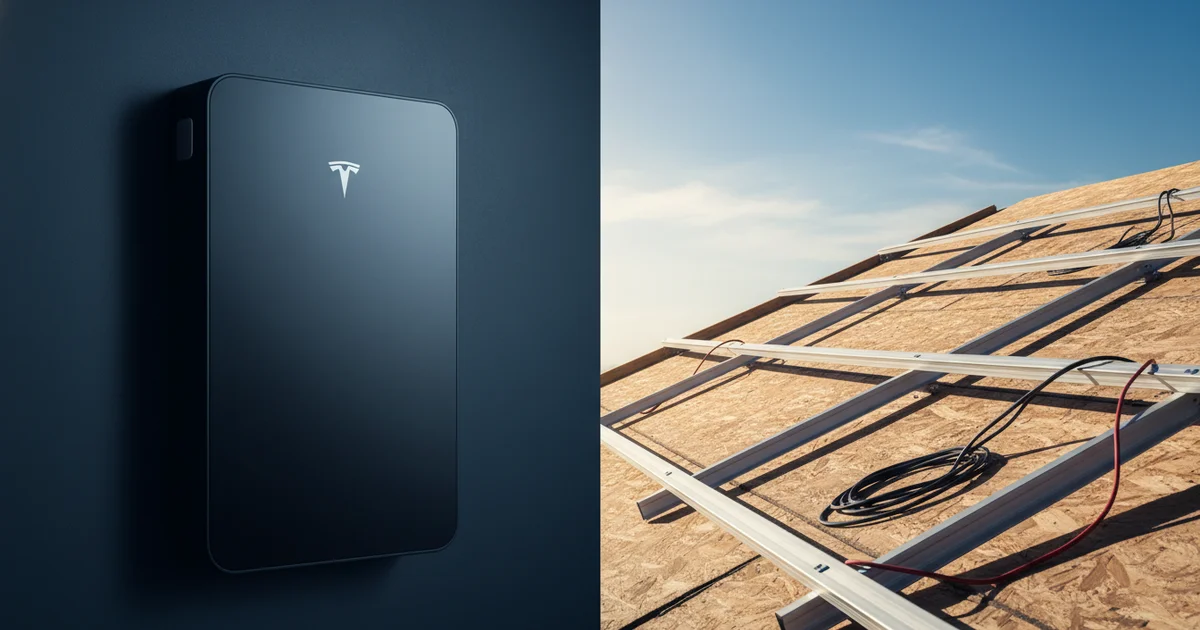
These weren’t vague aspirations. They named products, set targets, and described market strategies. The Powerwall, the Solar Roof, the utility-scale Megapack — each existed as a physical expression of the written plan.
That context matters enormously right now, because most coverage of the recent SpaceX IPO filing treats Musk’s apparent turn toward space-based solar as a curiosity or a bold new idea. It is neither. It is a departure from a decade and a half of documented commitments. When Musk wrote about a solar electric economy, he meant rooftops, grids, and terrestrial infrastructure — not orbital arrays beaming power down from space. Understanding what he actually promised is the only honest baseline for evaluating what he appears to be walking away from.
The SpaceX IPO Filing: What the Signal Actually Says
The SpaceX IPO filing — a legal document, not a press release — is what cracked this story open. IPO filings carry a different weight than Musk’s posts on X or his stage performances at product reveals. Securities law requires them to reflect actual strategic thinking, because misrepresentation invites liability. When SpaceX’s filing gestures toward space-based solar as a meaningful energy future, that is the company’s lawyers and executives signing off on a worldview, not a founder riffing in front of a crowd.
And the worldview embedded in that filing represents a clean break from what Musk spent two decades building his public identity around. Tesla’s original Master Plan, written by Musk himself, was unambiguous: the company’s purpose was to accelerate the shift from a “mine-and-burn hydrocarbon economy” to a “solar electric economy.” That framing defined four successive Master Plans and positioned Tesla, SolarCity, and the Powerwall as interlocking pieces of a coherent energy transition strategy.
The SpaceX filing reorients that vision off-planet. Earth-based solar is not the bet anymore — at least not in the corporate documents that actually govern how capital gets allocated.
Most coverage has treated this as a curiosity, a Musk-being-Musk moment filed under “eccentric billionaire pivots.” That framing misses what the document actually is. Meanwhile, the behavior inside Musk’s other companies has been moving in the same direction without drawing the same scrutiny. His AI company xAI is running dozens of unregulated natural gas turbines to power its data centers, with plans to spend $2.8 billion on additional fossil fuel infrastructure. That is not a detour. Combined with the SpaceX filing, it looks like a consistent pattern of choices made by a person who has stopped betting on the clean energy transition he once claimed to lead.
The Missing Context: Tesla’s Solar Business Was Already Struggling
Tesla’s solar ambitions were collapsing long before SpaceX filed its IPO paperwork. The Solar Roof, unveiled in 2016 and positioned as a cornerstone of the Master Plan’s vision of integrated home energy, spent years plagued by installation delays, contractor disputes, and pricing reversals. Tesla raised Solar Roof prices on existing customers mid-contract, triggering lawsuits and a wave of cancellations. Deployment numbers never came close to matching Musk’s projections.
The broader energy division tells the same story. Tesla’s solar deployments peaked in 2019 and declined sharply through subsequent years, even as residential solar adoption across the U.S. accelerated. Competitors like Sunrun expanded their installation footprints while Tesla retreated, laying off solar sales staff and abandoning door-to-door sales channels. By the time Tesla began bundling Solar Roof sales exclusively with Powerwall purchases, the business had effectively been restructured around damage control.
Master Plan Part Deux, published in 2016, called for Tesla to become a full-service clean energy company — solar generation, battery storage, and electric transport as a unified ecosystem. That vision required a scaling solar business. What Tesla built instead was a shrinking one.
This is the context missing from most coverage of Musk’s apparent pivot toward space-based solar. His skepticism about Earth-based generation, now embedded in a formal IPO filing, reads less like a bold strategic repositioning and more like post-hoc rationalization of a business line that already failed to deliver. The SpaceX filing gives that failure an ideological frame — but the underperformance predates the framing by years.
Musk once described Tesla’s overarching purpose as accelerating the shift from a “mine-and-burn hydrocarbon economy” to a “solar electric economy.” The company’s actual solar trajectory moved in the opposite direction. That gap between rhetoric and execution is the real story, and the SpaceX filing didn’t create it. It just made it harder to ignore.
Space-Based Solar: Moonshot Pivot or Convenient Rebranding?
Space-based solar power is a real concept with genuine scientific backing. The idea — launching photovoltaic arrays into geostationary orbit and beaming energy back to Earth via microwave — has been studied by NASA, the European Space Agency, and the Pentagon for decades. But every serious analysis places commercial viability somewhere between 2040 and 2060 at the earliest, contingent on dramatic reductions in launch costs and technologies that don’t yet exist at scale.
SpaceX’s IPO filing positions the company as a future player in this space, offering Musk a clean narrative: he hasn’t abandoned solar, he’s just thinking bigger. It’s a rhetorically elegant move. By pointing toward orbital energy infrastructure, Musk preserves his identity as a clean energy visionary while stepping back from the difficult, unglamorous, ground-level work of actually deploying rooftop panels and utility-scale solar across American homes and grids — work Tesla’s Solar Roof program repeatedly stumbled on, missing installation targets and burning through workforce reductions.
The timing makes the pivot harder to accept at face value. xAI, Musk’s artificial intelligence company, is running its Memphis data centers on dozens of unregulated natural gas turbines and has committed to purchasing $2.8 billion more in gas-powered generation capacity. That isn’t a company waiting for orbital solar. That’s a company locking in fossil fuel infrastructure right now, in 2024, while the planet cannot afford new hydrocarbon dependencies.
Clean energy advocates argue the math here is straightforward and damning. Proven terrestrial solar technology is deployable today. The U.S. solar industry installed a record 50 gigawatts of capacity in 2023 alone. Every year spent waiting for speculative orbital systems is a year of preventable emissions. Framing a decades-away moonshot as a substitute for near-term deployment doesn’t accelerate the energy transition — it provides political and reputational cover for abandoning it.
Musk once defined Tesla’s entire purpose as moving civilization from a mine-and-burn hydrocarbon economy toward a solar electric one. Space-based solar keeps that sentence technically alive. Whether it keeps the mission alive is a different question entirely.
Why This Matters Beyond Musk: The Influence Gap
Elon Musk spent a decade functioning as the clean energy industry’s most powerful unpaid spokesman. His Tesla Master Plans — four of them across nearly two decades — built a coherent public narrative around a singular goal: moving civilization from what he called a “mine-and-burn hydrocarbon economy” toward a “solar electric economy.” That framing didn’t just sell cars and rooftop panels. It shaped how investors priced renewable energy companies, how policymakers justified clean energy subsidies, and how millions of consumers started thinking about their relationship with fossil fuels.
That influence created a dependency the industry never fully acknowledged.
When Musk signals — through SpaceX’s space-based solar ambitions and xAI’s $2.8 billion bet on natural gas turbines — that terrestrial solar is not where serious money and serious minds should focus, the market listens. Not because Musk controls the physics of photovoltaics, but because narrative momentum in emerging industries is a real economic force. Investor sentiment shifts on perception as much as on fundamentals.
The damage isn’t hypothetical. Clean energy still needs mainstream champions at the exact moment it faces political headwinds across the United States and parts of Europe. Musk was uniquely positioned to hold that ground — a tech billionaire with credibility across conservative and libertarian circles who made solar feel inevitable rather than ideological. His retreat from that role leaves a gap no other figure currently fills.
The harder question this pivot forces is this: how much of the clean energy narrative over the past decade was genuinely structural, and how much was one man’s personal branding? If the answer leans toward the latter, the clean energy transition carries a fragility that deployment numbers and falling panel costs don’t capture. Industries built on a founder’s vision rather than broad institutional consensus are exposed when that founder moves on.
Solar power’s underlying economics remain strong. But economics don’t build political will or cultural permission. Musk did that work, whether intentionally or not — and he has stopped doing it.
What Comes Next: Tesla, SpaceX, and the Electrification Story Without Musk as Its Hero
Tesla still sells solar panels, the Solar Roof, and Powerwall batteries. The product line exists. The question is whether the executive attention and capital allocation needed to scale those products will follow Musk toward space-based power generation or stay anchored to the ground-level electrification work Tesla once defined itself by.
The signals from Musk’s broader empire point in one direction. xAI is burning natural gas at its Memphis data center through dozens of unregulated turbines, with $2.8 billion more in fossil fuel infrastructure planned. SpaceX’s IPO filing frames solar collection in orbit as the company’s energy future. These are not abstract philosophical positions — they are spending decisions that reveal where Musk believes the real leverage is.
That leaves a gap. Utilities like NextEra Energy, governments executing on the Inflation Reduction Act’s remaining incentive structures, and rivals like Sunrun and Enphase will need to carry the residential and commercial solar story forward without the cultural oxygen Musk once provided. None of them generate the same narrative gravity, but narrative gravity was never a panel or a battery. It was just attention.
The clean energy transition does not require Musk. Solar deployment has continued through policy shifts, corporate procurement commitments, and falling installation costs that exist independent of any one person’s enthusiasm. The International Energy Agency projected solar becoming the dominant source of new electricity generation globally through this decade — a trajectory set by economics, not celebrity.
What Musk’s apparent pivot does expose is how personality-dependent the “inevitable green future” framing has become in media and investor circles. When the person most associated with that story starts powering AI servers with gas turbines and talking about solar satellites, it forces a useful recalibration. The transition’s actual momentum lives in manufacturing capacity, grid interconnection queues, and policy continuity — not in any master plan authored by one man.
Tesla without Musk as its ideological engine is still a major clean energy company. Whether it behaves like one depends on choices its board and leadership have yet to make publicly.