What Micro RGB Actually Is — And Why the Hype Was Real
Micro RGB television technology works on a straightforward but genuinely significant principle: instead of using a white or blue backlight to illuminate pixels, each pixel generates its own red, green, or blue light directly. Traditional LED TVs rely on a white backlight filtered through color layers, which bleeds and dilutes the final image. OLED panels improved on that by eliminating the backlight entirely, but their organic compounds carry brightness limitations. Micro RGB subpixel arrays sidestep both problems by producing pure, discrete color at the source.
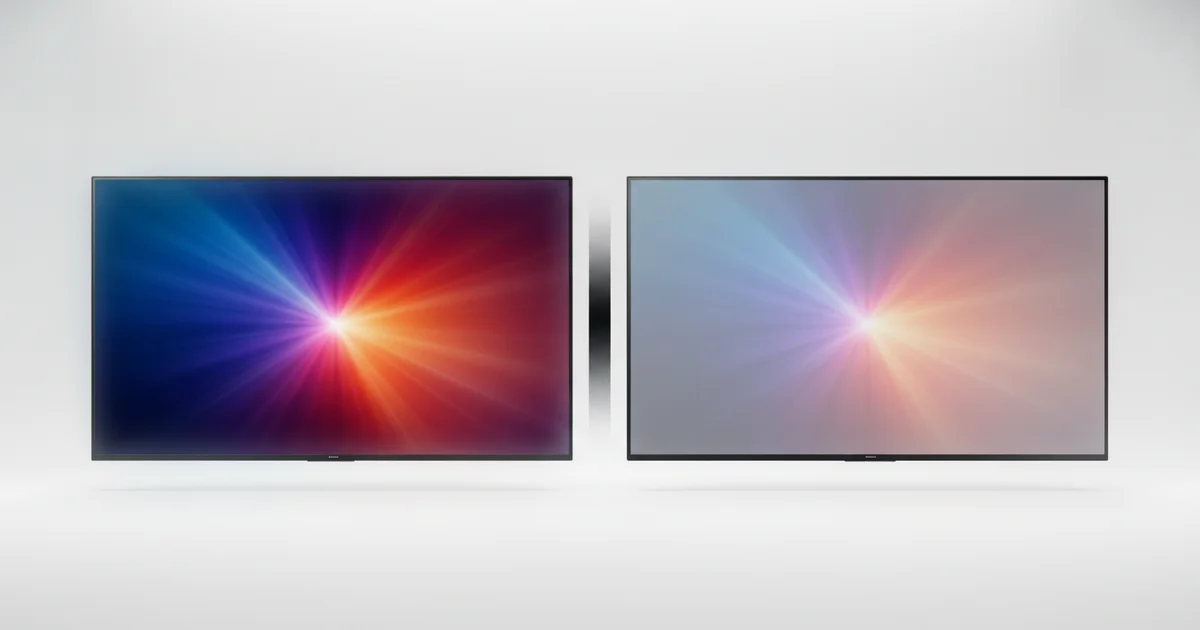
The implications for picture quality are real. When red is red at the pixel level rather than a filtered approximation of red, the display’s color volume expands dramatically. Greens stay vivid without washing into yellow. Blues hold their depth without graying out at higher brightness levels. This architecture theoretically delivers both the contrast depth associated with OLED and the peak brightness headroom that LCD panels have always held over them.
That dual capability is exactly what made the Micro RGB pitch so compelling. Home theater content doesn’t behave uniformly. A single evening’s viewing might move from a dark, shadow-heavy thriller to a sunlit stadium broadcast running at 60 frames per second. Legacy display technologies force trade-offs between those extremes. Micro RGB promised to handle both without compromise — rich, saturated color and strong contrast across every content type.
Consumer expectations arrived at this technology already running high. Years of incremental QLED and OLED improvements trained buyers to treat each new display generation as a meaningful leap. The jump from standard LED to QLED was real. The jump from QLED to OLED was real. Premium TV buyers — the audience shopping $3,000-plus displays like Samsung’s 65-inch R95H — don’t arrive skeptical. They arrive expecting the technology to deliver what the spec sheets describe. When a display category enters the market carrying the genuine scientific logic that Micro RGB carries, that expectation intensifies. Any shortfall doesn’t read as a minor disappointment. It reads as a broken promise.
Where the R95H Falls Short of Its Own Promise
The Samsung R95H arrives carrying every advantage Micro RGB technology promises — dedicated red, green, and blue subpixels driving deeper contrast and more saturated color than conventional white-LED or OLED panels can produce. At $3,200 for the 65-inch model, it also arrives carrying a price tag that demands those advantages show up on screen. They don’t, not fully.
What reviewers encounter is a television that performs well without performing exceptionally. The color vibrancy that Micro RGB display technology is engineered to deliver — the kind that makes a soccer kit genuinely luminous or a horror film’s shadows feel physically present — stays just out of reach. Picture-quality controls lack the precision that premium buyers expect at this price point, and the overall image falls short of what the panel architecture is technically capable of producing. Good is not the same as realized potential, and with the R95H, the gap between the two is impossible to ignore.
That gap lands harder because of who built this television. Samsung is one of the largest and most resourced consumer electronics manufacturers on the planet. Its display engineering divisions operate at a scale few competitors can match. If any company had the production infrastructure and panel expertise to launch Micro RGB TVs at full capability, Samsung was the logical candidate. The R95H suggests that even that level of investment does not guarantee execution at launch.
The competitive picture makes the shortfall more consequential. The LG Micro RGB Evo has already established itself as the stronger Micro RGB option in early comparisons, outperforming the R95H on the picture quality metrics that drive purchase decisions at the premium end of the market. For buyers spending serious money on next-generation LED display technology, that ranking matters. The R95H is not the benchmark for Micro RGB television performance — it is a demonstration that the technology’s ceiling remains higher than any manufacturer has yet reached, and that Samsung, for now, is not the one closest to it.
The Missing Context: First-Generation Growing Pains vs. Fundamental Flaw
Most reviews of the Samsung R95H land on a straightforward verdict: good TV, wrong price, better options exist. That verdict is accurate. It is also incomplete. The more useful question is whether Samsung’s specific execution stumbled or whether Micro RGB as a display category is simply not ready to deliver on its core promise — pure red, green, and blue subpixel illumination producing class-leading color volume and contrast — at mass-market scale.
Display technology history argues for patience before declaring either conclusion final. Early OLED panels carried genuine burn-in risks that spooked buyers and reviewers alike. First-generation QLED sets from Samsung delivered expanded color gamuts on paper that fell apart under real viewing conditions. Both technologies required two to three product generations before manufacturers solved the manufacturing tolerances, backlight control algorithms, and panel calibration challenges that separated spec-sheet performance from living-room performance. Micro RGB, which replaces the conventional white or blue LED backlight with individually addressable red, green, and blue LEDs at the subpixel level, introduces a comparable layer of engineering complexity. Getting color mixing, local dimming zones, and thermal management right across a full production run is not a first-generation problem anyone solves cleanly.
The fact that the LG Micro RGB Evo already outperforms the R95H on picture quality controls and color accuracy at launch — despite both companies entering the Micro RGB television market at roughly the same time — does complicate the “immature category” defense for Samsung specifically. LG has demonstrated that tighter execution is achievable now, which shifts some of the blame back toward Samsung’s implementation choices rather than fundamental RGB LED panel limitations.
For buyers pricing out a 65-inch R95H at $3,200 in 2026, this distinction is not academic. Paying a premium to be an early adopter of a technology on an upward trajectory is a different financial decision than paying that premium for a product sitting near its ceiling. The evidence currently points to Micro RGB LED display technology having real headroom left, and Samsung having specific refinements to make. That combination suggests the R95H’s shortcomings reflect a version-one execution gap more than a category dead end — but the next product cycle will settle that question definitively.
What This Means for Different Types of Viewers
Sports fans and action-movie watchers have the most to lose with the Samsung R95H. Micro RGB technology was specifically marketed as the answer for fast-paced, high-energy content — bright soccer pitches, explosive blockbuster sequences, HDR highlights that punch hard in a lit room. When brightness and contrast fall short of category benchmarks, that promise collapses. The viewers who bought into the Micro RGB value proposition based on exactly those use cases are the ones left holding a $3,200 65-inch television that delivers something closer to a very good LED experience than a genuine display breakthrough.
Cinephiles watching dark, atmospheric content — slow-burn thrillers, prestige dramas, moody horror — will feel the R95H’s limitations less acutely in a properly darkened room. Lower ambient light masks contrast weaknesses that daylight viewing exposes immediately. The problem is that serious home cinema viewers are the demographic most likely to already own a calibrated OLED. Asking that audience to spend $3,200 on a lateral move, or a modest step sideways, is a hard sell. The R95H does not offer the precise picture-quality controls that would justify pulling an OLED off the wall.
Casual viewers upgrading from mid-range LED TVs occupy a different position. Someone stepping up from a $700 or $800 LCD panel will notice real improvements in color vibrancy and overall image quality with the R95H. Micro RGB backlighting does produce richer, more saturated color than standard white or blue LED arrays, and that difference is visible even when the panel underperforms against class leaders like the LG Micro RGB Evo. The R95H is not a bad television — it is a television that disappoints relative to its own category and price tier, not relative to budget displays it easily outclasses.
The viewer segmentation here matters for anyone navigating the current premium TV market. Samsung’s Micro RGB implementation on the R95H sets a floor, not a ceiling, for what this display technology can do. Buyers who need peak brightness and contrast for sports and action content should look at competing Micro RGB panels before committing. Everyone else needs to be honest about what they are upgrading from — and what they actually need — before spending at this level.
The Competitive Landscape: Who Is Winning the Micro RGB Race Right Now
Samsung built its premium TV reputation on being first and best. In the Micro RGB race, it is currently neither. The R95H sits at $3,200 for the 65-inch model, and reviewers are pointing buyers directly toward the LG Micro RGB Evo as the stronger option — a verdict that would have been unusual to deliver against Samsung just two years ago in the high-end display market.
LG’s Micro RGB Evo beats the R95H on the metrics that matter most in this display category: precise picture-quality controls, color volume, and the kind of image pop that RGB backlighting technology promises in the first place. The fact that LG’s entry point starts at 75 inches signals that the company is targeting serious home theater buyers rather than the mass market — and it is winning that argument on performance grounds.
This is a meaningful shift in the competitive landscape for premium LED TVs. Samsung has historically dominated conversations around mini-LED and quantum dot displays. Losing the top-performer position in Micro RGB — a segment it helped bring to market — tells buyers something important about where engineering investment and display tuning expertise currently live.
For consumers, the timing of this competitive reversal matters as much as the gap itself. When a category leader stumbles and a rival pulls ahead on picture quality, prices typically compress. Samsung has commercial incentive to respond quickly through firmware updates, revised processing algorithms, or a follow-up model with tighter local dimming and expanded color controls. LG has incentive to defend its lead. That dynamic, playing out between two of the world’s largest TV manufacturers, tends to produce better products at lower prices within six to twelve months.
Buyers who need a large-screen RGB TV today have a clear answer: LG’s Micro RGB Evo outperforms the R95H. Buyers who can wait are entering a window where the competition between these two companies is likely to drive the entire Micro RGB TV segment forward faster than either brand would push it alone.
Should You Buy It? The Honest 2026 Buyer’s Guide to Micro RGB
The Samsung R95H is not a bad television. At $3,200 for the 65-inch model, it delivers a genuinely capable picture, and buyers coming from a standard LED or OLED set will notice real improvements. That caveat matters, though, because Micro RGB as a display category was never sold on the premise of “genuinely capable.” It was sold on a leap — richer color volume, sharper contrast, and the kind of visible difference that justifies a premium price tag. When a Micro RGB TV lands as merely good, that gap between promise and delivery becomes the story.
The LG Micro RGB Evo already demonstrates what the technology can do when executed well. Samsung’s own R95H lacks the precise picture-quality controls that rival sets offer, and at its price point, that absence is not a minor complaint — it is a disqualifying one for buyers who are specifically shopping in this category for peak performance. The R95H competes poorly against the LG option on the dimensions that define Micro RGB’s value proposition: vibrant color reproduction across different content types, and contrast that holds up whether you’re watching a dark horror film or a fast-moving soccer broadcast under stadium lighting.
Before spending premium money on any Micro RGB television right now, wait for independent brightness and color-volume benchmarks from credible measurement labs. Marketing claims around nit counts and color gamut coverage consistently outpace what calibrated instruments confirm in real-world testing. That gap is meaningful enough to change a purchase decision.
The pragmatic mid-2026 advice: treat Micro RGB LED as a technology to monitor rather than one to buy today — unless independent testing confirms a specific set has closed the distance between its spec sheet and its actual measured output. The R95H does not clear that bar. Buyers who need a premium television now are better served by a well-reviewed OLED or a proven mini-LED display than by paying early-adopter prices for Micro RGB hardware that hasn’t yet matched its own category’s ambitions. First-generation promise rarely equals first-generation performance, and the R95H proves that rule more than it breaks it.