The Bulk Problem Was Always the Real Problem
Samsung built powerful phones for years that people admired in stores and left on desks at home. The Z Fold 6 folded down to 12.1mm thick — wider than a standard candy bar and heavy enough that sliding it into a front pocket felt like a compromise every single time. Early adopters accepted that trade-off because the large inner display genuinely changed how they worked. Everyone else looked at the bulk and walked away.
That thickness was never a minor inconvenience. It was a psychological barrier. A phone that doesn’t disappear into daily life doesn’t become a daily driver. Foldable smartphones stalled at roughly 1% of global smartphone sales not because buyers rejected the concept, but because the hardware rejected normal human behavior — the unconscious pocket-check, the one-handed scroll while standing on a train, the effortless grab off a nightstand.
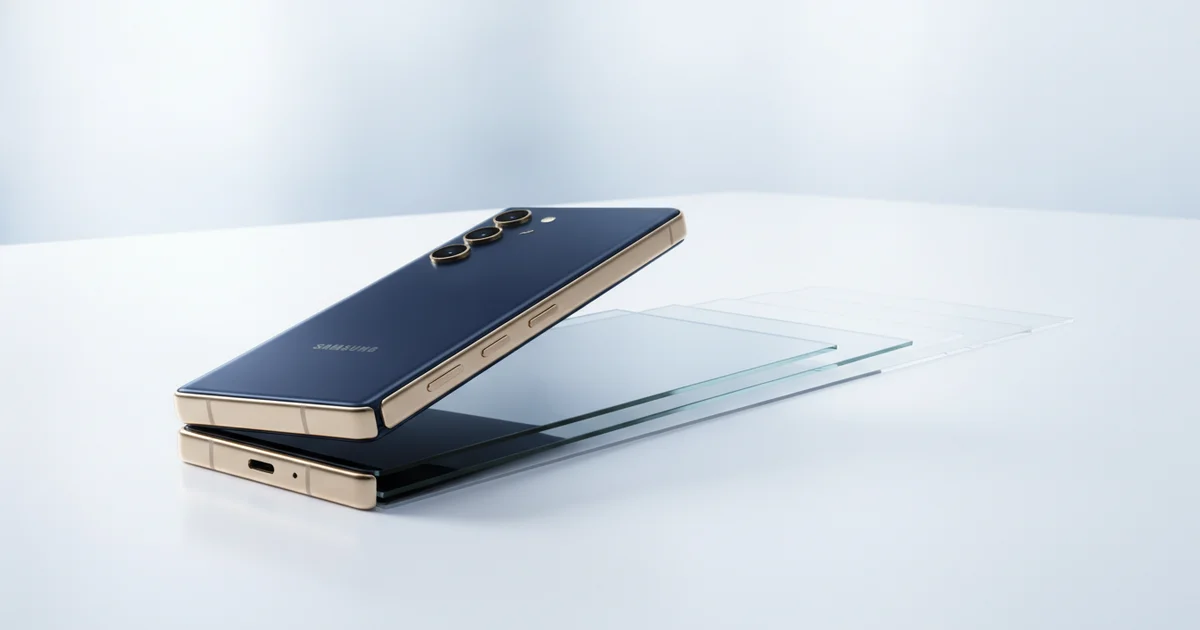
The Z Fold 8 breaks from that pattern deliberately. Samsung trimmed the folded profile down to approximately 10.6mm, a reduction that sounds modest on a spec sheet and feels significant the moment the phone sits in a hand. The cover screen widened enough to function as a real display rather than a narrow emergency panel. The weight dropped to around 213 grams. These aren’t incremental refinements — they reflect a design team that finally prioritized pocket-friendly ergonomics over raw spectacle.
Most reviews published at launch buried this shift beneath processor benchmarks and camera comparisons. The Snapdragon 8 Elite chip and the improved sensor array matter, but they don’t explain why this generation of book-style foldable phones has a realistic shot at mainstream adoption when previous ones didn’t. The form factor does. Compact foldables succeed or fail based on whether someone who owns a Galaxy S25 or an iPhone 16 can switch without feeling punished by the device’s physical presence.
Samsung’s Z Fold 8 is the first model in the Fold lineup that answers that question with anything close to a yes.
What ‘Compact’ Actually Means in Practice
The Z Fold 8 measures 73.4mm wide when closed — a meaningful reduction from the Fold 7’s 77.6mm. That 4mm gap sounds trivial on a spec sheet. In daily use, it’s the difference between a cover screen your thumb can actually navigate and one that forces constant repositioning. One-handed typing, scrolling a news feed, answering a message without unfolding — these become default behaviors rather than awkward workarounds.
Weight follows the same logic. The Fold 8 comes in at 213 grams, down from 236 grams on its predecessor. Compact book-style foldables have always suffered from a specific psychological tax: every time you reach into your pocket, you feel the device announce itself. That sensation trains users to leave the phone on a desk rather than carry it. Shaving 23 grams eliminates enough of that resistance that the phone stops feeling like a commitment.
The inner display tells a different story. Samsung held the unfolded screen at 7.7 inches — the same real estate as before — despite compressing the overall footprint. That’s the engineering achievement the spec-focused conversation keeps skipping past. The aspect ratio shifted slightly to accommodate the narrower frame, but the productive workspace that makes a large-format Android foldable worth owning remains intact. Users get the tablet-mode experience for split-screen multitasking, media consumption, and document editing without carrying a larger closed device.
This is what separates the Fold 8 from previous Samsung foldable generations. Earlier iterations asked buyers to accept bulk as the price of versatility. The Fold 8 reframes that trade-off entirely — the folding smartphone form factor no longer penalizes you during the 80 percent of the day you spend using the outer screen like a regular phone. The compact foldable category has been a theoretical promise since book-style devices launched. Samsung finally built the version that makes the promise credible to someone who has never owned a foldable before.
The Missing Context: Foldables Have a Retention Problem, Not a Feature Problem
Foldable smartphones have a dirty secret the industry rarely advertises: a significant share of buyers abandon them within twelve months, returning to conventional slab phones — not because an app crashed or the software felt unfinished, but because the devices were simply exhausting to carry and hold. The culprit was almost always physical: too tall when folded, too heavy in a jacket pocket, too awkward to use one-handed in the moments that actually define daily smartphone use.
This is a retention problem, and it has quietly undermined every spec-sheet win the foldable category has achieved since Samsung launched the original Z Fold in 2019. Faster processors and improved crease visibility mean nothing if the phone ends up sitting on a desk instead of traveling in someone’s pocket.
Samsung’s decision to shrink the Z Fold 8 — reducing its folded height and shaving grams off its overall weight — targets this exact failure point. That choice reflects a more sophisticated understanding of the market than another camera sensor upgrade would. Winning a benchmark test does not keep a device in rotation. Fitting naturally into the physical rhythms of someone’s day does.
The tech press has largely responded to the Z Fold 8 by cataloging its Snapdragon 8 Elite chip, its Galaxy AI features, and its updated camera array. Those are real improvements. But coverage that leads with processors while burying the form factor redesign has the priorities backwards. A foldable phone that people actually carry every day — even with last year’s chip — delivers more value than a spec-leader that gets swapped out for a Galaxy S25 Ultra by February.
The compact foldable design is not a cosmetic refresh. It is Samsung’s direct answer to the category’s most documented weakness. Getting that wrong in the analysis means missing why the Z Fold 8 matters as a market signal, not just as a product.
Who This Device Is Actually For Now
Samsung built every previous Z Fold for the person who already knew they wanted a foldable. The Z Fold 8 is built for someone who hasn’t committed yet.
That shift in target buyer changes everything about how to evaluate the device. The professional who commutes with a laptop bag, jumps between spreadsheets and video calls, and resents carrying both a phone and a tablet now has a legitimate answer that fits in a jacket pocket. The compact book-style foldable form factor — narrower and lighter than the Z Fold 7 — removes the single biggest objection that kept that buyer on the sidelines: the phone is simply too large to live with daily.
This also fills a gap Samsung’s own lineup left open. The Galaxy Z Flip series attracted users who wanted something different but delivered a cover screen too small for real productivity. The Z Fold series delivered the inner display real estate but punished users with bulk. The Z Fold 8 lands between those two positions in a way no previous Samsung foldable managed. Users who found the Flip limiting and the older Fold unwieldy now have a device sized for one-handed use when closed and genuine multitasking when open.
The competitive implication extends beyond Google’s Pixel 9 Pro Fold. Samsung is now making an argument against the premium slab phone itself — the iPhone 16 Pro Max, the Galaxy S25 Ultra — as the default rational choice for a high-spending buyer. A single flat screen, no matter how refined, cannot open into a 7-inch display. The Z Fold 8’s compact foldable design lets Samsung frame that capability not as a trade-off but as an upgrade path for professionals who already justify flagship phone prices.
The audience has moved from early adopters logging benchmark scores to executives and frequent travelers who want fewer devices without accepting smaller screens. That is a much larger pool of potential buyers, and the Z Fold 8 is the first Samsung book-style foldable credibly sized to reach them.
What Still Needs to Improve for Foldables to Go Truly Mainstream
The Z Fold 8’s slimmer chassis and lighter build move foldable phones meaningfully closer to daily carry territory, but three stubborn problems still block the category from reaching the buyers who currently choose a $799 iPhone 16 or a $999 Galaxy S25 Ultra and never look back.
Price is the loudest obstacle. The Z Fold 8 launches at $1,899 — a figure that buys you two flagship slab phones with money left over. Compactness improves the experience for people already in the market, but it does nothing to close that gap for the budget-conscious mainstream buyer who equates a two-thousand-dollar phone with financial recklessness. Until Samsung drives the entry price for a book-style foldable below $1,400, the form factor stays a premium curiosity.
The crease on the inner display remains a real friction point. Samsung has reduced its visibility across successive generations, and the Fold 8’s hinge engineering represents a genuine step forward. But run your finger across the screen in landscape mode and the ridge is still there. Brightness improvements and a high refresh rate cannot train the eye to ignore it. Consumers who spend this much money on a device expect a surface that feels flawless, and the crease signals compromise every time they touch it.
Third-party app optimisation continues to fracture the unfolded experience. Android’s large-screen compatibility has improved, but popular apps — streaming platforms, social media clients, productivity tools — still render as stretched phone layouts or leave dead space on a 7.9-inch inner display. Samsung’s Galaxy Z ecosystem can optimize its own applications, but it cannot force every developer to rework their UI for a folding display. Google needs to close that gap through stricter Play Store guidelines, and developers need a larger installed base to justify the investment — a chicken-and-egg problem the entire foldable smartphone category still faces.
Solving all three requires price pressure, display manufacturing advances, and an industry-wide software commitment that no single hardware revision can deliver alone.
The Bigger Signal: What the Z Fold 8 Tells Us About Samsung’s Strategy
Samsung’s decision to shrink the Z Fold 8 rather than stuff it with experimental features is a deliberate strategic signal. The company is no longer trying to impress early adopters with what a folding phone can do. It’s trying to convince the mass market that a foldable phone is simply the phone — something you carry without thinking twice about its form.
That bet follows a pattern that reshaped consumer electronics before. Early smartphones were thick, fragile, and compromised on nearly every dimension. Buyers tolerated those limitations because the concept was compelling enough. Then industrial design caught up, hardware became thin and reliable, and the category exploded. Samsung is applying that same logic to the foldable phone market: remove the friction first, and the buyers follow.
The Z Fold 8 drops to a folded thickness that finally competes with conventional flagship phones, and its reduced weight means it no longer announces itself as a specialty device every time someone pulls it from a pocket. That physical normalization is the product strategy. Specs like the Snapdragon 8 Elite processor and upgraded camera system are competitive, but they are not the argument Samsung is making. The argument is that a compact foldable smartphone should feel inevitable, not exceptional.
If that argument lands commercially, the consequences extend well beyond Samsung’s own product line. Apple has been developing a foldable iPhone for years, with credible reports pointing toward a 2026 launch. A strong Z Fold 8 sales performance tightens Apple’s timeline and raises the design standard Apple will need to meet on entry. Samsung essentially sets the floor.
The Z Fold 8 also pressures Google, whose Pixel 9 Pro Fold took a different path — wider, heavier, more tablet-forward. Two competing philosophies now exist inside the Android foldable space alone. Samsung is betting that pocketability wins. The outcome of that bet will define what the next generation of folding phones looks like across every manufacturer, and whether foldable devices finally stop being a category that enthusiasts recommend and ordinary buyers skip.