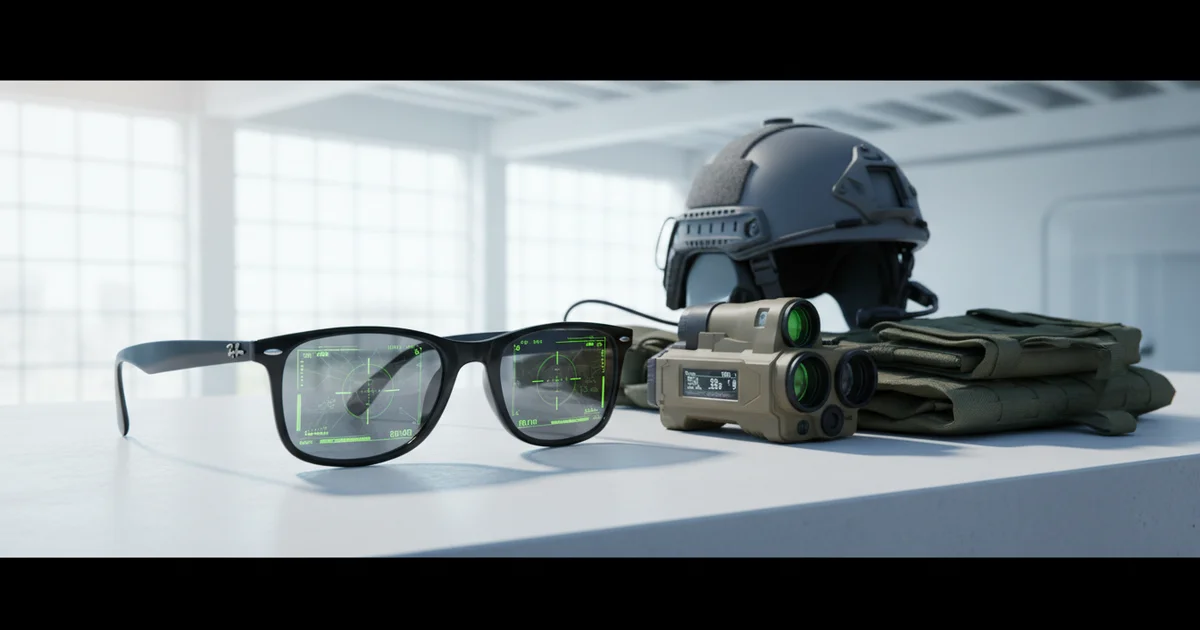
The Partnership Nobody Saw Coming: How Meta’s Ray-Bans Ended Up on the Battlefield
Roughly a year ago, Anduril and Meta entered the US Army’s augmented-reality competition together, combining Anduril’s weapons-systems architecture with Meta’s consumer AR hardware — the same Ray-Ban smart glasses platform that millions of people use to take photos and play music. The pairing looks strange on paper. In practice, it reflects a deliberate calculation: consumer AR has already solved hard problems in optics, weight, and battery life that purpose-built military hardware has failed to crack for years.
The backdrop is the Army’s Integrated Visual Augmentation System program, known as IVAS. Microsoft has held the IVAS contract since 2018, and the program has accumulated a record of cost overruns, delivery delays, and complaints from soldiers about dizziness, visual artifacts, and poor field performance. The Army has spent billions and still lacks a headset troops will actually wear in combat. That failure created the opening for an unconventional team.
Leading the Anduril side is Quay Barnett, a VP who spent his earlier career inside the Army’s Special Operations Command. His presence is not incidental. Barnett’s stated goal is to optimize what he calls “the human as a weapons system” — fusing soldier perception with drone sensor feeds so that a person and an autonomous platform share a unified picture of the battlefield. The practical expression of that vision includes ordering drone strikes through eye-tracking and voice commands, with the headset acting as the interface layer between the soldier’s intent and lethal action.
That framing is where the commercial-to-military translation gets ethically complicated. Meta’s hardware was designed for Instagram sharing and navigation prompts. Anduril is now adapting that stack to route targeting decisions. The company building the social graph and the company building autonomous weapons are, for the first time, shipping a product together — and the product in question is a fire-control interface worn on a soldier’s face.
Eye-Tracking, Voice Commands, and Drone Strikes: What the Interface Actually Does
Anduril and Meta’s prototype military headset eliminates most of the human steps currently required to authorize a drone strike. A soldier wearing the device can identify a target, designate it, and order a weapons deployment using nothing but eye-tracking and voice commands. What previously required radio communication across multiple personnel and a documented decision chain now fits inside a single wearable interaction.
Quay Barnett, the Anduril vice president leading the project after a career in Army Special Operations Command, describes the explicit goal as optimizing “the human as a weapons system.” The design philosophy is fusion: drones and soldiers sharing the same visual field, processing the same information, acting as one unit. The headset is the mechanism that makes that fusion operational.
The interaction paradigms enabling this are not new. Eye-tracking and voice commands are the same input methods Meta has developed and refined for consumer products — the same gestures used to scroll a feed, dismiss a notification, or answer a call. Transposing those interactions onto lethal targeting decisions is not an incidental detail. It is the architecture of the system. The familiarity and speed that make consumer interfaces feel frictionless are now design features for weapons authorization.
That speed is the product’s central value proposition for the military. Faster identification. Faster designation. Faster strike. But international humanitarian law — the Geneva Conventions, the principles of distinction, proportionality, and precaution — was constructed around deliberation, not throughput. Those frameworks assume a decision process with enough friction to allow for judgment: Is this target a combatant? Is this strike proportionate? Are civilians present? Compressing that process into an eye movement and a voice prompt does not make those legal requirements disappear. It just makes them structurally harder to satisfy in the seconds the interface allows.
The interface does not just accelerate the kill chain. It reshapes who bears accountability within it — and makes that question significantly harder to answer.
The Missing Context: Why This Moment Is Different From Previous Military AR Efforts
Microsoft’s IVAS program — the Army’s previous flagship AR headset effort — was built around navigation, situational awareness, and training simulation. Killing was a downstream possibility, not a design premise. The Anduril-Meta system inverts that logic entirely. Quay Barnett, the Anduril vice president leading the program after a career in Army Special Operations Command, has stated his explicit goal is to optimize “the human as a weapons system.” Ordering drone strikes via eye-tracking and voice commands is not a feature being added later — it is the point.
That philosophical shift matters because it changes what accountability structures even need to exist. A tool designed to help soldiers navigate terrain occupies different legal and ethical territory than a tool designed to initiate lethal action. Most coverage of the Anduril-Meta partnership treats these as equivalent steps on a continuum. They are not.
The hardware gap that killed earlier military AR programs has also closed. Meta’s investment in consumer Ray-Ban smart glasses produced genuinely wearable, field-realistic hardware at a scale no defense contractor could have achieved building from scratch. Previous military AR prototypes were heavy, thermally unstable, and battery-constrained enough that soldiers refused to wear them in field conditions. The consumer market absorbed those engineering costs.
The deeper structural difference is what sits behind the glasses. Anduril’s Lattice platform is already a deployed AI command-and-control network, and the company operates autonomous drone systems in active use. The smart glasses are not a standalone device undergoing testing in isolation — they are a proposed front-end interface to an autonomous weapons network that already exists. A soldier wearing the headset would not be gaining information and then separately initiating action through a chain of command. They would be a node inside an integrated kill chain, with AI systems surfacing targets and the glasses serving as the authorization layer. That architecture has no real precedent in how militaries have previously introduced new technology into lethal decision-making.
The Accountability Black Hole: Who Is Responsible When the Interface Fails?
When a soldier using Meta and Anduril’s AR headset orders a drone strike through eye-tracking or a voice command, and that strike kills the wrong person, the question of who bears legal responsibility has no clean answer. Liability fractures across at least four parties: the soldier who issued the command, the software stack that interpreted it, Meta as the hardware manufacturer, and Anduril as the defense systems integrator. No existing legal framework — not the Uniform Code of Military Justice, not international humanitarian law, not domestic tort law — was written to handle a lethal decision mediated in milliseconds by a consumer wearable running military AI.
The technical failure modes are not hypothetical. Eye-tracking systems produce false positives under physical stress, when eyes are dry, when lighting conditions shift, or when a soldier is moving at speed. Voice command recognition degrades sharply in acoustically chaotic environments — gunfire, wind, radio crosstalk — which describes every active combat scenario these devices are designed for. Anduril’s vice president Quay Barnett has described the explicit goal as optimizing “the human as a weapons system,” treating soldiers and drones as a single decision-making unit. That framing collapses the human judgment that both military law and the laws of armed conflict treat as the irreducible precondition for lawful lethal force.
The coverage of this partnership has focused almost entirely on capability: what the headset can see, how fast it can process targeting data, how seamlessly it integrates drone feeds. That framing buries the harder question. When the interface fails — and interfaces fail — no investigator, no military tribunal, and no war crimes prosecutor has a clear legal pathway to assign responsibility. The soldier can point to a misread eye movement. Meta can argue the device performed within commercial specifications. Anduril can argue the military defined the use case. The accountability disappears into the seam between consumer hardware and weapons deployment, and the person who died stays dead.
What Silicon Valley Normalization of Defense Work Means Long-Term
Meta’s involvement in the Anduril smart glasses project represents a structural shift, not an incremental one. Google and Amazon built defense revenue on cloud infrastructure — storage, compute, logistics software. Meta and Anduril are co-designing a system whose explicit purpose is to put lethal targeting capability on a soldier’s face. The product is not neutral infrastructure that happens to have military customers. The product is a weapons interface.
Quay Barnett, the Anduril vice president leading the project and a veteran of Army Special Operations Command, has stated his goal plainly: optimize “the human as a weapons system.” That framing comes directly from Silicon Valley’s product vocabulary — optimize, seamless, human-centered design — applied to the act of ordering a drone strike via eye-tracking and voice command. The UX patterns Meta refined to keep users scrolling through Instagram are now being engineered to help soldiers acquire targets faster.
The consumer-to-military pipeline creates a specific accountability problem. Ethical review processes at companies like Meta were built around data privacy, content moderation, and algorithmic bias — genuine concerns, but ones that operate on entirely different moral terrain than lethal force authorization. Those internal frameworks are now being stress-tested in a context they were never designed to evaluate, and the stress-testing happens largely out of public view. By the time reporting surfaces on a project like this, the contract is signed, the prototype is running, and the policy conversation is chasing the engineering.
For anyone who follows consumer technology, the Anduril-Meta project is a direct signal about where the industry is heading. The same company building Ray-Ban smart glasses for taking hands-free photos is designing the interaction model for battlefield kill-chain decisions. The normalization is the point. When the interface feels familiar — voice commands, heads-up display, intuitive gestures — the threshold for deploying it in higher-stakes contexts drops. Silicon Valley has always moved fast and called the resulting problems someone else’s problem to fix later. In warfare, later is too late.
What Comes Next: Milestones, Risks, and What to Watch
The Army’s competitive evaluation process for its augmented-reality soldier program does not guarantee Anduril and Meta the contract. It does not need to. Their participation alone establishes consumer AR hardware as a legitimate military platform. Other defense contractors, future procurement officers, and allied militaries are watching. The category is now validated regardless of who wins.
On the technical side, two pressure points will determine whether this system is battlefield-viable or remains a demonstration project. The first is degraded-environment performance — whether the headset’s sensors and displays function reliably through dust, smoke, and acoustic chaos. The second is latency in the AI decision-support layer. Quay Barnett’s vision of ordering drone strikes via eye-tracking and voice commands depends on a system that processes targeting data faster than the situation changes. In combat, a lag of even a few seconds is the difference between a viable tool and a lethal liability. Neither of these challenges has been publicly resolved.
The deeper problem sits outside the engineering. The question of whether soldiers should be able to call in lethal strikes through an AI-mediated wearable interface — and how accountability is assigned when that system fails or misidentifies a target — is not being debated in Congress. It is being settled in procurement offices through contract specifications and capability requirements. Barnett’s explicit goal of optimizing “the human as a weapons system” describes a doctrine, not just a product. That doctrine is advancing through acquisition paperwork while legislatures have not passed a single law governing autonomous or semi-autonomous targeting systems on the U.S. battlefield.
The democratic gap here is not a future concern. It is already open. By the time any legislature examines the framework, the hardware will be fielded, the software architecture will be entrenched, and the accountability structures — or the absence of them — will be inherited as baseline assumptions. The milestones worth watching are not just technical. They include whether any elected body moves to assert oversight before the architecture of AI-assisted lethal decision-making becomes too embedded to meaningfully question.