The $600 Hand That Changes the Math on Humanoid Robotics
LinkerBot sells a fully dexterous robotic hand for $600 in China. That price tag — cheaper than a flagship iPhone — buys five fingers, at least 11 joints, and enough fine motor capability to play piano, thread needles, tighten screws, and assemble consumer electronics. Founder and CTO Zhou Yong, 40, says that figure will drop to $200 within three to five years.
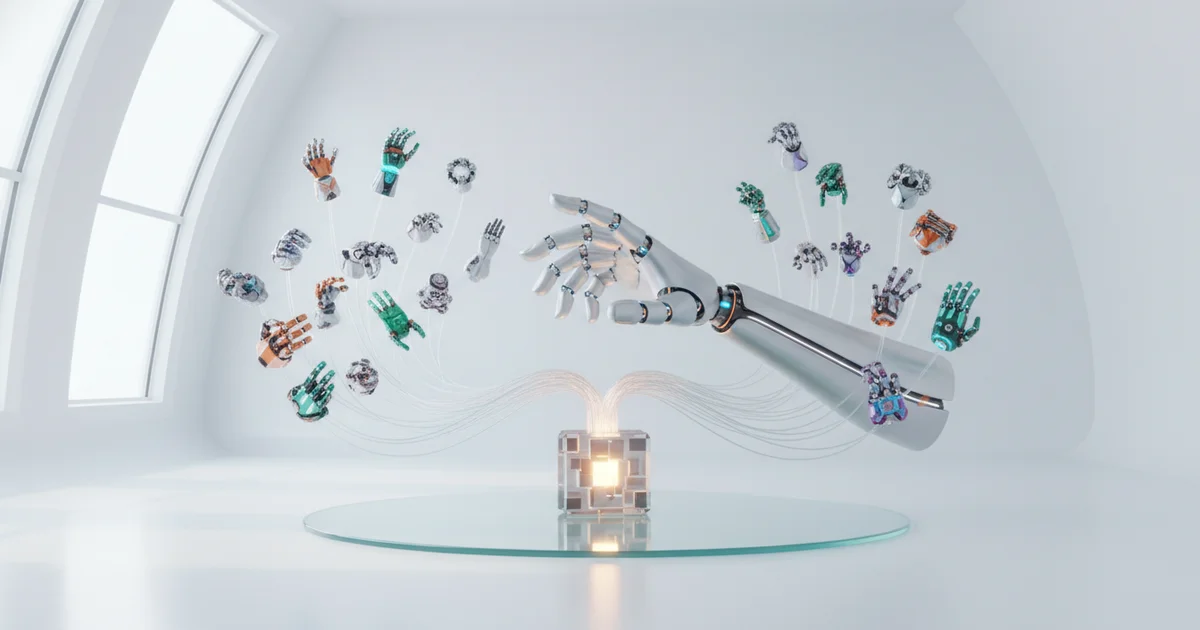
The low price is the strategy, not a side effect of it. Zhou’s explicit goal is commoditization: turn the robotic hand from a bespoke engineering problem — one that every humanoid manufacturer currently has to solve independently — into a standardized, plug-and-play component that any company can drop into its robot and ship. LinkerBot is not trying to build the next Atlas or Optimus. It is trying to make hands the way Taiwan made chips: indispensable, interchangeable, and everywhere.
That positions LinkerBot as the potential “Intel Inside” of humanoid robotics. Intel did not win the PC era by building the best computer. It won by becoming the critical component that every computer needed, regardless of which brand’s logo was on the lid. Zhou is running the same play. If humanoid robots become a mass-market product category — and the current pace of investment in China and the US suggests the industry is betting they will — then the manufacturer of the standard robotic hand captures value from every unit sold, across every brand, at every price point.
The math compounds fast. Zhou predicts that eventually the average person will own ten robots. At that scale, the hand supplier is not a vendor. It is infrastructure. LinkerBot’s $6 billion valuation reflects the market’s read on exactly that logic: the company that commoditizes the hard part of humanoid robotics does not need to win the robot race. It just needs everyone else to keep running it.
Who Is Zhou Yong and Why Does His Vision Matter?
Zhou Yong is 40 years old, holds the titles of both founder and CTO at LinkerBot, and shows no sign of handing the technical wheel to someone else. That dual role is a deliberate signal. Most venture-backed robotics startups separate the visionary from the engineer the moment serious money arrives. Zhou hasn’t. He is the engineer, and that keeps LinkerBot’s roadmap grounded in what the hardware can actually do rather than what a pitch deck needs it to promise.
His vision is deliberately outsized. In an exclusive interview with WIRED, Zhou argued that households won’t stop at one robot — they’ll eventually own ten on average, deploying separate machines for cooking, cleaning, babysitting, and professional tasks. That framing repositions LinkerBot entirely. This isn’t a company selling components to factory integrators; it’s building what Zhou sees as consumer infrastructure, the skeletal layer beneath an entirely new category of household appliance.
The numbers he cites make that vision plausible rather than fanciful. LinkerBot’s dexterous hands — five fingers, at least 11 joints — sell today for as little as $600 in China. Zhou projects that price dropping to $200 within three to five years. At $200, a robotic hand stops being a specialized industrial purchase and starts approaching the economics of a consumer peripheral.
That’s the story most technology coverage is missing. Journalists and investors have trained their attention on full-body humanoid robots — Tesla’s Optimus, Figure AI’s systems, the headline-grabbing humanoid marathon staged in Beijing. Those platforms absorb enormous capital and generate enormous press. Zhou is working one level below that spectacle, at the component layer where the actual capability bottleneck lives. A humanoid robot is only as useful as its hands. LinkerBot is betting that whoever controls the hands controls the stack — and that the company building the cheapest, most capable hands at scale will matter far more than any single robot brand built on top of them.
The Missing Context: Component Dominance as China’s Robotics Strategy
China has run the same industrial playbook before. In solar panels, it didn’t just build panels — it captured polysilicon refining, wafer cutting, and cell manufacturing until the entire global supply chain ran through Chinese factories. In electric vehicles, BYD and CATL didn’t compete on brand prestige; they competed on battery chemistry, cell costs, and vertical integration until Western automakers found themselves dependent on Chinese components regardless of where they assembled the final car. LinkerBot fits this pattern precisely: don’t win the robot race, win the parts race.
A $6 billion valuation for a company selling a single robotic component is the market pricing in that strategic logic. LinkerBot’s dexterous hands start at $600 today and are on a trajectory to hit $200 within three to five years, according to founder Zhou Yong. At that price point, the hands become a commodity input — the kind of component that every robotics manufacturer will benchmark against and most will struggle to beat internally. Whoever sets that price floor controls the economics of the entire humanoid robotics stack.
Western companies building full humanoid robots — Figure, Agility Robotics, Boston Dynamics — are currently solving the dexterous-hand problem themselves, absorbing years of R&D cost to develop proprietary grasping systems. That internal investment makes sense when no cheap, capable alternative exists. LinkerBot’s pricing changes that calculus. A Western robotics firm facing $200 commodity hands from a Chinese supplier must either match that cost through its own manufacturing scale — which takes years and capital — or accept a structural dependency on Chinese hardware to stay price-competitive. Neither option is comfortable, and one of them is strategically dangerous.
The leverage point is real: whoever supplies the hands sets the ceiling on what every other robotics company can build and at what cost. China has demonstrated twice in a decade that owning that position — not the headline product, but the critical enabling component — is where durable industrial power actually sits.
What ’11 Joints and Five Fingers’ Actually Means Technically
The human hand contains 27 bones and more than 20 degrees of freedom. LinkerBot’s hand has 11 joints. That gap is not a failure — it’s a deliberate engineering decision that sits at the center of the company’s commercial strategy.
Roboticists have long understood that a relatively small subset of joint configurations handles the overwhelming majority of real-world manipulation tasks. Grasping, pinching, rotating, and pressing objects — the motions that fill factory floors and kitchen counters — do not require full anatomical replication. Eleven joints, distributed across five fingers, clears the threshold for what engineers call dexterous manipulation: the ability to reposition an object within the hand without setting it down. That capability is what separates a useful robotic hand from a glorified gripper, and it’s what makes LinkerBot’s $600 price point commercially meaningful rather than just cheap.
Piano playing entered robotics benchmarking precisely because it stress-tests that threshold. Striking individual keys in sequence requires each finger to act independently while the hand maintains stable positioning — simultaneous fine-motor coordination across multiple digits, not just sequential movement. When LinkerBot demonstrates its hands playing piano, the performance signals to OEM buyers that the underlying joint control architecture can handle electronics assembly, needle threading, and screw tightening. These are the tasks that humanoid robot manufacturers are actually trying to automate.
The harder problem sits one level up. Playing a fixed sequence of piano notes is a structured, repeatable task. Picking up a raw egg or handing a surgeon a scalpel requires real-time force sensing and adaptive grip modulation — the hand must detect resistance, adjust pressure continuously, and respond to surface texture and object deformation. LinkerBot’s current hardware performs the structured tasks convincingly. Whether it can be engineered to handle the unstructured ones, at the same price point, is the question that will determine whether its $6 billion valuation reflects genuine capability or anticipation. Zhou Yong has projected the price falling to $200 within three to five years. Closing the force-sensing gap while cutting costs in half is the engineering proof that still needs to be delivered.
The Geopolitical Wildcard: Export Controls, Trust, and the Robot Supply Chain
The Huawei parallel is not subtle. A Chinese company with deep technical capability, aggressive pricing, and global ambitions is positioning itself to become the default infrastructure layer for an entire industry. Western governments banned Huawei from 5G networks not because the gear didn’t work — it worked well — but because Chinese national security law compels domestic companies to cooperate with state intelligence requests. LinkerBot operates under the same legal framework.
At a $6 billion valuation, LinkerBot is not a scrappy startup pitching at trade shows. That number reflects serious commitments from serious buyers. The question of whether US or EU humanoid robotics manufacturers will be permitted — or will choose — to source hands from a Chinese supplier is one that regulators and defense analysts have not yet publicly addressed. That window will not stay open long.
The stakes extend beyond supply chain dependency. A robot hand is a sensor array. It collects continuous data on grip force, object geometry, surface texture, and manipulation sequences — exactly the training signal that embodied AI models need to learn physical tasks. Every LinkerBot hand deployed in a warehouse, factory, or home is generating proprietary manipulation data. If LinkerBot’s hardware becomes the dominant interface between robots and the physical world, the company — and by extension, the Chinese state — sits upstream of the most valuable dataset in next-generation robotics AI.
Zhou Yong’s prediction that hands will drop to $200 and that people will eventually own ten robots on average is a market-capture strategy, not just a product roadmap. Commodity pricing drives volume. Volume drives data. Data trains models that competitors cannot easily replicate. The US learned this lesson late with semiconductors and surveillance hardware. The robot hand is a smaller, cheaper component than a base station — which makes it easier to overlook and harder to dislodge once embedded across thousands of OEM product lines.
What Comes Next: Can LinkerBot’s Bet Actually Pay Off?
LinkerBot’s window to dominate is real, but it’s closing. The humanoid robot market is on track to scale dramatically through the late 2020s, and companies that lock in OEM relationships now — while Western competitors still can’t match a $600 price point — will be embedded in supply chains before rivals reach cost parity. Zhou Yong’s target of $200 per hand within three to five years would make LinkerBot’s components effectively disposable, the kind of commodity pricing that ends competitor conversations before they start.
Three threats stand between LinkerBot and that outcome. First, quality at scale. Performing piano recitals and needle-threading in controlled demos is not the same as surviving millions of cycles on a factory floor. Reliability data across real industrial deployments doesn’t exist yet, and OEM customers building products around LinkerBot hands will demand it before committing at volume. Second, geopolitics. US export restrictions already targeting Chinese semiconductor and drone companies create a template that robotics components could follow. A single executive order could sever LinkerBot from international markets overnight. Third, domestic competition. China’s robotics sector moves fast, and the same cost structure LinkerBot exploits — local supply chains, state support, manufacturing scale — is available to every well-funded startup in Shenzhen. Market fragmentation from copycat competitors is a structural risk, not a hypothetical one.
The deeper question sits beneath all of it. If robot hands reach the price and ubiquity of USB ports — standardized, interchangeable, cheap enough to buy in bulk — hardware stops being the bottleneck on the robotic future entirely. The constraint shifts to AI software: the perception systems, the manipulation models, the training pipelines that tell those hands what to do and how to recover when something goes wrong. LinkerBot can manufacture the grip. The company that controls the intelligence behind it controls the industry. That’s the race inside the race, and right now, it’s far less settled than the hardware story suggests.