What plug-in solar actually is — and why it’s bigger than it sounds
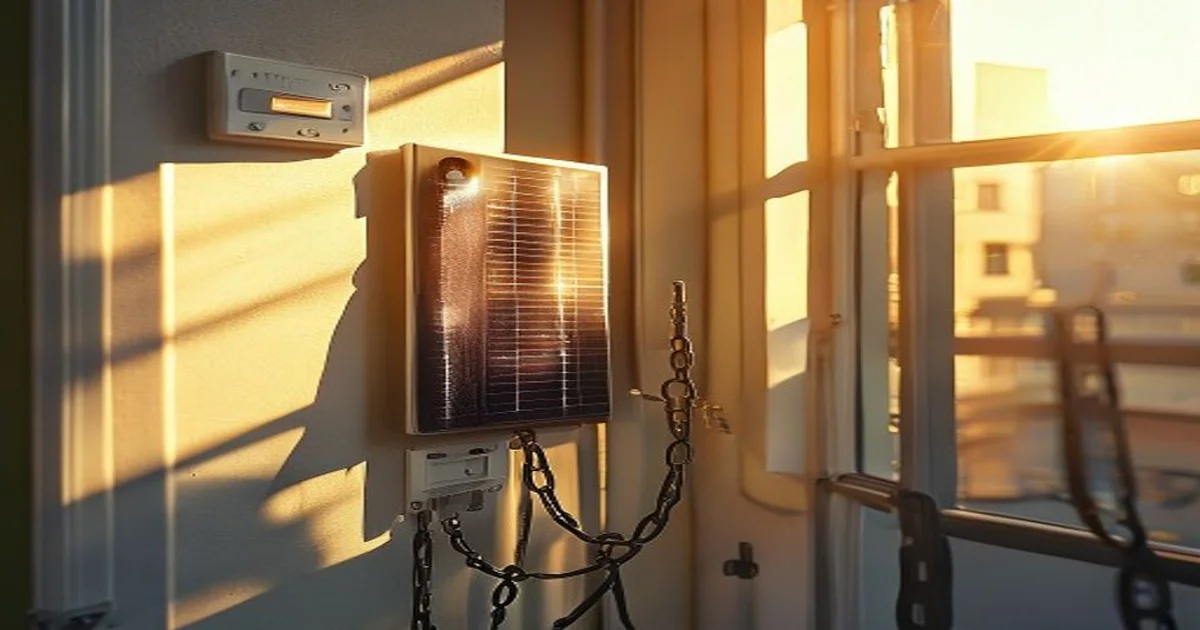
Plug-in solar — also called balcony solar or plug-and-play solar — does exactly what the name suggests. You buy a small solar panel system, plug it into a standard household outlet, and it immediately begins offsetting your electricity consumption. No licensed installer. No permit application. No waiting months for utility approval.
Utah became the first US state to explicitly legalize the technology, allowing systems up to 1,200 watts to connect directly into a conventional outlet. A 1,200-watt system running at peak output can power a refrigerator, several lights, and a laptop simultaneously — not energy independence, but a meaningful dent in a monthly electricity bill.
The cost difference between plug-in solar and traditional rooftop solar is not marginal — it’s an entirely different financial category. A conventional rooftop installation runs $15,000 to $30,000 before incentives, requires professional labor, and demands homeownership. A plug-in system costs a few hundred dollars on Amazon. It ships to your door. You set it up yourself. When you move, you take it with you.
That last point reshapes who solar is actually for. Renters make up roughly 36 percent of US households. Traditional rooftop solar has been functionally unavailable to all of them. Plug-in solar eliminates every barrier that kept renters out — upfront capital, landlord permission for permanent installation, credit requirements for financing. A renter in a third-floor apartment with a south-facing balcony can now generate their own electricity.
The technology is not experimental. Germany has deployed more than 400,000 balcony solar units, operating within a clear regulatory framework that treats them as ordinary consumer appliances. German consumers register their units with a simple online form and start generating power the same day. The grid hasn’t collapsed. Utilities have adapted. The model works.
What’s new isn’t the technology. What’s new is that the US regulatory structure — built around large utilities, professional contractors, and centralized control — is finally starting to crack.
The regulatory wall: Why the US is years behind Europe
America’s utility regulatory framework was built in the mid-twentieth century around a single assumption: power flows one direction, from the utility to the customer. That assumption is now hardwired into decades of state-level code, tariff structures, and interconnection rules that simply have no category for a consumer plugging a 400-watt solar panel into a kitchen outlet and pushing surplus electricity back through the meter.
Utah is currently the only US state that has passed legislation explicitly legalizing plug-in solar, permitting systems up to 1,200 watts to connect directly to a standard household outlet. Every other state exists in a legal gray zone where the practice is neither clearly permitted nor cleanly prohibited — a regulatory limbo that leaves consumers exposed and kills mainstream adoption before it starts.
Utilities have leaned on legitimate technical concerns to justify the slow pace of reform. Anti-islanding — the risk that a home-generation system keeps energizing a grid segment while line workers assume it’s dead — is a real safety issue. Modern microinverters with built-in anti-islanding protection have largely solved that problem, but the objection persists in regulatory proceedings long after the engineering argument for it has weakened.
Critics point to a less technical reason for the resistance: utilities earn returns on capital investment, and a customer who self-generates is a customer buying fewer kilowatt-hours. Every plug-in solar panel installed is a small but direct threat to that revenue model. When financial interest and safety concern point in the same direction, disentangling genuine caution from incumbent protection becomes nearly impossible — and utilities have little incentive to make that distinction easy.
The structural obstacle compounding all of this is federalism. There is no national plug-in solar standard, no federal pathway, no FCC-style preemption that could clear the field. Fifty state legislatures, fifty utility commissions, fifty separate lobbying battles. Europe moved through this problem by setting continent-wide standards for so-called “balcony power plants,” enabling mass adoption in Germany, the Netherlands, and Austria. The US has no equivalent mechanism, which means the dam breaks one state at a time — slowly, expensively, and years behind the curve.
Utah’s breakthrough: What the first US law actually does and doesn’t do
Utah passed the first law in the United States explicitly legalizing plug-in solar, permitting systems up to 1,200 watts to connect directly to a standard household outlet without professional installation or utility approval. That 1,200-watt ceiling is a deliberate constraint — enough to meaningfully offset a portion of a household’s electricity consumption, but well below what a fully committed solar adopter would want.
The law clears the most important legal hurdle: it establishes that a US state can authorize plug-in solar without catastrophic grid consequences, giving skeptical legislators in other states a working proof of concept. Before Utah acted, the absence of any state-level legal framework left consumers in a gray zone, exposed to potential liability and with no recourse if utilities pushed back.
What the law does not do matters just as much. Utah does not require utilities to credit customers for surplus electricity fed back into the grid. In Germany, where balcony solar installations are mainstream, net metering-style compensation is part of the equation — it changes the financial math from “offset some bills” to “generate a return.” Utah’s version stops short of that. Users reduce what they draw from the grid; they do not get paid for what they contribute to it. That gap limits the financial incentive and keeps the economic case for plug-in solar weaker than it needs to be for mass adoption.
The practical impact on Utah households is real but modest. The symbolic impact is larger. State legislators in Arizona, Colorado, and elsewhere now have a template that survived political opposition, utility lobbying, and the first round of regulatory scrutiny. Utah did not solve plug-in solar. It proved the door could be opened.
The missing story: What this means specifically for renters and low-income households
America’s solar conversation has a blind spot the size of 44 million households. Nearly every news story, policy debate, and financing product targeting solar adoption assumes the reader owns their home. Renters — roughly a third of all US households — have been structurally excluded from rooftop solar since the technology’s inception. You cannot install panels on a roof you don’t own, and landlords have almost no financial incentive to do it for you.
Plug-in solar is the first on-site solar option that actually fits renter reality. A $300–$600 balcony or window-mounted system requires no roof access, no contractor, no landlord sign-off in most cases, and no long-term commitment. When a tenant moves, the panels move with them. That portability alone changes the calculus entirely.
The financial access gap matters just as much as the tenure gap. Traditional rooftop solar requires either strong credit, home equity, or the ability to sign a 20-year loan or lease. Moderate- and low-income households routinely fail those thresholds. Plug-in systems eliminate that barrier — a few hundred dollars, paid upfront or spread across a credit card, is a fundamentally different ask than $15,000–$25,000 in financing.
The honest tradeoff is that without net metering rights for plug-in systems, the savings stay modest. A 400-watt system in a sunny climate might offset $10–$20 per month in electricity costs. For a household spending $150 a month on electricity, that reduction is meaningful — energy costs consume a disproportionate share of income in low-income households, a burden researchers call “energy burden.” A 10–15% bill reduction is not a rounding error for those families.
Utah, the only state that has explicitly legalized plug-in solar, caps permitted systems at 1,200 watts. That ceiling limits savings but validates the model. The question now is whether other states extend the same legal clarity — and whether any of them pair that legalization with net metering access that would make the economics genuinely transformative for the households that need relief the most.
What’s moving in other states — and what to watch next
Utah’s law — capping plug-in solar systems at 1,200 watts and allowing them to connect to a standard household outlet without utility permission — has done something strategically important: it proved the utility lobby can lose. Legislators in several other states are now watching Utah’s rollout closely, treating it as a legislative template rather than a curiosity.
The next wave of state bills will hinge on a single question: net metering. Utah’s current framework lets homeowners offset their own consumption, but it stops well short of letting them sell surplus electricity back to the grid. That limitation is not a technical constraint — it’s a political one. Utilities have fought net metering expansions at every turn because distributed generation that earns money for consumers directly threatens the centralized revenue model that keeps utility monopolies intact. If a future state bill includes net metering rights for plug-in solar owners, the economics of a $300 balcony panel system change dramatically, and adoption accelerates far beyond what Utah has demonstrated so far.
Two federal bodies hold real leverage here. The Consumer Product Safety Commission could establish uniform safety standards for plug-in solar inverters, stripping utilities of their most durable stalling tactic — the safety objection. Right now, utilities in states without explicit legislation cite unverified safety concerns to justify blocking or discouraging plug-in systems. A federal safety certification makes that argument hollow. Separately, the Federal Energy Regulatory Commission could clarify interconnection rules for sub-2,000-watt devices, forcing utilities to treat compliant plug-in systems as presumptively safe rather than presumptively suspect.
Neither federal agency has acted yet. But the pressure is building from the bottom up. Millions of plug-in solar units are already operating in Germany and the Netherlands under straightforward regulatory frameworks. American consumers are buying these devices anyway — running them in legal gray zones, ignoring utility prohibitions, and betting that enforcement won’t come. That quiet mass noncompliance is itself a form of pressure. At some point, regulators have to decide whether to legitimize what’s already happening or keep defending a legal framework that a growing number of households are simply ignoring.
What consumers should actually do right now
The first question to answer is whether you can legally operate a plug-in solar system where you live. Outside Utah, the honest answer is almost certainly no. Most utility tariffs explicitly prohibit customers from connecting generation equipment without prior approval, and local electrical codes in the majority of jurisdictions require a licensed electrician for any work that feeds current into your home’s wiring. Buying a unit and plugging it in anyway exposes you to having your service disconnected and potentially voiding your homeowner’s insurance.
If you live in Utah, the path is cleaner. State law permits systems up to 1,200 watts connected through a standard outlet. Before you buy, confirm two things: your landlord’s lease agreement permits it if you rent, and your HOA covenants don’t ban exterior equipment if you own. When shopping, filter for systems with UL-certified microinverters — that certification matters both for safety and for any future insurance or code compliance questions.
If you live anywhere else, the most productive thing you can do right now is pay attention to your state legislature. Several states have introduced plug-in solar bills modeled on Utah’s framework, and this is genuinely one policy area where constituent contact moves votes. A call or email to your state representative costs nothing and carries real weight on a niche technical issue most legislators haven’t thought about. Find your representative through your state legislature’s website, mention Utah’s 1,200-watt threshold as a model, and ask whether similar legislation is under consideration.
The regulatory window is moving. Germany normalized plug-in solar years ago under a straightforward registration system, and US states are watching. Consumers who track their state’s legislative calendar and engage early are the reason Utah’s law exists at all — a coalition of residents pushed it through. The same playbook is available everywhere else.