The camera problem nobody in smart glasses wants to talk about
The camera has been smart glasses’ biggest liability since Google Glass turned “Glasshole” into a cultural punchline in the early 2010s. Strangers grew hostile toward Glass wearers in restaurants, bars, and gyms — not because the hardware was ugly, but because nobody nearby could tell whether they were being recorded. Google pulled the consumer product in 2015. The lesson most manufacturers chose to ignore.
Meta launched Ray-Ban smart glasses anyway, complete with a camera, and the backlash followed a predictable script. Researchers at Harvard demonstrated in 2024 that the glasses could be used to identify strangers in real time by cross-referencing photos with public databases — a capability Meta hadn’t advertised. The company added a recording indicator light, but a small LED does little to rebuild trust when the underlying anxiety is that a device on someone’s face is, by definition, designed to see what that person sees.
Even Realities made the opposite call. The G2 ships with no camera and no speakers. That’s a deliberate product decision, not a component shortage. The company’s hypothesis is that removing the camera eliminates the social friction that has kept every previous smart glasses product from achieving all-day, everyday wear. If the glasses can’t record, bystanders have no reason to object. Wearers have no uncomfortable explanations to make.
That repositioning matters for how the device gets categorized in people’s minds. Camera-equipped wearables sit in an uncomfortable gray zone between productivity tool and surveillance device. Strip the camera out, and the product moves closer to a smartwatch — a heads-up display for notifications, navigation, and information, not a bodycam strapped to your face. The wearable AR glasses market has spent years trying to normalize the camera. Even Realities is betting the faster path to mainstream smart eyewear adoption runs through removing it entirely. No other major player in the augmented reality glasses space has been willing to test that hypothesis at scale.
What the Even Realities G2 actually does — and what it doesn’t
The Even Realities G2 runs a monochrome heads-up display that renders text and information in green, producing what the company describes as a neon board aesthetic. Unlike conventional AR overlays that wash out in bright sunlight, this display remains visible across lighting conditions — a practical advantage that separates the G2 from smart glasses that work indoors but fail the moment you step outside.
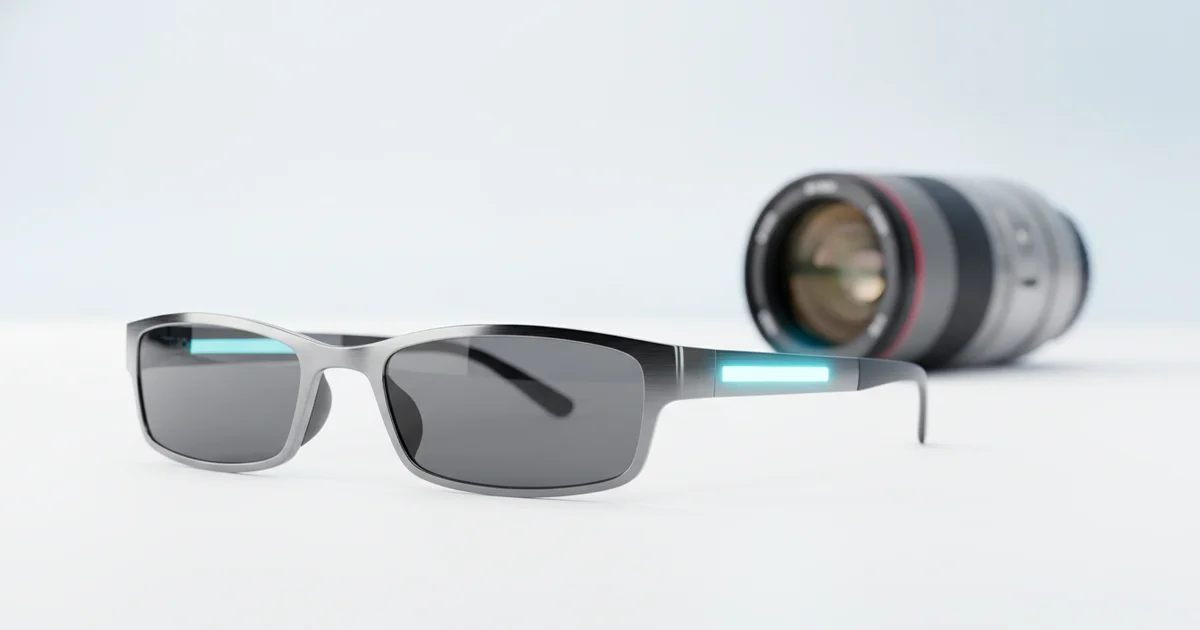
There are no cameras, no speakers, and no microphones built into the frame. Even Realities made those omissions deliberately, positioning the G2 as a productivity-focused wearable rather than a recording device. The hardware looks premium and sits on your face the way ordinary prescription glasses do — a legitimate design achievement in a category that has historically produced devices people are embarrassed to wear in public.
The catch is connectivity. The G2 depends on a paired smartphone to deliver its core functionality. Navigation prompts, notifications, AI responses — all of it routes through a phone connection that, according to hands-on reporting from TechCrunch, can be unreliable and frustrating in practice. That dependency turns what should be a seamless heads-up experience into something contingent on Bluetooth stability and phone battery life.
This is not an Even Realities problem specifically. It is an industry-wide constraint. Meta’s Ray-Ban smart glasses, Brilliant Labs’ Frame, and virtually every consumer smart glasses product on the market today offloads heavy computation to a paired device. Truly standalone smart glasses — with onboard processing powerful enough to run AI features, navigation, and real-time overlays without a phone tether — remain beyond what manufacturers can pack into a glasses-sized form factor at a price consumers will pay.
The G2’s display technology demonstrates real progress in wearable AR hardware. The phone dependency demonstrates exactly how far the category still has to travel before smart glasses function as an independent computing platform rather than a screen extension for the smartphone already in your pocket.
The productivity pitch: why focus beats features right now
Even Realities built the G2 around a narrow problem set — notifications, navigation, and AI-assisted information delivery — and that constraint is a strategic choice, not a compromise. Most smart glasses that have failed commercially suffered from the same condition: they tried to do everything and ended up doing nothing particularly well. By stripping the feature list down to what professionals actually need in front of their faces during a workday, Even Realities sidesteps the identity crisis that has plagued wearable display technology for years.
The camera-free design unlocks a market that Meta’s Ray-Ban glasses cannot realistically enter. Hospitals, law firms, manufacturing floors, government facilities, and financial institutions all operate under strict camera policies. A heads-up display that surfaces calendar alerts, turn-by-turn directions, and AI-pulled information without recording anything becomes a compliant productivity tool rather than a security liability. That B2B lane represents significant revenue potential, and right now the G2 occupies it almost alone among consumer-grade smart glasses.
The trade-off is real and specific. Without a camera, the G2 cannot offer scene recognition, real-time translation of physical text, or object identification — visual AI features that Meta and other competitors are actively promoting as headline capabilities for their wearable devices. Users who want their glasses to read a restaurant menu in a foreign language or identify a product on a shelf need to look elsewhere.
What Even Realities is betting on is that the average enterprise buyer, and a meaningful slice of productivity-focused consumers, cares more about reliable information delivery than visual AI novelty. The G2’s monochrome green heads-up display does one thing the camera-equipped competition struggles with: it stays useful across all lighting conditions without raising every eyebrow in the room. For smart eyewear to move beyond early adopters, that kind of focused, low-friction utility may matter far more than a feature checklist.
The missing context: smart glasses still can’t escape the phone
Tech executives have been promising that glasses will become the next dominant computing interface for years. That promise keeps colliding with the same unglamorous problem: smart glasses still can’t function without a smartphone doing the heavy lifting.
Even Realities’ G2 illustrates this perfectly. The hardware itself is genuinely impressive — a monochrome heads-up display that renders green text and information visibly in any lighting condition, housed in a frame designed to look like ordinary eyewear. Strip away the aesthetics, though, and the G2 operates as a Bluetooth-dependent peripheral. Its functionality ties directly to a companion app running on the user’s phone, and that connection is unreliable in daily use. When Bluetooth drops or the app misbehaves, the glasses lose their utility entirely. A heads-up display that goes dark because of a connectivity hiccup is not a primary computing device — it’s an accessory that occasionally works.
This is not a problem unique to Even Realities. Every significant smart glasses product released so far, including Meta’s Ray-Ban line, has hit the same wall. Onboard processors powerful enough to run meaningful AI inference, navigation, or real-time app workloads would generate heat and drain a battery housed in a frame weighing grams, not kilograms. The silicon and battery constraints are physical realities, and no software update resolves them. Wearable AI glasses that can operate independently require breakthroughs in low-power chip design that haven’t arrived at consumer price points yet.
The consequence is a category stuck in a frustrating middle ground. Augmented reality eyewear and AI-powered wearables get framed in product launches as transformative platforms. In practice, they extend the phone rather than replace it. Until smart glasses can process AI workloads, manage connectivity, and run applications entirely onboard — without a handset as a processing crutch — they remain dependent accessories. The gap between the vision tech executives sell and the tethered experience consumers actually get is the real barrier to mainstream smart glasses adoption, and clever design decisions like removing a camera don’t close it.
What Even Realities gets right — and what the industry should steal
Even Realities made a choice that no major smart glasses manufacturer had the nerve to make before: they shipped the G2 without a camera, and they did it on purpose. That single decision is the most honest public admission the wearable tech industry has produced — that social acceptability, not processing power or battery life, is what actually blocks smart glasses from going mainstream.
Meta’s Ray-Ban glasses are capable hardware. They record video, run AI queries, and sit on your face without looking absurd. Yet adoption stalls the moment someone walks into a meeting, a gym, or a first date wearing them. People don’t distrust the lens quality. They distrust the lens. Even Realities sidesteps that entire problem by removing the camera entirely, making the G2 a heads-up display for productivity rather than an AI-powered recording device.
If the G2 builds a loyal user base — professionals who want navigation prompts, notifications, and teleprompter-style text overlays without making everyone around them uncomfortable — it hands the broader wearables market a proof of concept it cannot ignore. Camera-first competitors would face real pressure to introduce dedicated privacy modes or camera-disabled product variants. That shift would represent a structural change in how the industry approaches consumer trust, not just a marketing adjustment.
The deeper lesson the smart glasses market keeps refusing to learn is that strategic ambiguity kills adoption. Trying to build a device that serves as both a discreet productivity tool and an always-on life recorder pleases neither audience and unnerves everyone else. Even Realities picked a lane. The G2 is a privacy-safe augmented reality display for people who want information on their face, not a camera strapped to their forehead. That clarity — not the green monochrome display, not the neon-style HUD aesthetic — is the product’s actual competitive advantage, and the part every other manufacturer in the AR wearables space should be copying right now.