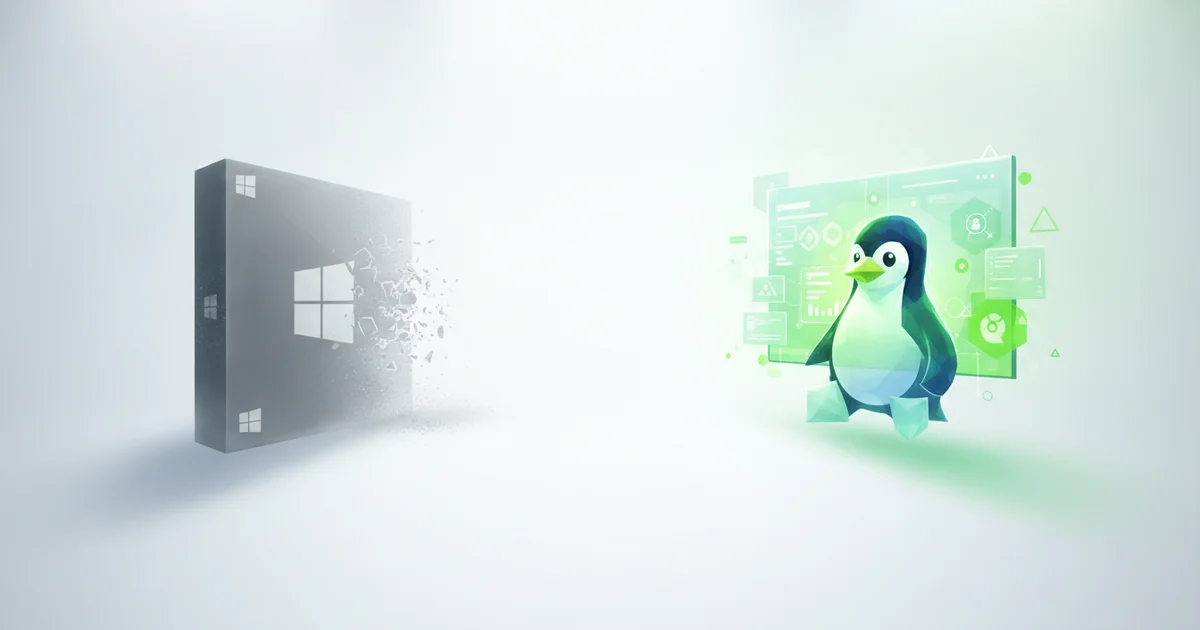
The Microsoft pressure cooker: why now is different for Linux adoption
Microsoft announced in 2023 that Windows 10 would reach end of support, setting October 14, 2025 as the deadline that would leave hundreds of millions of PCs without security patches or official updates. The company later extended paid security updates through October 12, 2027, but that option costs money — and it does nothing to solve the hardware problem sitting at the center of this entire situation.
Windows 11 requires TPM 2.0, a security chip absent from enormous numbers of machines built before 2017. A laptop that runs Windows 10 perfectly well today — fast, stable, capable of handling everyday tasks — fails Microsoft’s compatibility check not because it is broken, but because it lacks a specific piece of firmware. For those users, the upgrade path Microsoft assumes everyone will take simply does not exist.
This is where the current moment separates itself from every previous Linux breakthrough that never quite broke through. Past surges of interest in Linux desktop adoption came from enthusiasts, developers, or people reacting to a Windows version they disliked. This wave is different. It is driven by ordinary people — office workers, retirees, students — who own functional machines and face a binary choice: buy new hardware or find an alternative operating system. Linux distributions like Ubuntu run on hardware that Windows 11 rejects without complaint.
Most mainstream coverage treats the Windows 10 sunset as a Windows 11 migration story, focusing on TPM workarounds or upgrade discounts. That framing ignores the millions of users for whom a free Linux distribution is the only realistic path to a secure, supported operating system after October 2025. They are not switching out of passion for open-source software. They are switching because the alternative is running an unpatched OS or spending money they have no reason to spend on hardware that does not need replacing.
That is a fundamentally different pressure than Linux has ever had working in its favor before.
The installation reality check: Linux is still not plug-and-play
Ubuntu is the most beginner-friendly Linux distribution available. Dell is one of the most mainstream laptop manufacturers on the planet. Put them together, and you might expect a frictionless first install. That expectation will betray you.
A ZDNET writer who set out to test whether Linux could genuinely replace Windows documented exactly this scenario — Ubuntu on an old Dell laptop, a setup that should represent the best-case version of switching from Windows. It still required troubleshooting before the operating system would function correctly. That single detail cuts through years of enthusiast optimism about Linux desktop readiness.
The Linux community has repeated “the year of the Linux desktop” as a running joke for two decades. What that joke obscures is a genuine and consequential gap: Linux is ready for users who understand what a boot partition is, what UEFI Secure Boot does, and why a driver might be missing after installation. Linux is not yet ready for someone who has never needed to know any of those things — which describes the majority of Windows 10 users now facing end-of-life pressure.
This matters because the Windows 10 end-of-life deadline of October 14, 2025 is not sorting people by technical ability. It is pushing everyone toward a decision, including the users who have never opened Device Manager, never formatted a USB drive, and have no mental model for what an operating system actually does beneath the surface. For those users, hitting an installation snag on Ubuntu is not a minor inconvenience — it is a full stop.
There is something instructive buried in the frustration, though. Windows migration blockers and Linux install errors are both technical problems, but Windows has spent thirty years hiding that complexity behind automated processes and error messages that recommend calling a manufacturer. When Linux surfaces a driver conflict or a boot loader issue directly, it forces the user to confront what was always there. The operating system was never magic. Windows just did a better job of maintaining the illusion.
That illusion has a deadline now, and not everyone landing on a Linux ISO download page for the first time is equipped to work without it.
What everyday users actually notice once Linux is running
Once Ubuntu is actually running, something unexpected happens: the operating system feels less complicated than Windows 11, not more. That finding cuts against Linux’s longstanding reputation as a system built for developers and enthusiasts willing to wrestle with command lines. For ordinary users making the switch, the day-to-day reality is quieter, faster, and significantly less cluttered.
The difference becomes obvious within the first hour. Windows 11 greets new users with prompts to sign in with a Microsoft account, targeted advertising baked into the Start menu, and a default installation loaded with apps most people never asked for — Candy Crush, TikTok, Xbox Game Pass promotions. Ubuntu has none of that. The desktop loads clean. No sign-in walls. No upsells. No background processes quietly harvesting usage data for ad targeting.
What makes this genuinely striking is that Windows users rarely register these friction points as friction — they register them as normal. The ads in the Start menu become invisible through familiarity. The Microsoft account requirement feels like standard operating procedure. The pre-installed bloatware seems like part of how computers work. It takes switching to a Linux distribution like Ubuntu to reveal how much low-grade annoyance has been built into the Windows experience by design.
This subjective sense of cleanliness is almost never the centerpiece of Linux advocacy, which tends to focus on open-source philosophy, security architecture, or hardware compatibility. Those arguments reach enthusiasts. They don’t reach the 240 million Windows 10 users facing an end-of-life deadline in October 2025 who just want a laptop that opens quickly and doesn’t interrupt them.
The lived experience argument does reach them. A computer that boots without asking for a Microsoft account, shows no ads on the desktop, and doesn’t preload software from corporate partners is a meaningfully different product — and for many users coming off Windows 10, it will be the most noticeable upgrade they’ve made in years.
The hidden cost: what Linux still can’t replace for most Windows users
Software compatibility is the first wall most Windows migrants hit, and it hits hard. Adobe Creative Suite, AutoCAD, and Microsoft Office in its full desktop form have no true Linux equivalents. GIMP and LibreOffice fill some of the gap, but a graphic designer running a client deadline on Photoshop or an architect dependent on AutoCAD-specific file rendering will find workarounds that feel exactly like workarounds. Gaming adds another layer of friction. Valve’s Proton compatibility layer has improved dramatically, and Steam on Linux now runs thousands of Windows titles — but “most games” is not “all games.” Anti-cheat systems built into popular multiplayer titles like Valorant still block Linux users outright. Niche professional software — accounting packages, medical imaging tools, certain CAD programs — simply has no Linux port and no realistic substitute.
The deeper problem, though, is the mental model shift. Windows operates on an implicit contract: the OS manages complexity so the user never has to see it. Linux breaks that contract on day one. Installing Ubuntu on a Dell laptop, as many first-timers report, can require terminal commands just to resolve a driver conflict or fix a Wi-Fi issue that Windows would have handled silently in the background. That is not a bug — it reflects a genuine philosophical difference between a consumer-facing product built for passive users and an open-source platform built for people willing to engage with their own system.
That engagement has real value. Users who push through the initial friction consistently describe feeling more in control, more aware of what their computer is actually doing. But enthusiasm alone does not close the gap between wanting to switch operating systems and successfully running a Linux-based desktop as a daily driver. The users most likely to migrate smoothly are those with workflows centered on web browsers, email, and document editing. Everyone else faces a genuine compatibility audit before committing — and for many, that audit ends with a return to Windows or a dual-boot compromise rather than a clean break.
What this means for the broader Linux moment arriving in 2025
October 14, 2025 is not a soft deadline. On that date, Microsoft pulls security updates for Windows 10, an operating system still running on an estimated 240 million PCs worldwide. Millions of those machines don’t meet Windows 11’s hardware requirements — specifically the TPM 2.0 chip mandate — which means their owners face a hard choice: buy new hardware, pay Microsoft for extended security updates, or find another path entirely.
Linux is that path for a growing number of people, and the volume of first-time installs is already climbing ahead of the October cutoff. That number will spike sharply once mainstream users start seeing end-of-support warnings in their system trays. The early adopters working through Ubuntu installations on old Dell laptops right now are essentially the canaries. Their friction points — bootable USB creation, driver conflicts, Wi-Fi that doesn’t connect out of the box — are a preview of what millions of less technically confident users will hit in the months ahead.
The Linux community and distro developers have a narrow runway to act. Distributions like Ubuntu, Linux Mint, and Zorin OS have made real progress on desktop usability, but installation still demands a tolerance for troubleshooting that most Windows refugees simply don’t have. A user who hits a GRUB error or a blank screen after first boot doesn’t search forums — they reach for a Chromebook.
The real question for tech journalists and advisors isn’t whether Linux is technically capable of replacing Windows 10. It demonstrably is, for the majority of everyday computing tasks. The question is whether the open-source desktop ecosystem can compress its learning curve fast enough to catch people in the moment of displacement, rather than after they’ve already bounced to another platform. This is a demographic that browses, streams, video calls, and writes documents — and they don’t care about package managers. Meeting them where they actually are, not where Linux enthusiasts wish they were, is the only version of this moment that produces lasting desktop Linux growth.