The Cruel Bargain: Survived Vesuvius, Defeated by Fragility
Mount Vesuvius erupted in 79 AD with enough force to bury the Roman town of Herculaneum under a surge of superheated gas and volcanic material. The heat carbonized everything organic in its path — including an entire private library of papyrus scrolls. The result was one of history’s most bitter ironies: the scrolls survived nearly 2,000 years intact, but the very process that preserved them made them physically unreadable.
When excavators first uncovered the Herculaneum papyri in the 1750s, the scrolls looked like lumps of charcoal. Early attempts to peel them open destroyed more text than they recovered. Scholars who tried physical unrolling watched columns of ancient Greek crumble to dust at the touch. The papyri sat in museum collections — real, tangible, catalogued — while their contents remained as inaccessible as if they had never been found at all.
That destruction-by-reading problem left hundreds of sealed scrolls in permanent limbo. The Villa of the Papyri, where the collection originated, housed what archaeologists believe was a substantial philosophical library, possibly connected to the Epicurean philosopher Philodemus. More than 800 scrolls and scroll fragments are known to exist. Before the recent virtual unwrapping breakthrough, the overwhelming majority had never been read. Most coverage of the AI achievement buries this fact: scholars did not have a partial picture of this ancient library waiting to be filled in. They had almost nothing.
The carbonized Herculaneum manuscripts represent the only library from classical antiquity to survive physically intact. Every other collection from that world — Alexandria, Rome, Athens — is gone. What remains here is not a few rescued texts but a sealed archive, a complete intellectual snapshot of one wealthy Roman household in the first century AD. For generations, that archive sat behind a wall of fragility that no tool, patience, or expertise could breach. The scrolls kept their bargain: survive, yes — but never speak.
The Breakthrough: Virtual Unwrapping Without Touching a Thing
For nearly two thousand years, the Herculaneum scrolls maintained an impossible condition: survive or be readable, but never both. Unrolling a carbonized papyrus meant destroying it. Researchers just broke that bargain entirely.
The scroll known as PHerc. 1667 — designated Scroll 4 by the Vesuvius Challenge community — has been completely virtually unwrapped and read from end to end without anyone physically touching it. This is the first time any Herculaneum papyrus has been digitally unrolled in full, and the achievement is documented in a published preprint titled Complete Virtual Unwrapping and Reading of a Rolled Herculaneum Papyrus.
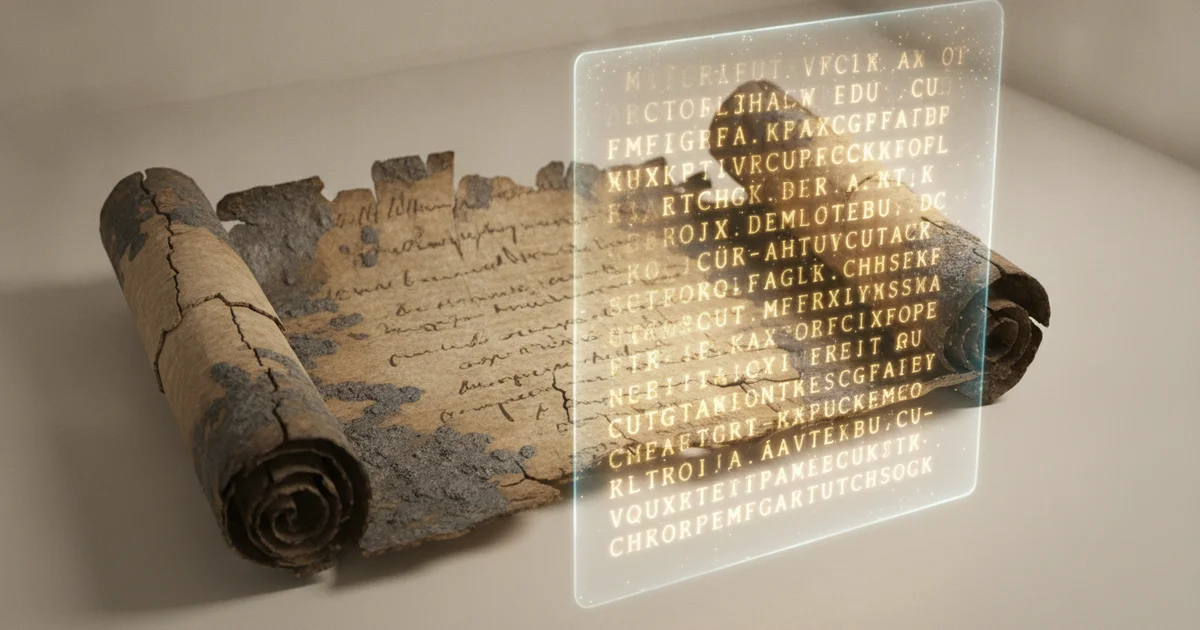
The process combines advanced X-ray computed tomography scanning with AI-driven ink detection. The scrolls are carbonized — essentially charcoal — and the carbon-based ink used by ancient scribes shares nearly the same density as the surrounding material. No human eye looking at scan data could reliably distinguish letter from papyrus. The machine learning models trained for this work learned to detect minute surface texture differences that reveal ink traces layer by layer inside a tightly wound, undisturbed roll. The AI reads what is physically invisible.
What most coverage skips past is the open-access dimension of this work. All scan data from the project is publicly available at scrollprize.org/data, and the full codebase is published on GitHub. Any researcher, programmer, or institution anywhere in the world can download the data and the tools right now. That decision transforms a single archaeological breakthrough into replicable infrastructure. The pipeline that read one ancient scroll can be pointed at another.
More than 800 Herculaneum papyri remain unread, sealed inside the only intact library to survive from the classical world. The virtual unwrapping method that decoded PHerc. 1667 doesn’t need to be reinvented for each one. The approach — scan, segment the layered surface geometry, apply the trained detection model, reconstruct readable text — is now documented, open, and demonstrated on a complete scroll. Ancient manuscript recovery just shifted from a painstaking case-by-case excavation of fragile objects to something closer to a scalable computational process.
What Most Coverage Is Missing: This Is One Scroll of Hundreds
The headlines celebrated one scroll. The real story is what’s sitting next to it.
Herculaneum holds what scholars consider one of the only intact libraries to survive from the ancient world. When Mount Vesuvius erupted in 79 AD, it buried the Villa of the Papyri under a superheated surge of volcanic material that carbonized the entire collection — but did not destroy it. More than 800 scrolls have been recovered from the site since excavations began in the 1750s. Hundreds more may still be underground, in sections of the villa that remain unexcavated.
The critical distinction that most coverage glosses over: these texts were never lost. They exist as physical objects, catalogued, stored, studied from the outside. The bottleneck was never access. It was the impossibility of reading a scroll without tearing it apart — a problem that reduced classical scholarship to educated guessing about what those sealed cylinders might contain.
That reframes the entire situation. This isn’t a story about recovering something that disappeared. It’s a story about an engineering problem — how to read carbonized papyrus without touching it — that AI-assisted tomography just cracked open with the full reading of PHerc. 1667, the papyrus catalogued as Scroll 4 in the Vesuvius Challenge. One scroll, fully read, end to end, for the first time in 2,000 years.
The collection is known to lean heavily toward Epicurean philosophy, largely because the villa’s partial readings have repeatedly turned up works connected to the philosopher Philodemus. But that skew may reflect the limits of what scholars could previously access, not the actual composition of the library. Unknown works of poetry, history, or rival philosophical schools could be sitting in the unread majority. No one can confirm what’s there until more scrolls are processed.
That’s the scope hiding behind the single-scroll headline. PHerc. 1667 is proof that the method works at scale. The ancient library of Herculaneum hasn’t been waiting to be found — it’s been waiting for a tool capable of reading it.
The Role of AI and Open Collaboration: A New Model for Archaeology
The Vesuvius Challenge rewrote the rules of archaeological discovery. Launched as an open prize competition at scrollprize.org, it replaced the traditional closed-door academic model with a global crowdsourcing approach — offering cash prizes to anyone, anywhere, who could develop the AI methods needed to read carbonized papyrus without physical contact. Independent developers, university researchers, and machine learning engineers competed and collaborated simultaneously. The result was a breakthrough that decades of conventional scholarly effort had failed to produce.
That open structure did not end at the finish line. The complete dataset from PHerc. 1667 is publicly available at scrollprize.org/data, and the full codebase is published on GitHub. Any researcher, institution, or developer on the planet can access the exact pipeline used to virtually unwrap and read a sealed Herculaneum scroll today. That decision compresses what would otherwise be a generational research timeline. Methods that might have taken 30 years to propagate through restricted academic channels can now be adopted, stress-tested, and improved within months.
The scalability of this approach extends well beyond the 800-plus scrolls still waiting at Herculaneum. Damaged papyri, sealed medieval manuscripts, burned archival documents, and deteriorated parchment collections exist in repositories across Europe, the Middle East, and North Africa. The combination of X-ray computed tomography scanning and AI-driven virtual unwrapping is not specific to volcanic carbonization — it is a general technique for reading documents too fragile or sealed to open physically. The Herculaneum papyrus project effectively serves as a proof-of-concept for a new class of digital humanities infrastructure.
What distinguishes this moment from previous incremental progress is the model itself. Archaeology has historically guarded its data, restricted site access, and filtered publication through slow institutional channels. The Vesuvius Challenge demonstrated that open competition, shared data, and transparent code produce faster, more reproducible results. Other projects holding damaged ancient texts now have both the technical template and the organizational blueprint to follow.
Why This Moment Is Different: From Proof-of-Concept to Pipeline
For nearly two millennia, the Herculaneum papyri existed in a paradox: physically present, intellectually absent. Scholars could hold a scroll and know it contained ancient Greek or Latin text, but reading it meant destroying it. Partial recoveries over the past decade — fragments here, a column there — were genuine achievements, but they remained tantalizing proof that the technique might work, not proof that it did.
The complete virtual unwrapping and reading of PHerc. 1667 eliminates that ambiguity. This is not another promising fragment. Researchers digitally unrolled the entire scroll, end to end, without touching it. That distinction matters enormously: a full scroll reading transforms virtual papyrus unwrapping from an experimental method into a repeatable, scalable pipeline.
The question the field now faces is not “can this be done?” It is “how fast can we move through the remaining 800-plus sealed scrolls?”
That shift changes everything about how institutions, funding bodies, and governments need to respond. The Herculaneum collection is split across multiple custodians, access to physical scrolls for CT scanning requires diplomatic and bureaucratic coordination, and the computational resources needed to process high-resolution scan data are substantial. These were manageable constraints when the process was experimental. They become urgent bottlenecks the moment the process is proven.
For classicists and ancient historians, the situation is genuinely without precedent in modern scholarship. Recovering a significant body of lost ancient literature — Epicurean philosophy, lost Greek drama, Roman history — within a foreseeable timeframe has never been a realistic prospect. It is now. The Herculaneum library almost certainly holds texts that exist nowhere else on earth. Every month a sealed scroll sits unscanned is a month that knowledge remains inaccessible for reasons that are logistical rather than technical.
The Vesuvius Challenge community, which coordinated the work on Scroll 4, has made both the scroll data and the underlying code openly available. That open-access model accelerates the timeline considerably. The bottleneck is no longer the algorithm. It is institutional will and resource allocation — and those are problems that humans, not AI models, have to solve.