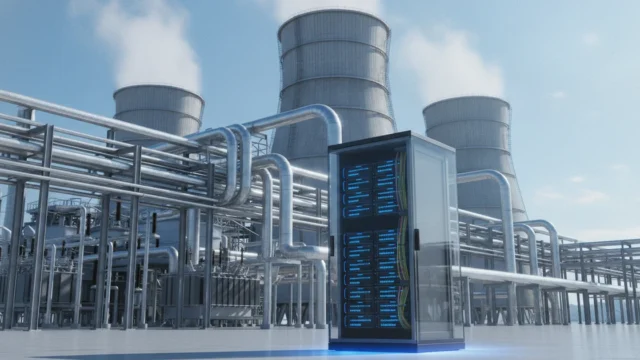
The Plant by the Numbers: How Big Is 33 Million Tons?
Thirty-three million tons of carbon dioxide per year. That number demands context, because raw figures this large tend to slide past without registering their true weight.
No existing power plant in the United States emits that much CO2 annually. The planned Amazon facility in Pecos County, Texas, would not just join the list of major industrial polluters — it would sit alone at the top of it. For comparison, the entire country of Portugal produces roughly 40 million tons of greenhouse gas emissions per year. A single Amazon data center complex, in a remote stretch of West Texas desert, would approach that national total on its own.
The facility burns natural gas on-site. That detail matters enormously. Amazon is not simply purchasing electricity from a grid that happens to include fossil fuel sources — a practice tech companies routinely obscure behind renewable energy certificates and carbon offset accounting. Amazon is building, owning, and operating fossil fuel combustion infrastructure directly. The company becomes the emitter, not a downstream consumer of someone else’s emissions. That distinction collapses the buffer between Silicon Valley climate pledges and the physical reality of how AI compute gets powered.
Data centers have long been framed as passive electricity consumers — invisible buildings pulling watts from a shared grid, their carbon footprint a function of whatever the regional energy mix happens to be. The Pecos County project shatters that framing. A facility permitted to release 33 million tons of CO2 annually is not an electricity consumer. It is an industrial polluter on the scale of petrochemical plants and steel mills — the categories of heavy industry that climate policy has spent decades trying to decarbonize.
Amazon reported a 16% increase in its carbon emissions last year, a trajectory moving in the wrong direction as the company simultaneously promotes net-zero commitments. The Texas gas plant, if built to permitted capacity, would accelerate that trajectory dramatically.
The Missing Context: Why Texas, Why Now, and Why Gas?
Pecos County is not an accident. Amazon chose West Texas deliberately — sparse population, minimal political friction, vast stretches of cheap land, and a natural gas supply chain already built into the region’s DNA. When you need to power the equivalent of a small city without asking permission from urban regulators or ratepayers, you go where nobody is watching closely.
The fuel choice follows the same logic. Natural gas burns on demand. It doesn’t depend on wind speeds or sunlight. Large language models running inference workloads 24 hours a day, processing millions of queries simultaneously, need power that shows up every second — not power that shows up when the weather cooperates. Solar and wind, despite their cost advantages and scalability, cannot yet deliver the uninterrupted, massive-scale baseload that hyperscale AI infrastructure requires without significant storage solutions that don’t yet exist at this price point. Gas fills that gap cleanly, from an engineering standpoint.
Amazon’s decision to build on-site generation rather than draw from the Texas grid solves another problem: grid reliability. ERCOT, Texas’s independent grid operator, has faced well-documented stress events. A facility permitted to consume as much power as this data center campus would represent a genuine grid stability risk if connected directly. On-site generation eliminates that dependency.
But the workaround carries a hidden cost to Amazon’s own climate accounting. The company’s renewable energy commitments — central to its public-facing sustainability narrative — rely on purchasing renewable energy credits and matching grid consumption with clean generation. On-site gas generation sits outside that accounting framework entirely. Amazon’s carbon emissions already climbed 16 percent last year, a direct consequence of accelerating AI infrastructure buildout. A plant permitted to release 33 million metric tons of carbon dioxide annually, more than any existing power plant in the United States, doesn’t fit inside any credible net-zero story. It simply contradicts it.
The Pledge vs. The Plant: Amazon’s Climate Contradiction
When Amazon’s spokesperson confirmed that its Pecos County, Texas data center will be “powered by new on-site generation that won’t raise electricity costs for Texas families,” the statement was a masterclass in strategic omission. It confirmed nothing about the natural gas plant underneath that phrasing and explained nothing about how a facility permitted to emit 33 million tons of carbon dioxide per year fits inside Amazon’s public commitment to reach net-zero carbon emissions by 2040.
That number — 33 million tons — is not a footnote. It exceeds the annual output of any existing power plant in the United States. Amazon spent years building a renewable energy portfolio it markets as the world’s largest corporate clean energy program. A single gas plant in West Texas, running at permitted capacity, could erase the carbon math behind that entire narrative.
Most reporting frames this as an awkward exception, a company caught between principle and practicality. The accurate frame is structural. Amazon’s climate targets — along with those of Google, Microsoft, and every other tech company that made ambitious net-zero pledges between 2019 and 2021 — were calculated against energy demand projections that predated the generative AI explosion. Those models had no meaningful data on the power requirements of training and running large language models at commercial scale. The pledges were real commitments made against fictional load forecasts.
Amazon’s own emissions data confirms the pressure. The company reported a 16% increase in carbon emissions last year, moving in the opposite direction from every decarbonization target on its books. That increase happened before its AI infrastructure buildout reached full velocity.
The Texas gas plant is where the corporate carbon accounting fiction meets physical reality. Data center power demand is growing faster than renewable capacity can be deployed, and natural gas is the fastest answer to that gap. Amazon did not invent this problem, but its Pecos County project makes the contradiction impossible to ignore — or spin.
What the Rest of the Industry Is Doing — and Not Saying
Amazon is not alone in this retreat from climate commitments. Microsoft and Google have both quietly revised their emissions targets as data center construction accelerates globally. Microsoft’s carbon emissions rose 30% between 2020 and 2023, directly attributed to the energy demands of building AI infrastructure. Google reported a 48% increase in greenhouse gas emissions over the same five-year stretch. Neither company has permitted a single facility anywhere near the reported scale of Amazon’s Pecos County project, yet both have softened the language around their net-zero deadlines without issuing formal retractions.
The mechanism these companies rely on to maintain their “clean energy” branding deserves scrutiny. Renewable Energy Certificates — RECs — allow a company to purchase credits representing renewable electricity generated somewhere on the grid, then claim that power as their own. A data center burning fossil fuels at 3 a.m. in Virginia can still call itself “renewably powered” if it holds enough RECs generated by a wind farm in Iowa. The certificates do not require the clean electricity to flow to the facility using it, and they do not require it to flow at the same time. This accounting trick has become the backbone of Big Tech’s sustainability reporting.
The Amazon gas plant in Texas exposes a different problem: a regulatory gap that existing environmental frameworks were never designed to close. State and federal regulators have historically focused their oversight on utility-scale power plants feeding into the public grid. A privately owned, on-site natural gas plant — one permitted to emit 33 million metric tons of carbon dioxide annually — sits in a different category. It operates largely outside the reporting structures applied to public utilities, which means emissions from AI data center power generation can accumulate without triggering the same level of regulatory review or public accountability.
Environmental groups are now pushing for disclosure requirements that treat on-site data center power plants the same as grid-connected generation. Until those rules exist, tech companies can continue expanding fossil fuel infrastructure behind a wall of corporate sustainability pledges that the underlying numbers consistently contradict.
Why This Moment Is a Turning Point for Tech and Climate Policy
The permit decision in Pecos County is bigger than one data center. If Texas regulators approve Amazon’s application and the natural gas plant gets built, every hyperscaler facing the same power shortage has a ready-made blueprint — and a ready-made excuse. Microsoft, Google, and Meta are all racing to expand data center capacity under the same grid constraints. Amazon’s approval becomes the precedent they cite when submitting their own permits. One plant becomes an industry playbook.
The timing makes this a live policy fight, not a historical case study. Congress and the EPA are actively debating how to regulate AI energy consumption, and the Pecos County facility has landed in the middle of that unresolved argument. Legislators pushing for AI data center emissions standards now have a concrete example — 33 million metric tons of projected annual CO₂ — to anchor their case. Opponents of new regulation have the same example to argue that restricting data center power access hampers American competitiveness. Both sides are watching the same permit.
The deeper contradiction is hard to overstate. Amazon markets AWS cloud services and AI tools as instruments for decarbonization — helping companies optimize energy use, reduce waste, and model climate solutions. Meanwhile, Amazon’s own reported carbon emissions climbed 16% last year, driven in significant part by AI infrastructure expansion. The company’s internal climate commitments are moving in the opposite direction from its operational reality.
That gap defines the central tension of the AI energy crisis. The technology industry has built its public identity around climate leadership — net-zero pledges, renewable energy investments, sustainability reports. The Pecos County plant forces a direct confrontation with what that identity actually costs in carbon terms. AI systems designed to fight climate change are, under current growth trajectories, accelerating it. That is the moment policymakers, investors, and the public are now being asked to reckon with — before the concrete gets poured.