The Interface Problem Nobody Is Talking About
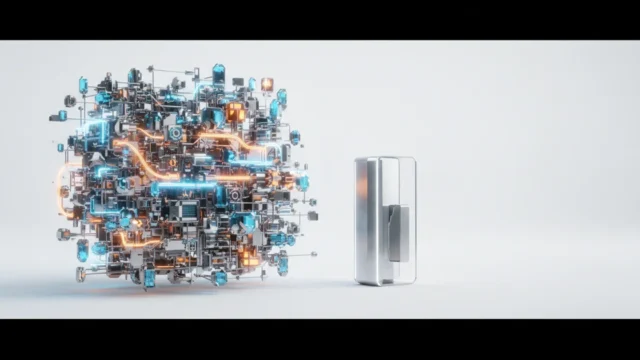
Every piece of software you use was designed for a human on the other side of the screen. Buttons exist because fingers click them. Menus exist because eyes scan them. Drag-and-drop exists because hands move things. The entire interface layer of modern software — decades of GUI design, UX research, and product thinking — was built around human perception and human intuition.
AI agents have neither.
When an autonomous agent needs to operate software today, it faces two bad options. The first is UI scraping: the agent attempts to interpret a visual interface the same way a human would, clicking through menus, reading rendered text, and navigating workflows designed for biological pattern recognition. This breaks constantly. It is slow, brittle, and fails the moment a UI updates. The second option is APIs — but most software simply doesn’t expose one. The tools engineers use daily, the creative applications, the domain-specific platforms, the legacy systems — they were never built to be called programmatically by an external process.
This is the structural gap that CLI-Anything, developed by HKUDS, names directly: today’s software serves humans, but tomorrow’s primary users will be autonomous agents, and the infrastructure isn’t ready for that shift. The project’s framing is blunt about it — “Today’s Software Serves Humans. Tomorrow’s Users will be Agents.”
That gap has real consequences. An agent trying to build a CAD model, generate a 3D scene, or edit video is not just slowed down by bad interfaces — it is effectively locked out. No amount of prompt engineering fixes a missing command-line entry point. No larger context window compensates for software that requires a human hand to operate.
The problem has gone largely unaddressed because, until recently, agents weren’t capable enough to expose it. Now they are. The bottleneck has moved from the model to the interface, and the entire software ecosystem is sitting on an assumption — that the user is always human — that is quickly becoming false.
What CLI-Anything Actually Does
CLI-Anything, built by the HKUDS lab at the University of Hong Kong, auto-generates command-line interfaces for virtually any existing software. The result is a clean, text-based control surface that AI agents can operate directly — no graphical interface, no simulated mouse clicks, no brittle screen-scraping.
The core problem it solves is straightforward: almost no software was designed with AI agents as the intended user. Vendors have little incentive to retrofit agent-friendly APIs onto mature products, and the process is slow even when they try. CLI-Anything sidesteps that bottleneck entirely. Instead of waiting on vendors, it lets the community generate CLI wrappers and publish them through CLI-Hub, a centralized package registry. Installing a community-built CLI takes a single command — pip install cli-anything-hub, followed by cli-hub install <name>. Contributors submit wrappers via pull request, and once reviewed and merged, the hub updates instantly.
The project’s scope extends well past text manipulation. Three features — preview, live preview, and trajectory loops — let agents work iteratively toward real, non-text artifacts. Preview renders intermediate output so an agent can evaluate progress before committing a change. Live preview streams output in real time as the agent issues commands. Trajectory loops let the agent cycle through generate-evaluate-revise sequences autonomously, without human checkpoints at each step. The practical output from these loops includes CAD models, 3D scenes, gameplay elements, diagrams, and video subtitles — categories of work that AI agents have historically struggled to produce reliably because they lacked stable, programmable access to the tools that create them.
The community model is deliberate. Rather than centralizing CLI development inside the HKUDS lab, the project treats the wrapper library as a shared resource. Anyone can request support for a specific tool through a public wishlist, and contributors who build and merge a wrapper gain ongoing access to the contributor community. That structure means the catalog of agent-accessible software can grow as fast as the contributor base, independent of what any single software vendor decides to prioritize.
CLI-Hub: The npm Moment for Agent Tooling?
The distribution problem for agent tooling now has a solution: CLI-Hub, hosted at clianything.cc, operates as a community-driven marketplace for agent-ready CLI wrappers. Install the hub itself with a single pip command — pip install cli-anything-hub — then pull down any available CLI with cli-hub install <name>. Browse, install, manage. Three steps, no configuration hell.
The contribution model mirrors what made npm and PyPI engines of ecosystem growth rather than walled gardens. Any developer can wrap a new piece of software, open a pull request, and once it clears review, the hub updates instantly. The barrier to entry is a PR. The barrier to consumption is one terminal command. That symmetry — easy to give, easy to take — is exactly the dynamic that turned Node’s package registry into an infrastructure layer nobody planned to depend on but everyone does.
The strategic logic compounds quickly. Every CLI added to the hub expands what AI agents can do without any changes to the agents themselves. A new CAD wrapper means every agent using CLI-Anything can suddenly operate CAD software. A new subtitle tool, a new 3D scene renderer, a new diagramming harness — each addition multiplies agent capability across the entire user base simultaneously. The hub already supports agents producing real artifacts: CAD builds, 3D scenes, gameplay outputs, subtitles, and more, as shown in CLI-Anything’s demo library.
HKUDS also built in a demand signal: users can submit wishlist requests for specific software or services they want wrapped. That feedback loop directs contributor effort toward actual gaps rather than duplicated work, accelerating the coverage of the most-needed tools first.
This is the npm moment pattern applied to agent infrastructure. npm didn’t win because it was technically superior to every alternative — it won because it got the flywheel moving first and made contribution frictionless enough that the catalog became the moat. CLI-Hub is making the same bet: the project that becomes the default distribution layer for agent-ready software interfaces wins something much larger than a developer tool. It wins the interface layer for how AI agents interact with the world’s existing software stack.
What Most Coverage Is Missing: This Is a Design Philosophy Shift, Not Just a Dev Tool
Most coverage of CLI-Anything focuses on the wrong thing. Tech writers have catalogued it as a productivity shortcut for AI developers — a clever wrapper that saves time. That framing misses the actual argument the project is making.
CLI-Anything’s own tagline says it plainly: “Today’s Software Serves Humans. Tomorrow’s Users will be Agents.” That isn’t marketing copy. It’s a design thesis. The project treats human interfaces and agent interfaces as fundamentally different requirements that software must eventually serve separately — not as the same interface with a bot bolted on top.
The dominant approach right now is to give AI agents access to software the same way a clumsy intern might use it: browser automation that breaks when a button moves, fragile API wrappers that expire when a company changes its authentication flow, or screen-scraping pipelines that collapse on a UI refresh. CLI-Anything’s architecture rejects that path. It generates purpose-built command-line harnesses designed from the ground up for machine consumption — structured inputs, predictable outputs, no GUI dependencies.
The strategic implication for software companies is sharper than it first appears. CLI-Anything ships a community hub at clianything.cc where contributors can build, publish, and install CLI harnesses for any software via a single pip install. The hub updates the moment a pull request merges. That means if a software company doesn’t expose an agent-native interface, the open-source community will build one anyway — and that community-built version will become the canonical way agents interact with that product. The company loses control of its own integration layer.
This is what a genuine interface fork looks like in practice. Humans keep their polished GUIs. Agents get structured, scriptable, composable CLIs. The software companies that recognize this early and ship agent-native interfaces on their own terms will define how their tools get used. The ones that ignore it will find CLI-Anything contributors have already made that decision for them.
Real-World Stakes: What Agents Can Already Build With This
The demos remove any doubt about what CLI-Anything unlocks in practice. Agents using generated CLI harnesses have already produced CAD builds, 3D scenes, gameplay sequences, subtitle files, and technical diagrams — artifacts that previously required a human to sit inside specialist software, navigate menus, and make dozens of sequential decisions. None of that human presence is required anymore.
This is the functional difference between an AI that talks about tasks and one that completes them. When an agent can invoke Blender, a CAD suite, or a subtitle editor through a structured command interface built for machine consumption, it stops being a conversational assistant and becomes an autonomous technical worker operating professional-grade tools at whatever speed the underlying hardware allows.
The trajectory loop feature is what makes that autonomy reliable rather than brittle. Multi-step tasks fail when early errors compound — a misplaced vertex in step two ruins the geometry in step twelve. Trajectory loops give agents the ability to observe intermediate output, identify where the process drifted, and self-correct before continuing. That feedback mechanism is not a convenience feature. It is the architectural requirement that separates a system capable of genuine autonomous operation from one that needs a human standing by to catch mistakes.
Taken together, the artifact range and the self-correction capability define a new category of AI worker. An agent that can render a 3D scene, check the output against the original prompt, adjust lighting parameters, and re-render without human intervention is doing creative and technical work, not just generating text about it. CLI-Anything’s community hub already hosts CLIs across multiple domains, and contributors can add new ones through a pull request process that updates the hub immediately. The surface area of software that agents can operate expands with every merge.
Open Questions and Risks Worth Watching
CLI-Anything’s community-driven model is its greatest strength and its most obvious liability. Any contributor can open a pull request to add a new CLI harness to the CLI-Hub, and once reviewed and merged, that harness becomes available to any agent that installs it. The review process is a human checkpoint, but human checkpoints have limits. A malicious or sloppily written CLI could feed an agent incorrect flags, redirect outputs to unintended destinations, or silently fail in ways that compound across a multi-step task. When a human misreads a menu, the consequence is usually a wrong order. When an agent executes hundreds of operations through a flawed harness, the blast radius is larger.
The legal picture is equally unsettled. Software vendors have not been consulted on whether they want agent-native access to their products built by third parties. Some will welcome it — reduced support burden, wider adoption, faster integration. Others will treat community-built CLI wrappers for their software as unauthorized scraping, a terms-of-service violation, or grounds for a cease-and-desist. Enterprise vendors with tightly controlled APIs have both the incentive and the legal firepower to push back. CLI-Anything has no announced partnerships with major software companies, which means every community-built harness for a proprietary product sits in contested territory.
The standardization question is the biggest unknown of all. CLI-Anything is currently the most developed open attempt to define what an agent-native software interface looks like, but it is not the only candidate for that role. Anthropic’s Model Context Protocol, various OpenAI plugin architectures, and cloud provider tooling from AWS and Google all represent competing visions for how agents connect to external software. If any of those players decides to back a different interface standard with serious resources, CLI-Anything becomes one approach among several rather than the default layer. The project’s open-source structure and CLI-Hub distribution model give it a head start in community adoption, but community adoption and industry standardization are different races. Which one determines how agents interact with software for the next decade is still genuinely open.