The Scrutiny Is Growing — And That’s the Real Story
This isn’t a single bad week for Tesla. It’s a pattern becoming impossible to ignore.
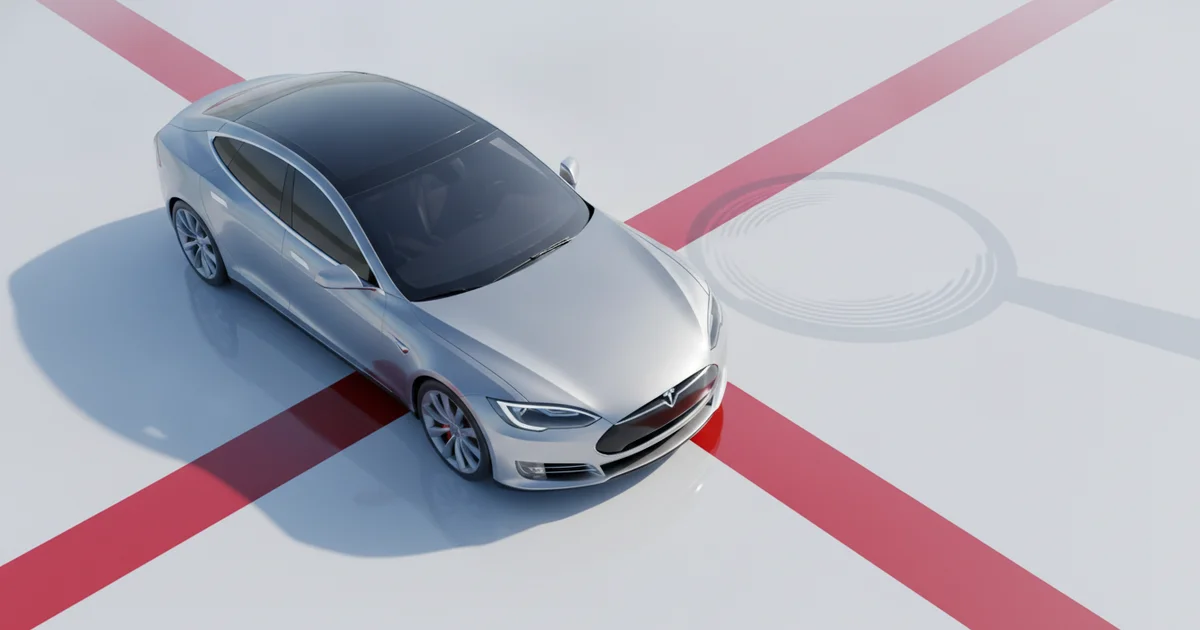
A fatal crash in Texas — where a Tesla struck a home and killed a 76-year-old woman — pulled national attention back to how Tesla’s driver-assistance systems actually work in practice. The driver told police that Autopilot was engaged at the time. Tesla has since discontinued Autopilot, but the incident landed in a media and regulatory environment already primed for exactly this kind of story. That context matters.
TechCrunch Mobility flagged what the crash really represents: not an isolated accident, but one data point in a series of converging stories that together signal escalating scrutiny of Tesla’s Full Self-Driving system. Regulators, journalists, and safety advocates are no longer treating each FSD-related incident as a standalone event. They’re building a systemic case.
A central pressure point is the name itself. “Full Self-Driving (Supervised)” is a product designation that critics argue actively misleads consumers about the level of autonomy they’re purchasing. The parenthetical “Supervised” does real work — it means a human driver must remain alert and in control at all times — but that nuance disappears in casual use and marketing shorthand. Regulators are now pushing harder on whether labeling an advanced driver assistance system as “Full Self-Driving” creates a false sense of capability, contributing to misuse and, potentially, fatal outcomes.
That naming debate points to a broader governance gap. The automated vehicle industry has long operated in a regulatory environment that struggled to keep pace with software-defined vehicles updating their behavior over the air. What’s shifting now is the nature of the questioning. Oversight bodies and public discourse have moved past asking “what happened in this crash” and started asking “who is responsible for how these systems are understood, sold, and supervised.”
For Tesla FSD specifically, that shift puts autonomous driving claims, consumer disclosure standards, and AI accountability frameworks all under the same spotlight — at the same time.
What Most Coverage Is Missing: The AI Angle Behind FSD
When a Tesla running Full Self-Driving struck a Texas home and killed a 76-year-old woman, most outlets framed it as a car crash story. It is not. It is an AI accountability story — one that happens to involve a vehicle.
Tesla’s FSD is not a driver-assistance feature in any conventional sense. It is a large-scale, real-world deployment of a machine learning system making autonomous decisions on public roads, updated iteratively through over-the-air software releases, and tested — in practice — by paying customers. That makes it one of the most consequential AI experiments running anywhere in the world right now. The fleet spans hundreds of thousands of vehicles. Every mile driven feeds data back into the model. The testing environment is not a controlled lab. It is every highway, school zone, and residential street in America.
Mainstream automotive reporting consistently misses this framing. Coverage of FSD incidents focuses on crash mechanics, regulatory filings, and Tesla’s stock price. That framing obscures what is actually being debated: how AI systems should be validated before consumer deployment, who bears liability when an algorithm makes a fatal decision, and what meaningful oversight of autonomous decision-making looks like at scale.
TechCrunch Mobility acknowledged directly that transportation coverage and AI coverage have become inseparable beats — yet most general-interest reporting still treats them as distinct. A fatal crash involving a neural-network-driven vehicle is not just a NHTSA investigation. It is a case study in AI risk management, edge-case failure, and the gap between benchmark performance and real-world reliability.
The scrutiny now building around Tesla’s full self-driving technology — regulatory, legal, and journalistic — signals that this framing is finally shifting. Autonomous vehicle safety, AI transparency, and machine learning accountability are converging into a single conversation. The public deserves coverage that reflects that reality, not coverage that treats a software system’s fatal failure as a traffic incident.
The Regulatory Gap: Rules Built for Cars, Not AI
The federal safety standards governing American roads were written to catch brake failures and structural defects — physical, testable, repeatable problems. They were not written for a neural network making split-second probabilistic decisions at 70 miles per hour. That mismatch is now impossible to ignore.
Tesla’s Full Self-Driving (Supervised) system has forced the question into the open. When a Tesla using Autopilot struck a Texas home and killed a 76-year-old woman, investigators faced a problem that existing vehicle safety regulations were never designed to solve: how do you assign fault to an AI system that doesn’t fail in any conventional mechanical sense? It doesn’t snap a tie rod or blow a seal. It makes a prediction, and sometimes that prediction is wrong.
The National Highway Traffic Safety Administration has opened multiple investigations into Tesla’s automated driving systems, but the agency’s core toolkit — recall authority, defect standards, crash reporting mandates — was built around components, not algorithms. Regulators can demand a manufacturer replace a faulty part. They have no equivalent power over a software model that is simultaneously deployed across millions of vehicles and updated over the air without a single wrench being turned.
Liability is the sharpest edge of this problem. Traditional automotive law places responsibility on drivers, manufacturers, and occasionally component suppliers. Autonomous and semi-autonomous vehicle technology scrambles that chain. When an AI driver-assistance system controls steering, acceleration, and braking, the question of who caused a crash — the human behind the wheel, the company that trained the model, or the automaker that deployed it — has no clean legal answer under current frameworks.
The result is reactive governance. Oversight bodies investigate after people die rather than setting binding behavioral standards before autonomous driving systems reach public roads. The scrutiny surrounding Tesla FSD is exposing that gap in real time, and the pressure is building on regulators to move from incident response to actual AI-specific vehicle safety standards before the next generation of fully driverless technology makes the existing frameworks even more obsolete.
Tesla’s Position: Innovation Shield or Accountability Gap?
Tesla has built its Full Self-Driving system on a rapid iteration model that treats public roads as a continuous testing environment. Through over-the-air software updates, the company pushes new versions of FSD directly to consumer vehicles — sometimes weekly — without requiring a dealership visit or formal safety recertification for each release. This approach accelerated Tesla’s development cycle and gave it a competitive edge over automakers still navigating traditional regulatory approval processes for vehicle software changes.
The problem is structural. When millions of drivers operate vehicles running autonomous driving software that Tesla itself labels as requiring active supervision, the line between beta testing and commercial deployment effectively disappears. Consumers who purchased FSD — at prices that have ranged from $8,000 to $15,000 — became participants in a live AI experiment, whether or not they understood that framing. The system’s variable performance across different road conditions, weather, and edge cases means safety outcomes have not been uniform across that user base.
Tesla’s standard response to incidents and regulatory inquiries has leaned on the same core argument: the technology is improving, data from real-world driving makes it better, and the overall safety record compares favorably to human drivers. That argument carried weight in the early years of advanced driver-assistance system development, when regulators had little framework for evaluating AI-driven vehicle behavior and public expectations were still forming.
That tolerance is shrinking. Fatal crashes involving Tesla vehicles with automated driving features engaged — including a 2024 incident in Texas where a 76-year-old woman died after a Tesla struck a home — have intensified scrutiny from the National Highway Traffic Safety Administration and federal investigators. Regulators are no longer treating each incident as an isolated data point. They are examining whether Tesla’s deployment model for its self-driving technology creates systemic risk, and whether “we’re still improving it” constitutes an adequate safety posture for software controlling two-ton vehicles on public roads.
The accountability gap Tesla faces is not just reputational. It reflects a fundamental tension between Silicon Valley’s move-fast product philosophy and the liability standards that govern every other safety-critical consumer technology.
What This Means for the Broader Autonomous Vehicle Industry
The heat Tesla is facing over Full Self-Driving doesn’t stay contained to one company. Every automaker and technology firm developing AI-driven vehicle systems — Waymo, GM Cruise, Ford, Volkswagen, and the dozens of startups racing to deploy autonomous features — now operates in a regulatory environment that Tesla’s troubles are actively reshaping.
Tesla holds a singular position in this landscape. No other company has deployed a consumer-facing semi-autonomous driving system at anything close to Tesla’s scale, with FSD active across hundreds of thousands of vehicles on public roads. When regulators and federal investigators focus on that system, they are effectively writing the first draft of what accountability looks like for AI in mobility. The standards applied to Tesla become the baseline every other player gets measured against.
That creates direct competitive consequences. Companies like Waymo have pursued a more cautious, geofenced approach to autonomous deployment, investing heavily in safety validation before public launches. If tighter federal oversight forces Tesla to slow FSD rollouts, add more robust driver monitoring, or submit to mandatory incident reporting, those requirements will follow every competitor into the market. The compliance costs alone could shift the competitive balance between deep-pocketed legacy automakers and leaner autonomous vehicle startups.
The regulatory template that emerges from the current scrutiny will define AI vehicle safety governance for the next decade. The National Highway Traffic Safety Administration has already demonstrated it will investigate automated driving system failures publicly and aggressively. Congress is paying attention. The outcome — whether it produces mandatory performance standards, clearer liability frameworks, or new classification rules distinguishing driver assistance from true autonomy — sets the rules for every self-driving system that follows.
The autonomous driving industry has operated in a relatively permissive environment while the technology matured. That period is ending. Tesla’s position at the center of this accountability moment means the entire sector will feel the regulatory consequences, regardless of whose vehicle is under investigation.
The Reader Takeaway: Why You Should Care Right Now
Tesla’s Full Self-Driving system is not a lab experiment or a regulatory hypothetical. It is operating on public roads across the United States right now, installed in hundreds of thousands of vehicles driven by everyday consumers. A fatal crash in Texas, where a 76-year-old woman died after a Tesla struck a home, brought national attention to the real-world consequences of deploying AI-assisted driving technology at scale before accountability frameworks exist to match. That crash is one data point in a growing pattern of scrutiny that regulators, safety advocates, and journalists are no longer willing to treat as isolated incidents.
This debate will define far more than autonomous vehicle policy. The standards society sets for Tesla FSD — around transparency, incident reporting, liability, and independent safety auditing — will become the template for how AI systems get deployed in hospitals, power grids, and financial markets. If regulators accept minimal disclosure from an automaker running a live AI driving system on public infrastructure, they signal to every other industry that opacity is acceptable when the technology moves fast enough.
Informed citizens carry real weight here. Regulatory agencies respond to public pressure. Investigative coverage of automated driving safety gains traction when readers share it, demand answers from their elected officials, and ask pointed questions of dealerships and automakers. You do not need to be a machine learning engineer to recognize that a system marketed under the name “Full Self-Driving” — while legally requiring constant human supervision — represents a transparency problem worth challenging.
The scrutiny of Tesla’s driver assistance technology is a stress test for AI governance itself. How this plays out will shape what companies in every high-stakes sector believe they can get away with. Pay attention to it.