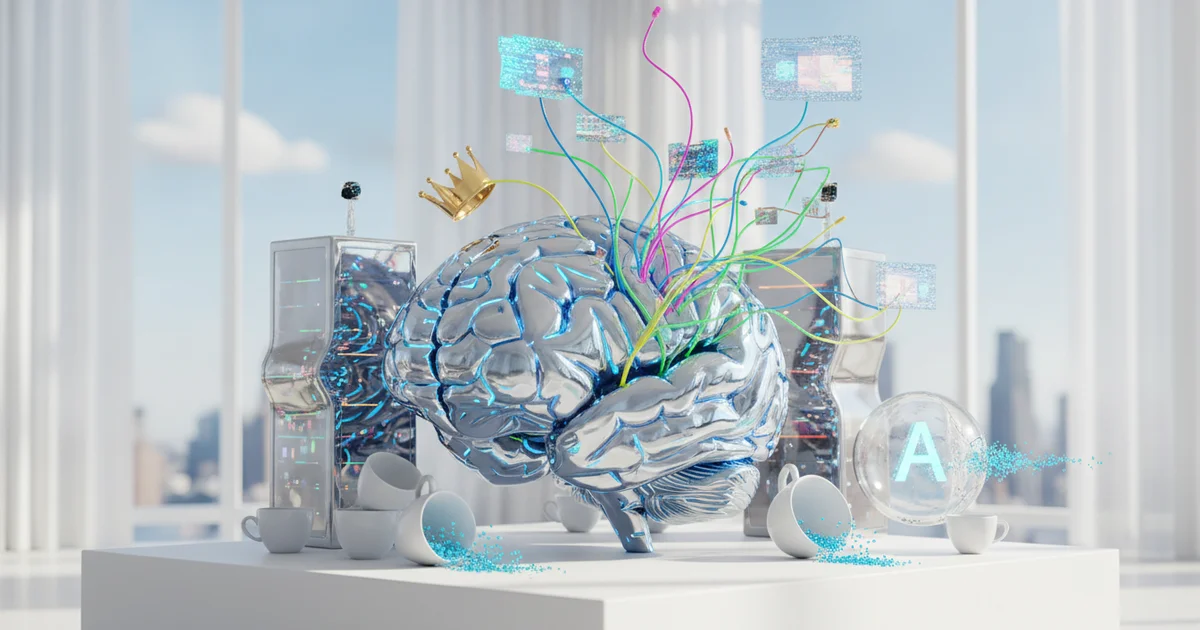
The Diagnosis: What ‘AI Psychosis’ Actually Means
Box founder Aaron Levie coined the term on X, and the fact that it came from a sitting tech CEO — not a skeptic, academic, or journalist — is what gives it weight. Levie’s diagnosis: “CEOs are uniquely prone to AI psychosis because they’re sufficiently distant from the last mile of work that still has to happen to generate most value with AI.”
The mechanism is specific. A CEO fires up an AI tool, generates a contract, builds a rough prototype, watches it work, and then makes a catastrophic logical leap — concluding that AI agents can therefore handle the full operation. They mistake a demo for a deployment. They confuse a proof of concept with a production reality. The gap between what AI can do in a controlled test and what it can do at the messy, exception-filled, human-dependent last mile of actual work gets ignored entirely.
This pattern echoes earlier tech disruption cycles. Cloud computing produced its own era of runaway costs and irrational exuberance before the market corrected. But the current AI moment carries a distinct and more dangerous characteristic: the delusion is being funded by genuine, record-breaking revenues. When a company posts historic earnings while simultaneously announcing mass layoffs and betting its entire product roadmap on half-proven AI capabilities, the financial numbers provide executive cover that earlier hype cycles never had. It becomes nearly impossible to call a decision reckless when the quarterly report looks extraordinary.
That combination — real transformative technology, real revenue, and executive teams with limited visibility into ground-level operations — creates the conditions for psychosis to spread and go unchallenged. The money says the bet is working. The prototype says the technology is ready. Neither tells the full story, and the people who know the full story rarely have a seat at the table where these decisions get made.
What Most Coverage Is Missing: The Paradox of Profit and Panic
Most AI coverage splits into two camps: breathless optimism about productivity gains, or philosophical dread about superintelligence. Both miss the more immediate story unfolding inside actual companies right now — a middle layer of executive decision-making that is structurally irrational even as the quarterly numbers look pristine.
The combination of record revenues and mass layoffs is historically anomalous. Companies don’t typically cut headcount while reporting their best financial results in history. That’s a signal, not a coincidence. It points to a leadership class that is reorganizing businesses around what AI is expected to deliver, not what it demonstrably delivers today.
Box founder Aaron Levie named the dynamic directly. “CEOs are uniquely prone to AI psychosis because they’re sufficiently distant from the last mile of work that still has to happen to generate most value with AI,” he wrote on X. The pattern he describes is specific: a CEO builds a prototype, generates a contract summary using an AI tool, watches an agent demo, and then makes a categorical leap — concluding that agents can now absorb entire functions. The prototype works. The production reality doesn’t match it. But the layoffs happen anyway.
This is not random chaos. It follows a consistent logic: CEOs over-index on AI’s future promise and under-weight the present-day operational and human costs of acting on that promise prematurely. The tech industry has seen distorted executive judgment before — cloud computing’s early years produced runaway costs before economics normalized — but the current moment carries a different signature. Previous manias burned money. This one is eliminating jobs at companies that aren’t losing money, which makes the decisions harder to explain through conventional financial pressure.
The wildness TechCrunch observed in the industry — and it is genuinely wild — isn’t a feature of the technology itself. It’s a feature of who controls the deployment decisions and how far removed those people are from the actual work AI is supposed to replace.
Why CEOs Are Especially Susceptible
Aaron Levie, the founder and CEO of Box, put his finger on something structural rather than personal when he wrote that “CEOs are uniquely prone to AI psychosis because they’re sufficiently distant from the last mile of work that still has to happen to generate most value with AI.” The problem isn’t that tech CEOs are reckless by nature. The problem is that their position systematically filters out the friction.
A CEO who spends an afternoon building an AI prototype or watching a demo of an agent drafting contracts experiences the upside with almost none of the operational drag. They don’t sit with the customer support rep troubleshooting a hallucinated output, or the compliance team trying to audit a decision the model can’t explain. That gap between the executive demo and ground-level reality is where AI bets quietly fall apart — and CEOs rarely see it.
The power imbalance makes this worse. CEOs hold enough authority to greenlight billion-dollar infrastructure contracts, reshape entire product teams, and announce workforce reductions — all before the underlying technology has been stress-tested at scale. The people who could provide corrective feedback, middle managers and frontline engineers, have every incentive to manage up rather than push back against a CEO who has visibly committed to an AI transformation story.
Competitive fear closes the loop. When Salesforce, Microsoft, and Google all announce aggressive agentic AI strategies within the same earnings cycle, the CEO of any mid-size SaaS company who counsels patience isn’t being prudent — they’re being exposed. Boards read the same headlines, and restraint in a moment of perceived technological shift reads as a leadership deficit. The herd dynamic is self-reinforcing: the more peers pivot hard into AI, the more costly caution appears, regardless of whether the underlying bets are sound.
The result is a class of executives who are simultaneously the most empowered to act on AI and the least equipped to reality-check those actions — a combination that explains a lot about the current moment.
The Real-World Fallout: Employees and Products Pay the Price
When a CEO plays with an AI prototype and decides the technology can replace entire departments, the people in those departments pay the bill. Tech companies posted record revenues in 2024 while simultaneously executing mass layoffs — a combination that has no clean historical precedent. The justification in nearly every case follows the same script: AI transformation requires a leaner workforce. What that script omits is that the productivity gains justifying the headcount cuts are projections, not measured outcomes. Real employees are losing real jobs based on a CEO’s conviction that a demo generalizes to enterprise-scale work.
Box founder Aaron Levie identified the core problem directly. CEOs are “sufficiently distant from the last mile of work,” he wrote, which makes them uniquely vulnerable to AI psychosis. They generate a contract with a tool, watch an agent complete a task, and extrapolate. The people who actually execute the work — engineers, support staff, content teams — understand exactly where the demo breaks down. They rarely get a vote.
Product roadmaps absorb the same distortion. When an AI-first mandate comes from the top before use cases are validated, engineering teams spend cycles building features nobody has confirmed customers want. Development timelines stretch. Releases ship bloated with AI capabilities that end users ignore or actively avoid. The product gets worse in pursuit of looking modern.
Investors are funding this dynamic with limited visibility into whether it holds. Companies are asking for significant capital underwriting on the strength of an AI thesis that often traces back to CEO conviction rather than demonstrated customer demand. Earnings calls offer confident language about AI-driven efficiency; they offer far less data on whether those efficiencies are materializing in the actual product or on the actual balance sheet. That information asymmetry is a problem investors in previous tech cycles learned to take seriously — usually too late.
The Missing Guardrails: Who or What Can Check CEO AI Psychosis
Boards of directors exist precisely to catch this kind of executive drift. They are failing at that job. The same AI hype cycle that distorts a CEO’s judgment hits board members with equal force — many of whom are themselves tech executives, venture capitalists, or institutional investors with direct financial stakes in AI’s success. A board composed of people who need the narrative to be true cannot correct a CEO who believes it too deeply.
The cloud computing era offers a partial warning here. Early cloud adoption produced runaway infrastructure costs that eventually forced CFOs and boards to impose discipline — cloud cost optimization became its own industry. But that correction took years, and it was triggered by something legible: a line item on a balance sheet that kept growing. AI’s cost structures are murkier. Returns are harder to attribute. Timelines for productivity gains remain genuinely contested even among researchers. The financial feedback loop that eventually sobered up cloud spending has no clear equivalent in AI, which means the reckoning could be delayed long enough to cause serious damage first.
What the industry lacks is a structured, independent mechanism for stress-testing AI strategy claims before they become hiring plans, layoff announcements, or product roadmaps. Financial auditing exists because self-reported numbers invite abuse. Technology vision operates with no equivalent check. When a CEO tells analysts that AI agents will replace entire workforce functions within 18 months, no credentialed body examines that claim against operational reality. No standard requires the underlying assumptions to be disclosed. Shareholders receive the optimism without the methodology.
Some researchers and practitioners have called for something like a technology audit function — independent assessors who can evaluate whether an AI deployment claim is grounded in demonstrated capability or in a well-produced demo. The concept exists in fragments: red-teaming practices at some AI labs, third-party model evaluations, nascent regulatory frameworks in the EU. None of it adds up to a coherent governance layer that operates at the speed of executive decision-making. Until it does, the primary check on AI psychosis in the C-suite remains the market — and markets have historically been very slow, and very expensive, correctors.
What Comes Next: Correction, Consolidation, or More Chaos
History rarely corrects technology bubbles cleanly. The dot-com crash required a full market implosion before the industry reset. The early cloud computing era burned through capital on runaway infrastructure costs before discipline took hold. AI may follow a different path — not a dramatic market failure, but a quieter organizational rot as promised productivity gains fail to materialize and the gap between CEO prototypes and actual business results becomes impossible to ignore.
That gap is already visible. Companies are posting record revenues while simultaneously executing mass layoffs — a combination with almost no precedent in previous tech cycles. When headcount reductions happen alongside strong financials, executives are making bets, not corrections. They are pricing in an AI-driven future that their own teams have not yet delivered.
The executives who survive this will be the ones who treat AI as a lens for sharpening strategy, not a substitute for having one. Playing with a demo, generating a contract summary, and watching an agent complete a bounded task does not constitute a workflow transformation. CEOs who cannot make that distinction will eventually face it made for them — by their boards, their customers, or their departing engineers.
Aaron Levie naming this dynamic publicly matters. Levie built Box into an enterprise software company worth roughly $4 billion, which means he understands the distance between a promising prototype and a shipped product that scales. His willingness to call out AI psychosis by name, directed squarely at his own peer group, suggests something is shifting among a small cohort of tech leaders who have enough real-world implementation experience to separate signal from noise.
Watch what that cohort does next. If they start walking back hiring freezes, rebuilding teams they cut, or publicly recalibrating AI timelines, that is the correction. It will not look like a crash. It will look like a handful of executives quietly admitting that the last mile of work still requires humans — and rebuilding accordingly.