The Night Tower Ladder 14 Failed: A Case Study in Systemic Risk
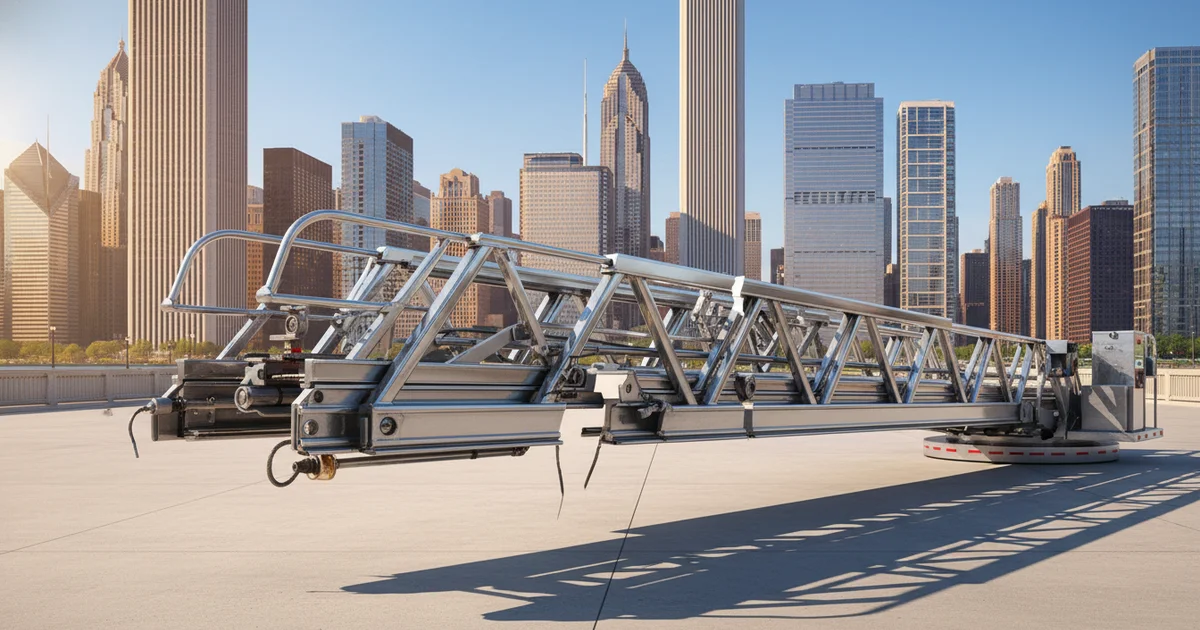
At 11:47 p.m. on June 26, 2025, Tower Ladder 14 arrived at a burning Chicago apartment building where an arsonist had already sealed the exits — gasoline poured across both stairwells, turning the only escape routes into accelerants. The crew needed the aerial ladder operational within seconds. It would not move.
The firefighters shut the entire rig down and restarted it from scratch, mid-emergency, with people trapped above the flames. The restart took approximately one minute. In a structure fire with blocked egress, one minute is not a rounding error. It is the difference between a rescue and a recovery.
Four people died that night. A pregnant woman. Her five-year-old son. Her sister, who threw her own child from a third-floor window before the fire took her too. The child survived. The three adults did not.
The family learned about the ladder malfunction from journalists. The city did not tell them.
What makes this a case study rather than a tragedy in isolation is the specific nature of the failure. The crew did not run out of water. The truck did not crash en route. The aerial ladder — the single piece of equipment that defined the entire tactical response to a high-rise arson with sealed stairwells — failed at the exact moment it was needed, then required a full system restart to function at all. That is not bad luck. That is a maintenance profile in which deferred repairs accumulate invisibly until they surface as single points of catastrophic failure.
Tower Ladder 14 did not break because equipment breaks. It broke because equipment breaks predictably when the financial logic governing its upkeep treats maintenance as a cost to manage rather than a risk to eliminate. The question that follows from June 26 is not what went wrong with one truck on one night. It is what ownership model produces a fleet where that truck was in service at all.
The Business Model Behind the Breakdown: How Private Equity Operates in Essential Services
Private equity firms acquire companies the way engineers acquire components — for extraction, not stewardship. The standard fund cycle runs five to seven years. Within that window, the acquired company must generate returns sufficient to justify the purchase price, service the debt used to finance the acquisition, and deliver the kind of multiple that keeps institutional limited partners — pension funds, university endowments, sovereign wealth funds — committed to the next fund. That math has consequences for how companies are actually run.
The primary levers are predictable: cut labor, defer maintenance, consolidate vendors, squeeze procurement costs. In consumer goods or software, deferred investment means slower product cycles. In essential services infrastructure — fire apparatus manufacturers, municipal maintenance contractors, emergency equipment suppliers — deferred investment means something else. It means vehicles that fail. Parts that arrive late or not at all. Technicians who leave and aren’t replaced.
EBITDA, the metric PE firms use to measure operating performance and set exit valuations, rewards cost reduction immediately and assigns no penalty to reliability failures that emerge after the hold period ends. A fund that acquires a fire truck manufacturer in 2020 and exits in 2026 books its profits before the consequences of stripped maintenance protocols or underinvested parts supply chains become visible in the field. The firm is gone. The trucks remain.
Liability diffusion compounds this. PE-owned companies operate through layered holding structures — the operating company sits below a holding company, which sits below a fund vehicle, which is managed by the general partner. When equipment fails, legal exposure attaches to the operating company, the entity with the least capital and the thinnest insurance. The fund itself, and the partners who managed it, are structurally insulated. There is no reputational consequence tied to service continuity because there is no single, named owner who faces the public when a ladder won’t extend.
Public agencies and long-term operators face a different calculus. A fire chief who defers fleet maintenance answers to a city council, a press corps, and eventually a jury. A PE fund that owns the company that made the truck answers to its limited partners — and only for the duration of the fund.
What Most Coverage Is Missing: This Isn’t About One Bad Actor
When the Chicago story broke, coverage split predictably between two frames: equipment maintenance failures inside a cash-strapped municipal department, and the heroism or negligence of individual firefighters on scene. Both frames stopped at the city line. Neither asked who built the truck, who services it, who owns the company that does, and what financial obligations that owner is managing.
That omission is not incidental. It reflects a genuine gap in how journalists, city councils, and oversight bodies have tracked the restructuring of essential service supply chains over the past two decades.
Private equity has become a dominant owner of the vendors, contractors, and manufacturers that cities depend on for public safety infrastructure. This is not confined to fire apparatus. Rural hospitals acquired by PE-backed hospital management companies have closed emergency departments within years of acquisition across Appalachia and the rural South. Ambulance operators like American Medical Response, which has passed through multiple PE ownership structures, have faced documented response time degradation in markets where they hold regional monopolies. Water treatment equipment manufacturers, prison health contractors, and school bus operators have followed the same pattern: acquisition, cost restructuring, reliability decline, public harm.
The structural reason is consistent. Private equity funds operate on fixed return timelines, typically three to seven years, with returns that require extracting more value than the acquisition price plus debt service. In essential services with captive government customers and long replacement cycles, the extraction mechanism is deferred maintenance, reduced staffing, and parts supply rationalization. Cities rarely notice until something fails, and when something fails, the accountability gap is immediate: the public agency takes political heat for infrastructure it no longer controls.
The Chicago fire did not happen because one truck had a bad sensor. It happened inside a system where the actual points of failure — manufacturing quality, service contracts, parts availability — sit behind ownership structures that face no public accountability and answer to investors, not residents. That system is operating in your city too.
Why It Matters Now: The Acceleration of Essential-Services Acquisition
The timing of Chicago’s ladder failure is not coincidental — it is structural. Private equity firms flooded infrastructure-adjacent sectors with capital during the low-interest-rate era of the 2010s and early 2020s, when cheap debt made leveraged buyouts of unglamorous but cash-stable businesses — equipment maintenance contractors, municipal service providers, fleet management firms — extraordinarily attractive. Those deals typically run on five-to-seven-year fund cycles. A large cohort of those acquisitions is now entering the back half of that window, the period when general partners face the most intense pressure to demonstrate returns before exit. Cost compression is not optional at that stage. It is the product.
Municipalities invited this exposure. Facing chronic budget constraints and the political difficulty of raising taxes for capital expenditures, city governments across the country have progressively outsourced equipment procurement, maintenance scheduling, and fleet management to private contractors. Each outsourcing decision moved another layer of essential-service infrastructure out of direct public control and into a chain of ownership that cities rarely audit and almost never fully understand. The surface area of private equity exposure in public safety infrastructure has grown substantially — with no corresponding increase in oversight.
Federal law does not require PE-owned contractors to disclose their ownership structures to the municipalities they serve. A city can sign a multimillion-dollar maintenance contract with a company whose ultimate general partner is a fund three months from its exit deadline and have no legal mechanism to know it. There is no federal registry. No mandatory disclosure requirement. No threshold of public-safety contract value that triggers ownership transparency. The regulatory gap is not an oversight — it is the default condition.
What this means practically: the cohort of acquisitions made between 2015 and 2022, now aging toward exit, represents a concentrated period of maximum cost pressure applied to contractors managing equipment that people depend on to survive. Chicago in June 2025 happened inside that window. So did every other city that signed similar contracts and has not yet had its ladder fail.
The Accountability Gap: Who Is Responsible When the Ladder Doesn’t Go Up?
When a Chicago Fire Department truck fails, the accountability chain is short and visible. The fire commissioner answers to the mayor. The mayor answers to voters. Internal affairs investigates. City council holds hearings. The public has legal standing to demand records through FOIA. That chain is imperfect, but it exists.
When a private equity-owned vendor’s equipment or maintenance protocols fail, that chain doesn’t shorten — it dissolves. Holding companies sit above operating companies. Operating companies contract to subsidiaries. Subsidiaries carry liability insurance structured to cap exposure. Limited liability protections, spread across multiple corporate layers, transform a single catastrophic failure into a jurisdictional maze.
The families of the four people who died in the June 26 Chicago fire face exactly that maze. Establishing liability requires identifying which entity in the ownership structure made the maintenance decisions, which entity held the service contract, and which entity had actual control over the truck’s condition on that night. Piercing those corporate veils in court takes years. Many plaintiffs run out of money before they reach the entity that holds real assets.
Cities hold almost no contractual leverage to prevent this outcome. Standard municipal procurement contracts specify deliverables and price. They rarely impose equipment reliability standards that mirror what a public fire department must meet under state law, NFPA codes, or collective bargaining agreements. A PE-owned contractor can miss a maintenance interval, defer a repair, or cut a service technician position — and face no contractual penalty unless the city wrote specific performance metrics into the original deal. Most cities didn’t.
The result is a structural accountability gap. Public departments operate under transparency requirements, union safety rules, civil service protections, and direct democratic oversight. PE-owned vendors operating in the same space carry none of those obligations as a baseline. They carry only what a municipal procurement officer thought to negotiate — often years before anyone understood what private equity ownership would actually mean for service delivery.
The Chicago fire didn’t expose a gap in one contract. It exposed a gap in the entire framework governing how American cities hand critical infrastructure to private capital.
What Would Actually Fix This: Policy Levers That Exist But Aren’t Being Used
The policy tools to prevent another Tower Ladder 14 failure already exist in draft form. Cities aren’t using them.
The first lever is disclosure. Any private equity-owned contractor bidding on a public safety contract should be required to reveal its full ownership chain, the vintage year of the fund holding it, and the projected exit timeline. That information is material. A city signing a five-year fleet maintenance agreement with a company whose PE fund is in year six of a seven-year hold is not signing with a long-term partner — it’s signing with an entity whose financial incentives terminate before the contract does. Procurement officers can’t price in that exit-cycle risk if they can’t see the clock.
The second lever is performance bonding tied to equipment uptime, with clawback provisions that reach the owning firm directly. Standard municipal contracts impose penalties on the operating subsidiary — the shell that holds the contract, not the fund that extracted the capital. Clawback provisions change that math. If an aerial ladder fails a deployment test because scheduled hydraulic maintenance was deferred, the financial consequence should hit the entity that made the deferral decision, not just the city that absorbs the liability.
The third lever is federal classification. Policy advocates have proposed creating an essential-services registry modeled on existing critical infrastructure designations under the Department of Homeland Security framework. A PE-owned fleet maintenance operator serving major urban fire departments would qualify under any reasonable definition of critical infrastructure. Federal designation would allow a regulatory body to enforce minimum maintenance intervals, technician staffing ratios, and parts inventory requirements — standards that can’t be quietly renegotiated when a fund needs to improve its EBITDA before a sale.
None of these proposals require new constitutional authority. Disclosure mandates fit inside existing procurement law. Performance bonds are already standard in construction contracts. Federal infrastructure designation has statutory precedent. The obstacle isn’t legal complexity. It’s that no political coalition has treated the private equity ownership of public safety services as a federal problem. The families who lost four people in Chicago in June 2025 didn’t have that luxury.