The Deal: What SolarSquare Is Actually Raising and Why the Numbers Matter
SolarSquare is in advanced talks to raise $55 million to $60 million in a Series C round, co-led by B Capital and Lightspeed Venture Partners. The round would value the Bengaluru-based rooftop solar company at $450 million to $500 million — within arm’s reach of unicorn status and a clear marker of how seriously institutional capital is treating India’s residential solar market.
The valuation figure carries real weight. It represents more than a doubling of SolarSquare’s worth in roughly 18 months, a compression of the typical VC timeline that signals something beyond routine growth. Lightspeed previously led the company’s $40 million Series B, and its return as co-lead in a significantly larger round at a much higher price signals strong insider conviction — the kind that moves other investors.
B Capital’s involvement adds a second layer of credibility. The firm, backed by the Boston Consulting Group and known for scaling technology businesses across Asia and the US, does not typically anchor rounds in markets it views as speculative. Its commitment here reads as a calculated bet on a structural shift, not a trend.
The timing sharpens the story further. SolarSquare closed what was reported as India’s largest-ever solar venture investment in December 2024. The fact that it is raising again at scale within months of that close — rather than deploying capital quietly and returning to market in 18 to 24 months — points to demand that is outrunning the company’s existing funding runway. SolarSquare is not raising because it needs to. It is raising because the opportunity cost of moving slowly is too high.
At $500 million, SolarSquare becomes one of the most valuable pure-play rooftop solar companies in India. That valuation does not emerge from hope. It emerges from a pipeline, an installation base, and a market that is growing faster than almost any other segment in Indian climate tech right now.
The Missing Context: Why Rooftop Solar, Why India, Why Now
Most coverage of SolarSquare’s near-unicorn raise fixates on the dollar figure and stops there. That misses the structural story entirely.
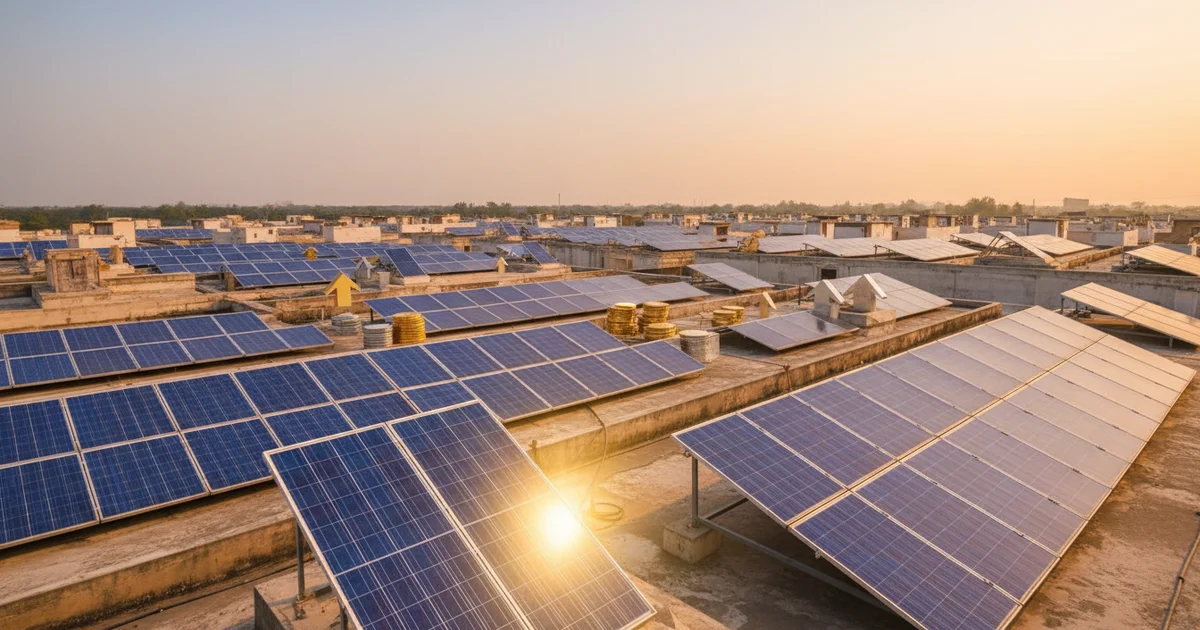
India’s residential electricity demand is climbing fast, but grid infrastructure hasn’t kept pace. Power cuts remain a daily reality across large parts of urban and semi-urban India — not an occasional inconvenience, but a persistent reliability problem that pushes households to seek alternatives. For millions of Indian families, rooftop solar isn’t a lifestyle choice or a climate statement. It’s a practical fix to an unreliable grid.
The Indian government accelerated this shift dramatically. The PM Surya Ghar scheme — launched in 2024 with an allocation of over ₹75,000 crore — offers households direct subsidies to install rooftop solar systems, slashing the upfront cost barrier that historically gutted solar startups before they could scale. Customer acquisition, the expensive and slow part of residential solar, gets meaningfully cheaper when the government is effectively co-marketing the product through a national scheme with 10 million household installations as its stated target.
Then there’s the structural opportunity that Western solar markets simply don’t have: housing societies. These are the dense, gated apartment complexes where hundreds of millions of urban Indians live — buildings with shared rooftops, common electricity infrastructure, and residents who make collective purchasing decisions. A single housing society installation can serve dozens or hundreds of households at once, compressing sales cycles and installation costs into a unit economics model that individual-home solar markets in the US or Europe cannot replicate. SolarSquare has built its business specifically around this format, targeting both standalone homes and these high-density complexes.
The combination — surging demand, unreliable supply, government subsidy reducing friction, and a uniquely dense installation opportunity — explains why investor conviction has more than doubled SolarSquare’s valuation in roughly 18 months. The funding headline is a symptom. This is the cause.
What SolarSquare Actually Does Differently From a Standard Solar Installer
SolarSquare serves two distinct customer types simultaneously: individual homeowners and housing societies that want building-wide solar deployments. That dual-channel structure matters because a single sales conversation with a residential apartment complex can generate the revenue equivalent of dozens of standalone household installs. Most competitors in India’s fragmented solar installation market chase one segment or the other. SolarSquare treats both as core business.
The more important distinction is what happens after the panels go up. SolarSquare wraps its installations inside a technology platform that handles solar financing, real-time system monitoring, and ongoing maintenance. That bundle converts what would otherwise be a one-time hardware transaction into a recurring service relationship — the company stays financially and operationally connected to each customer for years after installation day. Financing integration is especially significant in the Indian residential market, where upfront capital costs remain the primary barrier to adoption. By embedding loan origination into the sales process, SolarSquare removes the friction that typically kills deals before they close.
This is where the near-unicorn valuation starts making sense. B Capital and Lightspeed Venture Partners aren’t pricing SolarSquare as a regional installer with decent volume. They’re pricing it as a fintech-enabled energy-as-a-service platform that happens to use solar hardware as its distribution mechanism. The difference is enormous. An installer gets valued on installation margins, which are thin and commoditized. An energy services platform with recurring revenue, embedded financing, and proprietary monitoring infrastructure gets valued on customer lifetime value and platform stickiness — multiples that justify a $450 million to $500 million valuation on the trajectory toward a $60 million Series C.
The mainstream coverage keeps calling SolarSquare a solar installer. That label undersells the actual business architecture by a significant margin. The hardware sits on rooftops. The real asset is the long-term customer relationship that the technology layer locks in place.
The VC Signal: What B Capital and Lightspeed Co-Leading This Round Actually Tells Us
When two firms like B Capital and Lightspeed co-lead the same round, it warrants attention. These are not natural partners — they compete for deals, compete for ownership, and compete for board influence. Their decision to share the cap table here reflects something stronger than standard investment logic: a shared, high-conviction thesis that India’s residential solar market is producing one of the most defensible climate-tech businesses in any emerging market right now.
For Lightspeed, this is a doubling down. The firm already led SolarSquare’s $40 million Series B, and returning to co-lead a round that could push the valuation to $450–500 million is a direct signal that its earlier thesis — India-specific climate infrastructure with real unit economics — is playing out. Lightspeed doesn’t re-up at this scale out of loyalty. It does so when the numbers justify it.
B Capital brings a different lens. The firm, backed by Boston Consulting Group, has built its reputation around tech-enabled services in emerging markets that produce measurable impact outcomes. SolarSquare fits that template precisely: it’s a technology layer sitting on top of a physical infrastructure rollout, with trackable metrics around installations, carbon offset, and household energy savings. For B Capital’s LPs, that’s not just a financial return story — it’s a reportable one.
The co-lead structure also functions as a credibility signal to everyone who comes next. Follow-on investors, strategic acquirers, and potential IPO underwriters can reasonably infer that two of the more rigorous diligence operations in global venture have independently validated the business model, the management team, and the market size. That reduces perceived risk at every subsequent stage of the capital stack.
The $55–60 million round, combined with a valuation that has more than doubled in roughly 18 months, tells the rest of the market something simple: the smart money has already moved.
The Broader Market Shift: India Rooftop Solar as the New Fintech Frontier for Climate VC
SolarSquare’s fundraising trajectory reads like a playbook ripped from Indian fintech’s early 2010s boom. Lightspeed Venture Partners led the company’s $40 million Series B, then returned to co-lead the Series C alongside B Capital — a back-to-back commitment from a top-tier firm that signals category conviction, not just company conviction. When a fund doubles down at a valuation between $450 million and $500 million, representing more than a 2x jump in roughly 18 months, it is pricing in a market that has barely started, not one approaching saturation.
The addressable market justifies that logic. India has hundreds of millions of households with rooftops or balconies physically capable of hosting solar panels. Commercial providers have reached a fraction of them. The gap between installed capacity and theoretical capacity is not a rounding error — it is the entire opportunity.
What most climate-tech coverage gets wrong about this sector is the motivation driving adoption. Indian households are not installing rooftop solar as an environmental statement. They are doing it because electricity bills are rising and solar now offers a credible payback period. The financial calculus, not the carbon calculus, is closing deals. That reframe matters enormously for how investors should think about demand durability. Consumer behavior anchored in cost savings is stickier than behavior anchored in idealism.
This is the same dynamic that made Indian fintech explosive: a massive underserved population, a real pain point measured in rupees, and a technology layer that suddenly made the unit economics work. Fintech took roughly a decade to move from early-stage experiments to dominant platforms with billion-dollar valuations. Rooftop solar in India is showing the same early pattern — fragmented supply, surging demand, and venture capital beginning to concentrate bets on the companies building distribution infrastructure at scale. SolarSquare’s near-unicorn status is not an outlier. It is the first clear data point in what is shaping up as a multi-year repricing of climate-tech risk in emerging markets.
What To Watch Next: Risks, Rivals, and the Road to Unicorn Status
The Series C is in advanced talks — not closed. B Capital and Lightspeed Venture Partners are set to co-lead, but deal terms, regulatory filings, or a shift in VC sentiment could still alter the outcome. Treat the $450 million to $500 million valuation range as indicative until a formal close is announced.
Assuming the round does close at the upper end — $60 million at a $500 million valuation — SolarSquare clears the unicorn threshold and becomes the defining benchmark for Indian residential solar investment. That number will put pressure on competitors to accelerate their own fundraising timelines. Watch for rival announcements in the six months that follow a confirmed close.
The harder test is operational. SolarSquare competes on two fronts simultaneously. Well-funded startups are chasing the same urban homeowner and housing society customer base. Informal local installers undercut on price at the bottom of the market, where brand recognition and post-installation service matter less to buyers than upfront cost. SolarSquare’s ability to defend its margins while expanding its installation footprint — without sacrificing the service quality that justifies its premium positioning — is the central question the Series C money needs to answer.
The broader Indian rooftop solar market is moving fast regardless of this single deal. Government subsidy programs are pulling new customers into the funnel. Electricity prices are rising. Hardware costs are falling. Those tailwinds benefit every player in the ecosystem, which means SolarSquare’s competitive advantage narrows unless it builds durable advantages in financing options, installation speed, and long-term monitoring that informal operators cannot replicate. Lightspeed’s continued conviction — the firm led the Series B and is back for Series C — signals confidence that SolarSquare has those advantages. Whether the execution matches that confidence is the story to track through 2025 and into 2026.