Why this comparison matters right now
Robot vacuums now sit in millions of ordinary households, not just early-adopter living rooms. Flagship models from both Roborock and Ecovacs regularly drop to the $500–$800 range during sales, and entry-level versions with genuine mapping capability start below $300. At those prices, picking the wrong brand isn’t a minor inconvenience — it’s a multi-year commitment to an ecosystem of replacement parts, app updates, and customer support.
The timing makes comparison harder, not easier. Both brands now ship LiDAR-guided navigation, self-emptying bases, and combined vacuum-mop systems as standard features across most of their mid-to-high-tier lines. A spec sheet comparison between a Roborock S8 and an Ecovacs Deebot X2 produces near-identical columns of checkmarks. Suction numbers, dustbin capacity, mop water tank volume — the figures overlap so closely that choosing based on them is essentially arbitrary.
What those numbers hide is a genuine philosophical split between the two companies. Roborock builds around navigation precision and cleaning consistency, optimizing for homes where reliability and repeatable performance matter most. Ecovacs bets heavily on hardware ambition — the Deebot line has introduced retractable mop arms, dual rotating scrubber pads, and AI-powered obstacle cameras faster than almost any competitor. Those are real differences with real consequences for real households, but they only show up after weeks of daily use across different floor types, furniture layouts, and edge cases like pet hair or fine dust.
Most reviews don’t run robots long enough to expose those trade-offs. A week of testing captures first impressions. Extended hands-on use — across dozens of units, in varied home environments — reveals which brand’s bets pay off and which create frustration that no firmware update fixes.
How the testing methodology separates hype from reality
Testing dozens of robot vacuums from Roborock and Ecovacs across real homes produces a fundamentally different picture than unboxing a single unit and running it twice across a clean hardwood floor. Longitudinal testing — tracking the same models over weeks and months — exposes firmware bugs, brush-roll degradation, suction loss, and app instability that never surface in a 48-hour first impression.
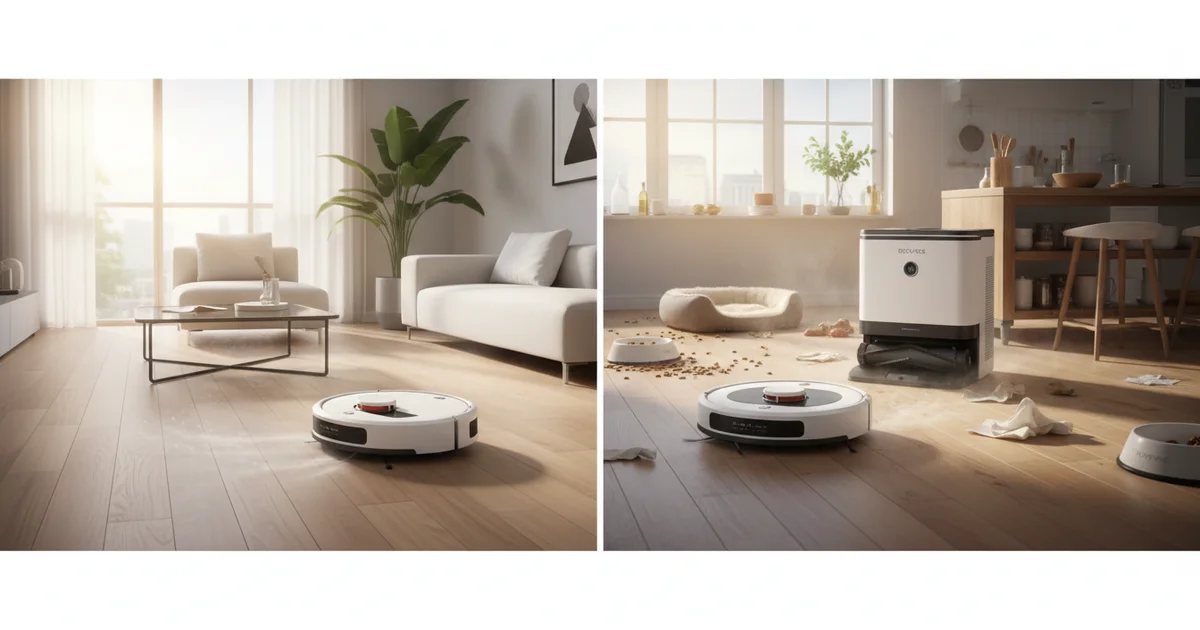
The test conditions matter as much as the duration. Units run through rooms with active pet hair shedding, transitions between hardwood, tile, and thick-pile carpet, and floor plans cluttered with chair legs, charging cables, and low-profile furniture. Multi-story homes present a separate challenge, forcing an evaluation of how well a robot reorients itself, reloads maps, and resumes cleaning after being carried between floors. These scenarios mirror what actual households deal with daily, not the open, obstacle-free rectangles that favor clean spec-sheet numbers.
Out-of-box performance is only the starting point. A robot vacuum that navigates perfectly on day one but starts missing sections of a room by week three — because a software update quietly changed its path-planning behavior — fails the household that depends on it. Evaluating software consistency means running scheduled cleans repeatedly and documenting whether the robot completes its assigned zones reliably, whether the app retains map data after updates, and whether customer-facing features like no-go zones and room-specific suction settings hold their configurations.
This kind of testing also reveals brand-level patterns rather than isolated product quirks. When multiple Ecovacs models share the same navigation stack, a recurring obstacle-detection weakness shows up across the lineup, not just one SKU. The same applies to Roborock’s mopping logic or dock reliability. Aggregating data across dozens of units from both brands turns individual anomalies into documented trends — which is exactly the information a buyer needs before committing several hundred dollars to a device expected to run autonomously, every day, for years.
Where Roborock pulls ahead
Roborock’s clearest advantage shows up before you even look at the flagship models. Mid-range units like the Q5 Pro and S7 Max Ultra hold navigation accuracy that competing brands typically reserve for their top-tier hardware. In back-to-back runs across cluttered living rooms and narrow hallways, Roborock robots consistently return more complete coverage maps with fewer stuck incidents — not because of superior sensors alone, but because the underlying path-planning software handles edge cases more reliably.
The app reinforces that dependability in daily use. Roborock’s interface lets you draw, resize, and reassign cleaning zones in seconds, with changes that actually register on the next run rather than requiring a full remap. Ecovacs users frequently report zone edits failing to save or reverting after firmware updates. With Roborock, the map stays where you put it.
Mopping is where the real-world separation becomes impossible to ignore for anyone with a mixed hard floor and carpet layout. Roborock’s no-mop zone detection — using the robot’s carpet recognition to automatically lift or halt the mop pad before crossing onto rugs — performs with tight precision. Competing brands either lack this feature at comparable price points or implement it loosely enough that damp edges still reach carpet fibers. In a home with hardwood in the kitchen and area rugs throughout the living room, this distinction matters every single day.
The S8 MaxV Ultra pairs a 6,000 Pa suction motor with a dual rubber brush system and a mop that scrubs at 4,000 RPM, but those specs only translate to usable performance because the software directing them is consistent. Roborock doesn’t force you to compensate for navigation errors by running the robot twice or resetting the map weekly. That reduction in friction — fewer interventions, fewer workarounds — is what hands-on testing surfaces that a spec sheet never will.
Where Ecovacs holds its own — and where it stumbles
Ecovacs builds genuinely impressive hardware. The flagship DEEBOT X2 Omni packs 8,000Pa of suction and uses a square-body design that cleans corners more thoroughly than the round robots most competitors ship. The DEEBOT T20 Omni introduced an articulating mop arm that physically lifts the mopping pad when the robot transitions from hard floors to carpet — a mechanical solution Ecovacs deployed before Roborock made it standard across its lineup. On paper and in direct cleaning tests, these machines match or beat Roborock equivalents at the same price tier.
The gap opens up in software. Ecovacs runs its robots through the ECOVACS HOME app, and the experience has been noticeably less polished than Roborock’s equivalent. Firmware updates have periodically broken features that previously worked — mapping errors, connectivity drops, and mop-lifting failures appearing after scheduled updates rather than before them. That pattern is particularly damaging because owners of premium robots expect software to improve over time, not introduce new failure modes.
Customer support compounds the problem. Across real-user feedback on Reddit, Amazon, and dedicated review platforms, Ecovacs support response times and resolution quality rank consistently below Roborock’s. Owners dealing with post-update bugs frequently report difficulty getting timely fixes, and some describe hardware problems persisting through multiple support contacts without resolution. For a robot that costs $900 to $1,500, that after-sale experience matters as much as first-month performance.
The honest picture is this: Ecovacs earns its place in the premium segment on hardware merit alone. A buyer who prioritizes mechanical innovation and strong suction power will find real value in the flagship DEEBOT lineup. But anyone who wants a robot that stays reliable across months of firmware cycles, and who expects responsive support when something breaks, faces more risk with Ecovacs than with its closest competitor. The hardware ceiling is high; the software floor is lower than it should be at this price.
The hidden cost framework most buyers ignore
The sticker price of a robot vacuum tells you almost nothing about what you’ll actually spend. Replacement brushes, HEPA filters, mop pads, and auto-empty bags accumulate into a real annual bill that varies dramatically by brand. Roborock’s auto-empty bags run roughly $15 for a three-pack, while some Ecovacs AIRBOT stations use proprietary bags that cost more per unit and are harder to source from third-party sellers. Across a full year of regular use, consumable costs can easily reach $150 to $300 depending on the model and how aggressively the manufacturer locks down compatible parts.
Software support is the factor buyers consistently underestimate. A robot vacuum with degraded app support becomes a dumb appliance that still occupies floor space. Roborock has a stronger track record of pushing meaningful firmware updates to models two or three years old, while Ecovacs faced significant user backlash after security vulnerabilities in older devices went unpatched for extended periods. When the app stops improving, features like room-specific scheduling, obstacle recognition tuning, and smart home integrations freeze in place — even as the hardware keeps running.
Ecosystem lock-in compounds the problem. Roborock integrates cleanly with Google Home, Amazon Alexa, and Apple Home, but its most advanced features — persistent maps, zone cleaning, do-not-disturb schedules — live inside the Roborock app. Switch brands mid-cycle and you lose saved maps, cleaning histories, and any routines built around that app. Ecovacs operates the same way through its Home app. Both brands are building walled gardens, and the deeper you go, the more expensive it becomes to leave.
Resale value follows brand perception. Roborock models hold value better on secondary markets, partly because buyers trust ongoing software support will follow the device to a new owner. A two-year-old Roborock S8 commands stronger resale prices than comparable Ecovacs units from the same period. For buyers who upgrade on a two- to three-year cycle, that delta matters. The total cost of ownership calculation — purchase price, consumables, software lifespan, resale recovery — shifts the competitive picture significantly away from what any spec sheet comparison would suggest.
The verdict and who should buy which brand
After testing dozens of models from both brands across real homes, a clear pattern holds: Roborock earns the recommendation for most households. Its software updates arrive consistently, app-based controls behave predictably, and navigation errors are rare enough that the average user will rarely need to troubleshoot. Models like the Roborock S8 Pro Ultra deliver reliable suction, competent mopping, and a self-emptying base that genuinely works without babysitting. For households with a mix of carpet and hard floors, pets, or simply low tolerance for tech friction, Roborock is the safer long-term investment.
Ecovacs earns its place for a specific buyer. The DEEBOT X2 Omni, for example, pushes mop-pad scrubbing pressure and auto-lift mechanisms further than anything in Roborock’s current lineup. On predominantly hard floors — tile, hardwood, stone — the cleaning results are visibly better. That hardware ambition comes with a trade-off: the Ecovacs app generates more error notifications, firmware updates occasionally introduce new bugs, and customer support escalations are more common among owners. Buyers who prioritise mopping above all else and are comfortable troubleshooting software should consider Ecovacs seriously. Everyone else should not assume the hardware wins translate to a better daily experience.
Floor type and pet ownership are the two variables that actually determine the right call. Heavy carpet and significant pet hair favour Roborock’s consistent suction power and dependable brush-roll design. Mostly hard floors with moderate mess favour Ecovacs, where the mopping edge is real and measurable. Homes with both surface types, especially with pets, tip back toward Roborock because reliability compounds over time — a robot that works without intervention every day outperforms a technically superior one that needs weekly resets.
Neither brand dominates unconditionally. The coverage that declares one a universal winner is skipping the context that actually matters. Match the brand to the floor, the household, and the owner’s patience for app-based problem-solving, and the right answer becomes straightforward.