The Dirty Secret of ‘Smart’ Outdoor Devices: They’re Not That Smart to Set Up
Most stand-alone smart sprinklers that attach to a garden hose demand two connections to function: one for water, one for power. That second connection — a long electrical cable snaking across the yard to reach the device — is where the “smart” promise collapses for most homeowners. Outdoor electrical outlets in garden zones are rare. The average suburban lawn simply doesn’t have one positioned anywhere near where a sprinkler needs to sit, and running an extension cord across open grass creates an immediate hazard for anyone operating a lawn mower.
This is not a minor inconvenience reviewers have occasionally flagged. It is a structural barrier that has quietly suppressed outdoor smart home adoption for years. Indoor smart devices — thermostats, plugs, lights — succeed partly because electrical access is everywhere inside a home. Move the same category of device outside, into the garden, and that assumption evaporates. The industry responded by largely ignoring the problem, shipping products that required consumers to solve the power puzzle themselves and then wondering why uptake lagged indoor equivalents.
The practical reality is that a homeowner who wants to use a conventional smart sprinkler must either have an outdoor outlet already installed near the garden, run a cable across the yard and accept the mowing hazard, or hire an electrician to add outdoor electrical access. None of those options are what someone buying a hose-attachment gadget expects to deal with. The setup complexity doubles — water connection plus power connection — and so does the failure surface. A cable chewed by a mower blade doesn’t just disable the sprinkler; it creates a safety risk.
The Oto Smart Sprinkler eliminates the second connection entirely by running on solar power. That single design decision removes the outdoor outlet requirement, the trailing cable, and the mower hazard in one move. The installation drops back to what consumers actually anticipated: attach it to the hose and configure it through an app. The innovation isn’t flashy, but it addresses the specific friction point that has kept this product category niche when it should have gone mainstream years ago.
What Oto Actually Built: Solar as a Design Philosophy, Not a Gimmick
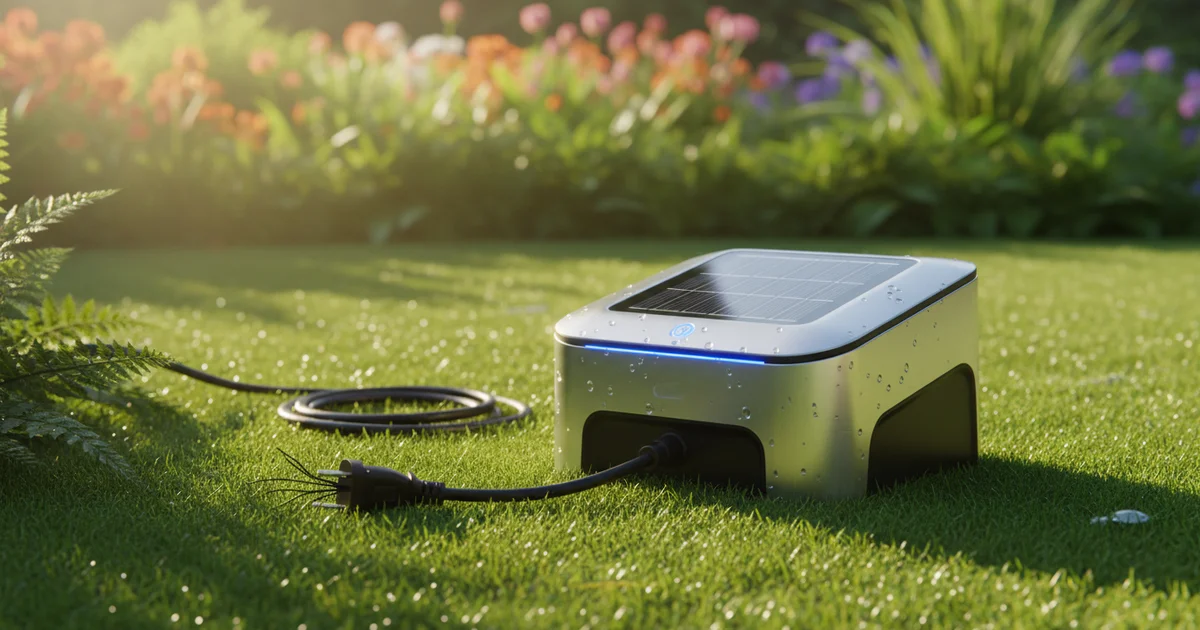
Most smart sprinklers that attach to a garden hose carry a hidden requirement: a power cable. That cable needs to reach an outlet, and outlets don’t grow in the middle of lawns. The result is a tangled compromise — homeowners running long extension cords across yards, creating exactly the kind of obstacle a lawn mower will eventually find. The Oto Smart Sprinkler cuts that cable entirely by building solar charging directly into the device.
This isn’t solar as a sustainability talking point stamped on packaging. Oto used solar to solve a concrete installation problem. The device connects to a garden hose and charges itself, which means the only physical constraint governing where you place it is hose reach and sunlight exposure. Outlet proximity drops out of the equation completely.
That shift in placement logic matters more than it sounds. When a device is tethered to a power outlet, the outlet chooses the location. The user works around infrastructure. Remove the cable, and the user makes the placement decision based on what the device actually needs to do — in this case, water a specific patch of lawn. The physical footprint of the product changes because the design constraints change.
Oto also leaned into setup simplicity as a primary feature rather than a secondary selling point. The solar-first architecture removes one entire category of installation friction: no cable routing, no outlet hunting, no second connection point that can fail or get damaged. A lawn mower chewing through a power cable is no longer a scenario the user has to plan around.
The product demonstrates that solar integration at the device level can function as a genuine usability decision — one that reshapes where hardware can live and how much effort it takes to get it running. Oto didn’t add solar to reduce carbon footprint optics. They added it because a sprinkler with no power cable is a fundamentally easier product to own.
The Missing Context: Solar Power in Consumer Gadgets Is Finally Good Enough
Solar-powered consumer electronics spent most of the last decade overpromising. Small photovoltaic panels couldn’t harvest enough energy to power devices that needed to do real work on a schedule, and the lithium cells paired with them degraded fast enough that reliability became a genuine problem within a single season. A solar garden light that flickered on at dusk was one thing. A sprinkler controller that had to open a valve, run a wireless radio, and execute a timed sequence at 6 a.m. regardless of whether Tuesday was cloudy — that was a different ask entirely, and solar couldn’t meet it.
That changed through a quiet convergence of two supply-chain shifts. Monocrystalline panel efficiency at the small-form-factor scale crossed 22–23% commercially in recent years, up from figures closer to 15% that defined budget consumer hardware for most of the 2010s. Simultaneously, the wireless chips used in smart home protocols dropped their active-draw power requirements dramatically — modern low-power Bluetooth and Zigbee silicon now operates at milliwatt levels during standby, which transforms the math on how much panel area and battery capacity a device actually needs to stay operational through a stretch of overcast days.
The Oto Smart Sprinkler exists because those two curves finally intersected at a price point and physical size compatible with a consumer outdoor product. This is not a novelty feature. The solar-first architecture is only functional because the underlying components matured enough to support it.
Most reviews treat the absence of a power cable as a convenience win — one less thing to run across the lawn, one fewer trip hazard in front of a mower. That framing undersells what actually happened. The Oto sprinkler is evidence that the component threshold for solar-primary outdoor smart devices has been crossed in a durable way. Designers working on outdoor cameras, soil sensors, and pathway automation hardware are drawing on the same supply chain. The Oto just got there first in the sprinkler category and made the underlying shift visible to anyone paying attention.
Ease of Use: Where Smart Sprinklers Usually Fall Apart
Smart sprinklers have a usability problem that predates any solar debate. Rachio, Orbit B-hyve, and Rain Bird’s smart controllers all arrived with app interfaces that assumed users wanted granular zone scheduling, soil type inputs, and ET-based watering calculations. Many do not. The typical homeowner who buys a hose-end smart sprinkler wants it to run on Tuesday mornings and stop when it rains. The gap between what these products offer and what most buyers need has kept the category stuck in enthusiast territory for years.
Oto targets a different customer. Its emphasis on quick setup and streamlined function signals a deliberate push toward mainstream homeowners — people who will not read a manual and will abandon a product within a week if the app frustrates them. Eliminating the power cable removes the first barrier. A simpler interface is meant to remove the second. That pairing suggests Oto is less interested in competing with Rachio on feature depth and more interested in competing with doing nothing — converting the homeowner who currently drags a hose around manually.
The harder test is what happens after installation day. Unboxing experiences are easy to engineer. Sustained reliability is not. A smart sprinkler that misses a scheduled watering cycle, fails to skip after rainfall, or loses its Wi-Fi connection quietly and waters anyway has failed its user even if setup took three minutes. Weather responsiveness depends on API uptime, accurate location data, and firmware that handles edge cases — cloudy days that don’t trigger rain sensors, battery dips from overcast weeks in a solar-powered device, app updates that break scheduling logic. These are the failure modes that generate one-star reviews six months after purchase, long after the “simple setup” marketing claim has been tested.
Simplicity is a promise made on day one. Reliability is what determines whether that promise holds.
What Oto Gets Right — and What Coverage Is Getting Wrong About It
Most reviews of the Oto Smart Sprinkler treat it as a lawn care upgrade — a cleaner way to water your grass without hiring someone to do it. That framing undersells what Oto actually built. The device is better understood as a proof-of-concept for a class of outdoor smart devices that never needed the power outlet to begin with.
The coverage keeps returning to convenience, and convenience is real. Existing stand-alone smart sprinklers require both a hose connection and a power cable run to the device — two lines crossing open lawn, both exposed to foot traffic, mower blades, and weather. Oto eliminates the power cable entirely by running on solar. But the significance of that cable’s absence goes beyond setup ease.
A power cable strung across a yard is a failure point and a damage vector. It can be severed by a mower, chewed through by animals, tripped over, or deliberately cut. In outdoor environments, fewer physical connections mean fewer ways the system breaks or gets compromised. Removing the cable is a durability decision and, in installations where tamper resistance matters, a security decision. Reviews are not framing it that way.
The larger question Oto raises is what happens if its solar approach holds up across full seasonal cycles — including low-sun winters in northern climates and extended overcast periods. If it does, the device hands other outdoor smart hardware makers a template they will be under pressure to replicate. Security cameras mounted on fence posts, soil moisture sensors embedded in garden beds, pathway lighting — all of these categories currently depend on either wired power or battery swaps. A proven solar-native design removes both constraints.
Oto is not the finish line. It is the demonstration unit. The lawn care framing is the wrong frame.
Who Should Actually Buy This — and What to Watch For
The Oto Smart Sprinkler is built for a specific type of homeowner: someone with a sun-exposed garden, a standard hose bib, and a history of abandoning smart sprinkler setups because running a power cable across the lawn felt like more trouble than it was worth. That demographic is larger than the current smart garden market suggests. Most competing hose-end sprinkler timers have kept their customer base narrow precisely because the dual-cable problem — water line plus power line — stopped casual buyers before installation even began. Oto removes that friction entirely.
Buyers in consistently cloudy regions or heavily shaded yards need to pause before purchasing. Solar-dependent devices are only as reliable as their panel exposure, and a unit installed under a dense tree canopy or in a Pacific Northwest garden that sees weeks of overcast skies will not perform the same as one mounted in a Phoenix backyard. Oto does not publish detailed battery backup specifications in its consumer-facing materials, so buyers in marginal solar environments should press the company directly on how the device behaves through extended low-light periods before committing.
The hardware case for Oto is clear. The software case is still being written. Smart home products fail on a predictable schedule: strong launch hardware, inconsistent app updates, degraded third-party integrations, and eventually orphaned devices. Oto needs to demonstrate that its app development, smart home platform support, and customer service infrastructure will match the ambition of its solar design. Buyers purchasing in 2026 should check whether Oto has delivered meaningful software updates since launch, whether its integrations with platforms like Apple Home or Google Home remain stable, and whether its support channels respond within a reasonable window. A sprinkler that waters your lawn reliably but loses app functionality in year two is not a smart home device — it is a timer with a dead screen.