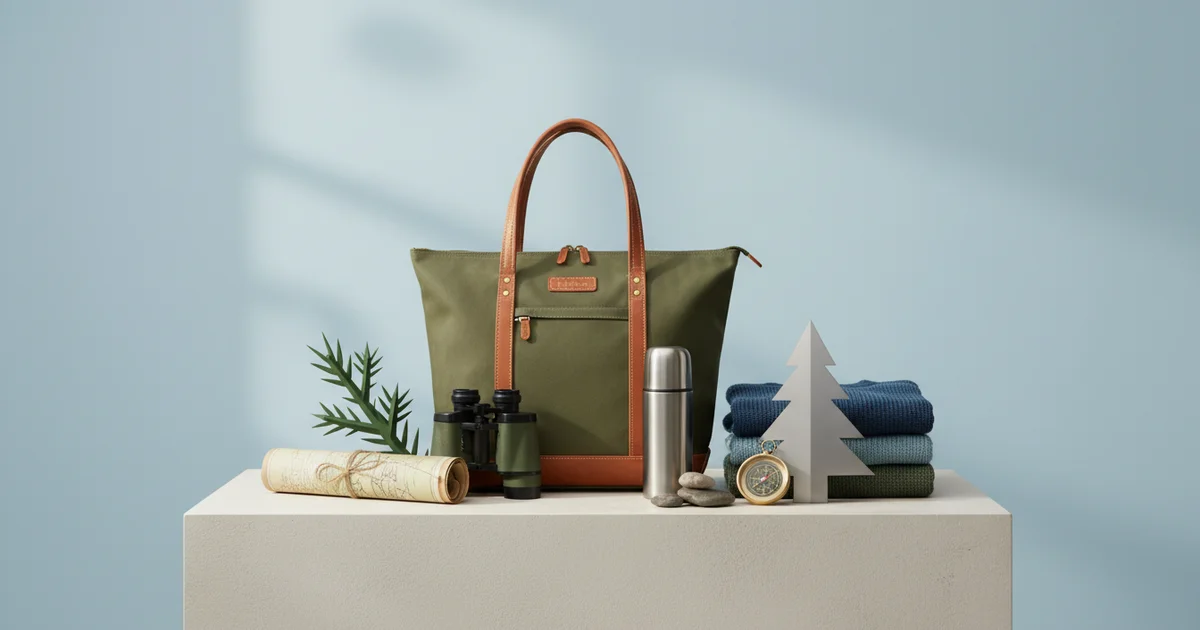
The Bag That Refuses to Be Just One Thing
Michael Calore, a reviewer at WIRED, loads the L.L.Bean Zip Hunter’s Tote onto his electric cargo bike every Sunday morning and rides it just over a mile to Rainbow Grocery, a San Francisco food co-op that has operated since 1975. He fills it with a full week of groceries for two people. That routine — repeated weekly, year after year — is the kind of unglamorous stress test that exposes what a bag actually is versus what its marketing claims it to be.
The Hunter’s Tote was designed for hunters carrying game. It now hauls organic produce through a Bay Area city neighborhood. That migration across contexts is not a quirk of one reviewer’s habits; it is the bag’s core competency. A reinforced bottom and water-resistant lining make it equally functional at baggage claim, where checked luggage routinely destroys lesser bags, and at a food co-op, where wet produce and bulk containers demand the same structural reliability.
This is precisely where purpose-built “smart” bags fail. A bag engineered around a specific use case — a dedicated camera bag, a tech commuter pack with a built-in cable management system, a structured weekender with a designated shoe compartment — locks the user into the context the designer imagined. Add one unexpected task and the architecture fights back. The Hunter’s Tote has no such architecture to fight. Its single main compartment and zipper closure impose almost no organizational logic, which means they impose almost no limitations either.
Most gear coverage sorts bags into categories: travel, EDC, gym, grocery. The Hunter’s Tote refuses that sorting. Calore’s use case sits at the intersection of urban commuting, weekly provisioning, and outdoor-heritage durability — a combination no dedicated product category addresses. The bag performs across all three not because L.L.Bean anticipated those intersections, but because the design is stripped down enough that nothing gets in the way. A canvas exterior, a reinforced base, a zipper. The absence of features is the feature.
Built for the Woods, Proven in the Real World
L.L.Bean built its reputation outfitting hunters and woodsmen in the Maine wilderness — people who needed gear to survive rain, mud, and cold, not just look good on an Instagram flat lay. The canvas tote that WIRED reviewer Michael Calore hauls to a San Francisco food co-op every Sunday morning carries that same DNA. Its reinforced bottom and water-resistant lining were not afterthoughts added for marketing copy. They were engineering decisions made for environments where failure means wet gear, ruined supplies, or a bag that splits under forty pounds of load.
That original over-engineering is precisely why the bag handles modern punishment so well. Calore straps it to an electric cargo bike, loads it with a full week of groceries for two people, and repeats the process every week without incident. That is a sustained stress test most purpose-built “smart” bags — with their laser-cut foam panels and Fidlock buckles — never face consistently over months and years. Baggage carousels, bike racks, and concrete floors are brutal in a slow, grinding way. A bag engineered for the woods handles that brutality without noticing it.
Legacy outdoor brands carry a construction heritage that lifestyle bag startups cannot buy. L.L.Bean has sourced, tested, and refined heavy canvas and water-resistant materials for over a century. The institutional knowledge embedded in their supply chain and quality standards took decades to build. A direct-to-consumer bag brand founded five years ago and selling at a comparable price point is not operating from that same foundation, regardless of how sophisticated its Kickstarter campaign looked.
The result is a bag that does not ask you to adapt to it. No charging ports to keep topped up, no app to configure, no organizational system that only works if you pack in a specific sequence. The L.L.Bean tote holds what you put in it, sheds water, and takes the abuse. That is a feature set built in the woods and validated, daily, in the real world.
What ‘Smart Bags’ Keep Getting Wrong
The tech bag industry spent the last decade solving problems most people don’t have. USB pass-through ports require a battery bank to function and the cables fray within a year. RFID-blocking panels add $20 to $40 to the retail price and protect against a theft vector that security researchers have called largely theoretical in real-world conditions. Magnetic closures interfere with hotel key cards. Dedicated “cable management” systems turn a simple retrieval into a puzzle. Each feature adds a failure point, and failure points compound over time.
What makes this pattern worth examining is who keeps rejecting these bags. WIRED’s gear-focused reviews team — writers who test equipment professionally and spend their own money on carry solutions — keeps returning to a different category entirely. Michael Calore, a reviewer at WIRED, uses an L.L.Bean zip-up tote as his primary bag for weekly grocery runs, travel, and daily carry. His reasoning isn’t sentimental. The bag has a reinforced bottom, a water-resistant lining, and a zip closure. It does those things reliably, every time, without firmware updates or proprietary components.
The Zip Hunter’s Tote operates on the same logic. No embedded electronics. No hidden compartments marketed as security features. No organizational system that presupposes how you pack. The result is a bag that tech-forward users — people who have owned the Nomatic, the Tortuga, the Peak Design — consistently keep coming back to after the novelty of feature-dense alternatives wears off.
Gear coverage rarely rewards this kind of staying power. Review cycles favor launch windows. A bag with a new magnetic locking system generates more copy than a bag that simply holds up after three years of daily use. Durability and long-term versatility don’t photograph well and don’t fit a news hook. That editorial bias has quietly distorted consumer expectations, training buyers to treat complexity as quality. The Zip Hunter’s Tote is a direct counter-argument to that assumption — and the people who use it longest tend to be the ones who learned that lesson the hard way.
The Zip-Top Detail That Changes Everything
The standard L.L.Bean Boat and Tote is an open-top bag. That’s a feature at the farmers market and a liability everywhere else. The zip-top version solves this with one addition: a full-length zipper that closes the bag completely, transforming its security profile from casual carryall to legitimate travel bag.
In crowded subway cars, airport terminals, and baggage carousels, an open tote is an invitation — to pickpockets, to spillage, to the slow creep of your belongings toward the floor. The zip closure eliminates all three problems at once. WIRED reviewer Michael Calore uses the zip-top version as his primary bag across both weekly grocery runs at San Francisco’s Rainbow Grocery co-op and checked baggage scenarios, a range of use cases that most purpose-built “smart” bags fail to cover simultaneously.
That baggage-claim survivability point deserves attention. When a bag goes into checked luggage or gets gate-checked on a regional flight, it gets stacked, compressed, dragged, and tossed. An open-top bag loses its contents. The zip-top Boat and Tote does not. The zipper keeps everything contained during rough handling — no lost items, no exploded contents on the carousel.
Most bag reviews treat this zip closure as a minor variant note, a bullet point buried under dimensions and color options. It isn’t. It’s the design decision that bridges two entirely different use cases. Without the zipper, the Boat and Tote is a sturdy market bag. With it, the bag functions as a travel carryall, a commuter bag, and a grocery hauler — often on the same day.
No smart bag with GPS tracking, hidden RFID pockets, or modular attachment systems has cracked this problem more efficiently. The zip-top Boat and Tote does it with a single piece of hardware.
The Quiet Comeback of American Heritage Gear
L.L.Bean has sold its canvas tote in some form since 1944. That’s eight decades of institutional memory baked into a bag that costs under $50 and has no Bluetooth pairing instructions. The company’s longstanding satisfaction guarantee — which allowed full returns for any reason until 2018, when it tightened to one year for most products — built a customer relationship that newer direct-to-consumer brands are spending millions in Facebook ad spend trying to replicate from scratch.
The more telling signal comes from who is now publicly endorsing this bag. WIRED’s Michael Calore, a gear-obsessed tech journalist who covers the kind of products that ship with companion apps and firmware updates, made an L.L.Bean zip-up tote his everyday carry. He hauls a week’s worth of groceries in it on an electric cargo bike every Sunday. When a technology publication’s review team — people paid to care about what’s new and optimized — starts writing lovingly about canvas and a reinforced bottom, that’s a cultural data point worth taking seriously.
This shift has direct implications for retailers and brand strategists. Heritage brands like L.L.Bean carry a form of pre-built credibility that no amount of influencer seeding replicates. A consumer who buys a “smart” bag from a two-year-old DTC brand is making a bet. A consumer who buys from L.L.Bean is cashing in on a century of resolved complaints and replaced zippers. The value proposition is fundamentally different, and the market is beginning to price that difference correctly again.
The broader trend is a recalibration away from feature density toward proven performance. Pockets with RFID blocking, hidden compartments, and modular attachment systems sound compelling in a product description. They feel less compelling after a buckle breaks in month four. The L.L.Bean tote offers none of those features and survives baggage claim. That trade-off is exactly what a growing segment of buyers — including the ones who read WIRED — are actively choosing.