The Portable Speaker Market Is Overcrowded — Here’s Why That Works in Your Favour
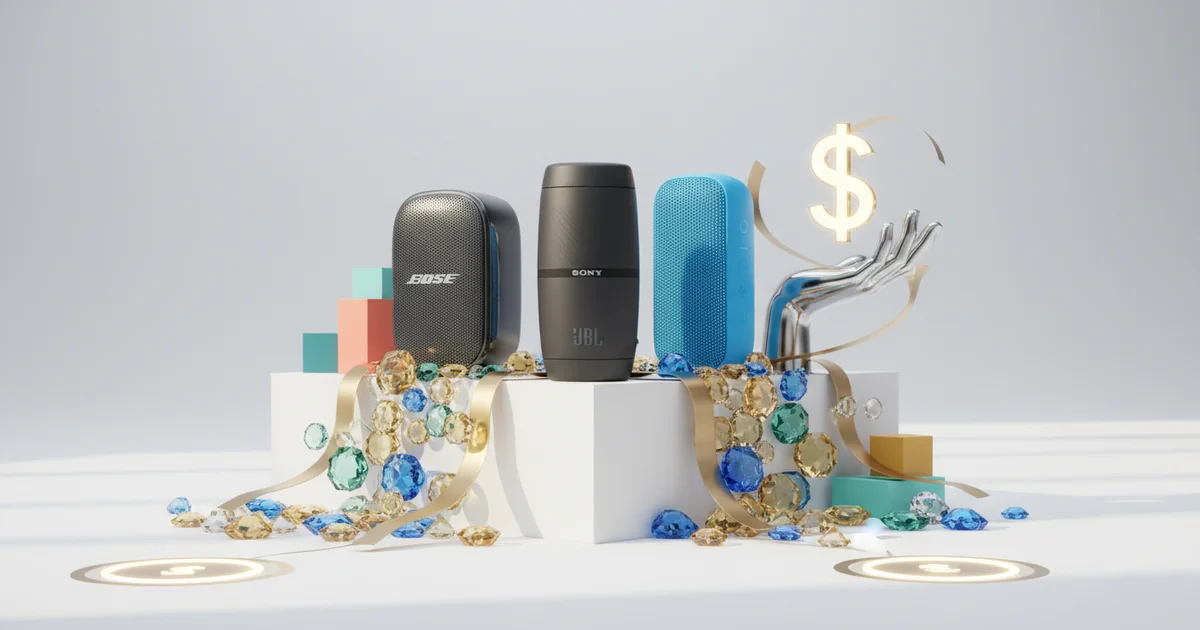
The portable speaker market has never been more crowded, and that pressure is forcing retailers to discount harder than ever to clear shelf space. Bose, Sony, and JBL are all fighting for the same customers, and emerging brands like Anker’s Soundcore line are undercutting them on price while closing the gap on audio quality. When four or five serious competitors are all chasing the same buyer, someone has to blink first — and that someone is usually the retailer sitting on last quarter’s inventory.
What makes this category different from, say, OLED TVs or noise-cancelling headphones is how slowly the core feature set actually changes. Bluetooth 5.0 connectivity, IP67 water resistance, and 12-hour battery life were the benchmarks two years ago — and they are still the benchmarks today. A Bose SoundLink Flex from a previous product cycle produces the same room-filling sound it did at launch, regardless of what the newest model costs. Sony’s XB-series speakers follow the same pattern. The hardware matures faster than the marketing does.
That gap between perceived value and actual performance is where smart buyers win. A speaker discounted 30 to 40 percent because a new model just dropped is not an inferior product — it is the same product with a better price tag. Retailers need the floor space and the cash flow, so the discounts are real, not manufactured urgency dressed up as a sale.
The brand premium is the other trap worth avoiding. JBL charges for the name as much as the driver. Soundcore and other challengers have proven, across multiple independent tests and consumer reviews, that spending $60 to $80 can get you 80 percent of the audio performance of a $150 JBL Charge. Knowing which brands have genuinely earned their premium — and which are coasting on logo recognition — is the single most useful thing a buyer can walk into a deal with.
What ‘Hands-On Testing’ Actually Reveals That Spec Sheets Don’t
Manufacturer battery life figures are marketing targets, not guarantees. JBL claims 12 hours for the Charge 5, but testers running it at 75–80% volume consistently log closer to 8 hours. Bose quotes 12 hours for the SoundLink Flex — real-world outdoor testing at moderate-to-high volumes typically yields 9 to 10. That gap matters when you’re eight hours into a camping trip and nowhere near a power source.
Water resistance ratings create a similar illusion of precision. IP67 certification means a device survived submersion to one meter for 30 minutes in a controlled lab test using still, clean water. That tells you almost nothing about whether the speaker survives a day at the beach, where it faces salt spray, sand ingress, repeated splashing, and UV exposure simultaneously. IP55-rated speakers get dismissed as inferior, but the practical difference between IP55 and IP67 performance in genuine outdoor conditions is far narrower than the certification gap implies. Neither rating accounts for port degradation after repeated exposure cycles.
Sound staging and bass response are where spec sheets fail completely. Two speakers priced at $150 can share identical frequency response specs on paper and sound nothing alike. Sony’s SRS-XB33 pushes exaggerated low-end that overwhelms midrange clarity at higher volumes. The Bose SoundLink Flex delivers a flatter, more balanced profile that projects more evenly across a room. Neither characteristic appears in any product listing — you only catch it by playing the same track through both units back to back, at the same volume level, in the same acoustic environment.
Hands-on testing also exposes how volume scaling behaves. Some speakers maintain tonal balance from 30% to 100% volume. Others introduce distortion and lose bass definition above 70%. That threshold is exactly where most people listen outdoors, which means a speaker that measures well in a quiet room can disappoint at a picnic. These are the details that separate a genuinely useful deal from a discounted product that underperforms in every condition that actually matters to buyers.
The Missing Context on Portable Speaker Deals: How to Spot a Genuine Discount
Retailers built the portable speaker market on a discount culture that distorts what buyers actually pay. A speaker listed at $199 MSRP and “marked down” to $139 may have sold at $139 for the past eight months straight. The 30% discount is real on paper and meaningless in practice.
Price history tools like CamelCamelCamel for Amazon listings expose this pattern clearly. Several JBL and Sony models spend the majority of their retail lives at prices that match or undercut their advertised “sale” figures. When a Bose SoundLink Flex drops to $119 during a promotional event, checking its 90-day price history often reveals it sat at $119 or $129 during weeks with no promotion attached at all.
The MSRP inflation problem runs deeper than individual sales events. Manufacturers set suggested retail prices knowing most buyers will encounter the product at a discount. This makes the gap between MSRP and street price a marketing tool rather than a reflection of actual value change.
Cross-referencing helps cut through this. Sites like ZDNET test speakers from Bose, Sony, JBL, and others directly, gathering data from vendor listings alongside independent review sources and real customer feedback. That combination — hands-on testing plus price tracking plus user experience — produces a more accurate picture of whether a given price represents genuine savings or a manufactured urgency play.
The practical rule: never evaluate a portable speaker deal against MSRP alone. Check the 30, 60, and 90-day price history on the specific retailer where you plan to buy. Compare that against competing retailers on the same date. A deal that holds up across that analysis is a real discount. A deal that evaporates under basic scrutiny is a sale in name only.
Brand Loyalty vs. Best Value: When Paying More for Bose or Sony Is Actually Worth It
Brand loyalty costs real money. A Bose SoundLink Max retails around $399, while a JBL Charge 5 delivers comparable loudness and bass response for roughly $180. For someone playing music at a backyard cookout or a beach trip, that $220 gap buys almost nothing in terms of audible difference.
Where Bose and Sony actually earn the premium is in the long tail of ownership. Bose pushes firmware updates to its speakers for years after release and maintains one of the more polished companion apps in the category — offering EQ customization, multipoint pairing management, and voice assistant integration that mid-tier competitors either skip entirely or handle poorly. Sony’s app ecosystem, particularly around its XB and SRS lines, similarly gives users granular control over sound profiles and device settings that JBL’s Connect app has historically lagged behind on.
Build consistency is the other factor that short-term reviews miss entirely. A reviewer spending two weeks with a speaker cannot tell you whether the rubber port cover cracks after 18 months of beach use or whether the charging port loosens after a year of daily plugging. Customer reviews at scale tell that story. Aggregate ratings across thousands of verified purchases on Amazon and Best Buy surface patterns — specific JBL models showing battery degradation complaints after 14 to 18 months, or Bose units maintaining near-original performance across three-plus years of heavy use — that no hands-on test can replicate.
The practical split comes down to use case. Casual listeners who want loud, clear audio for occasional outdoor use should buy mid-tier JBL without hesitation. Frequent travelers, daily commuters, or anyone who treats a speaker as a primary listening device will find the Bose or Sony premium justified — not because of the badge, but because the software support, app quality, and durability record are genuinely better over a three-to-five year ownership window. Pay more when you’ll actually use those advantages. Don’t pay more for a name.
What Real People Actually Use Portable Speakers For — And Which Features Actually Matter
Most people don’t buy a portable speaker to recreate a studio listening environment. They buy it to survive a beach afternoon, a camping trip, or a kitchen full of background noise. Buyer satisfaction surveys consistently rank outdoor durability and battery life above audio fidelity — meaning a speaker that sounds slightly less impressive but survives a rainstorm and runs for 16 hours beats a warmer-sounding unit that dies at hour eight and can’t handle a splash.
Water resistance ratings matter here. IP67 certification means a speaker can handle submersion up to one meter for 30 minutes. IP67 gives you confidence in rain, poolside use, and the occasional drop into a cooler. IP67 is a floor, not a luxury, when shopping in the $100-and-up range.
Multipoint Bluetooth connectivity is the feature most reviewers bury in spec sheets but real users wish they’d prioritized. It lets you pair two devices simultaneously — a phone and a laptop, for example — so switching audio sources doesn’t require disconnecting and reconnecting. For anyone who moves between a work call and a playlist without thinking about it, multipoint Bluetooth eliminates a genuinely irritating daily friction point. Bose and Sony both offer it across several current models. JBL includes it selectively. The absence of multipoint on a $150 speaker is a legitimate dealbreaker for regular desk or travel use.
Size and weight are where reviews consistently fail buyers. A speaker with exceptional audio specs that weighs 2.4 pounds gets left at home. Full stop. The speakers that get used are the ones that fit in a bag without demanding a dedicated pocket or adding noticeable load. Portable speaker reviews typically spend three paragraphs on frequency response and one sentence on the fact that a unit is the size of a water bottle. Buyers who actually carry their speakers report that compact form factor drives usage frequency more than any other single variable.
The practical checklist for a portable speaker worth buying: IP67 or higher water resistance, at least 12 hours of battery at moderate volume, multipoint Bluetooth, and a weight under 1.5 pounds for truly portable use. Everything else is secondary.
How to Make the Right Call: A Framework for Buying a Portable Speaker on Sale
Start with your use case, not the price tag. A commuter needs compact dimensions and strong call quality. An outdoor adventurer needs IP67 waterproofing and drop resistance. A home listener can prioritize sound staging over ruggedness. Buying a discounted speaker optimized for the wrong scenario wastes money regardless of how steep the markdown looks.
Once you know your use case, validate the deal itself. Cross-reference at least three independent review sources — outlets like ZDNET, Wirecutter, and RTings — against the retailer listing. ZDNET’s testing methodology, for example, involves hands-on comparison shopping across vendor listings and real customer feedback, not spec-sheet skimming. Retailers routinely inflate “original” prices to manufacture the appearance of a discount. If a speaker’s listed original price doesn’t appear in any review published before the sale, treat that number as fictional.
Use battery life per dollar as your primary sorting metric. Right now, the market sweet spot sits at 12 or more hours of playback for under $100. Several JBL and Anker Soundcore models hit this threshold at their regular prices — on sale, they represent genuine value. A speaker offering only 8 hours at $90 discounted from $130 is not a better deal than a speaker offering 15 hours at $79 with a stable price history.
Secondary checks matter too. Confirm Bluetooth version — 5.3 is the current standard for stable range and efficient pairing. Verify whether the IP rating covers submersion or only splash resistance; IP67 handles a meter of water for 30 minutes, while IPX5 only deflects jets of water. These distinctions disappear in marketing copy but surface immediately in the field.
The decision sequence is straightforward: define the use case, set the battery-life floor, check the price history, read three independent reviews, then confirm the technical specs match real-world claims. Any deal that survives that filter is worth taking.