The TV-Less Home Is More Common Than You Think
Plenty of millennials skipped the TV entirely — and not because they couldn’t afford one. The decision was deliberate. Urban apartments are small, aesthetic preferences lean minimal, and a 65-inch screen bolted to the living room wall signals a commitment to a lifestyle many younger homeowners actively reject. The television-as-centerpiece model, the one interior designers and consumer electronics brands have sold for decades, simply doesn’t match how a large and growing segment of people actually live.
The problem that follows is predictable and genuinely miserable: movie night becomes a laptop situation. Two adults hunched over a 15-inch screen on a couch, squinting at subtitles, arguing about the angle. It works the way a folding chair works — technically functional, quietly degrading. This is not a niche complaint. It’s the default viewing experience for a huge number of households that chose open living spaces over dedicated theater rooms and now have no good middle option.
That gap — between a wall-mounted TV that dominates a room permanently and a laptop screen that fits one and a half people — is surprisingly wide. The consumer electronics market spent years making TVs thinner and smarter without asking whether people actually wanted a fixed large screen anchoring their space at all. The assumption was that everyone eventually buys the TV. Many people simply stopped.
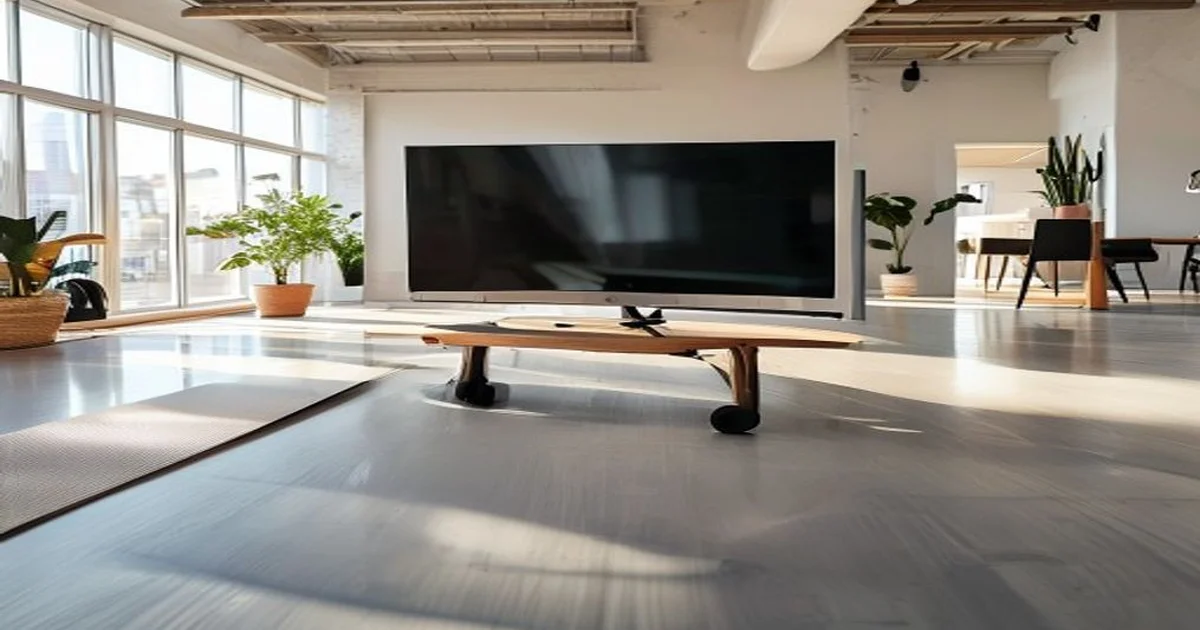
Samsung’s Movingstyle 32 is a direct response to that gap. The concept is straightforward: a 32-inch monitor mounted on a wheeled stand that rolls into a room when you need a real screen and disappears when you don’t. No wall mount. No permanent footprint. No redesigning a living room around a single device. The screen arrives for movie night and leaves before breakfast. For households that chose their layout specifically to avoid having a television define their space, that kind of flexibility isn’t a minor convenience — it’s the entire point.
What ‘A Screen on Wheels’ Actually Solves
The real breakthrough in Samsung’s Movingstyle 32 isn’t resolution or refresh rate — it’s the wheels. That single design decision changes the entire value proposition of a large display from a fixed installation to a piece of furniture you deploy on demand.
Most homes don’t have dedicated rooms for dedicated purposes anymore. A bedroom pulls double duty as a home office. A living room hosts movie nights, video calls, workout sessions, and dinner parties, sometimes in the same week. The traditional answer to this — mount a screen in every room, or resign yourself to squinting at a laptop — is either expensive or genuinely miserable. The writer who reviewed the Movingstyle described exactly this: no separate theater room, no TV in the living room, just two people hunched over a laptop on a couch watching movies like college students. That’s not a niche problem. That’s how millions of people actually live.
A mobile screen collapses the multi-room display problem into a single purchase. Wheel it into the bedroom for a Sunday film. Roll it into the home office for a video conference that actually looks professional. Park it in the living room for game night. When you’re done, it disappears — back into a corner, a hallway, a closet. The room returns to what it was before.
This reframes what a screen is. A wall-mounted television dictates your furniture arrangement, your sightlines, your room’s identity. You build the room around it. A screen on wheels does the opposite — it fits into the room you already have, on your schedule, without demanding a permanent seat at the table. That’s the shift from appliance to furniture: one is installed, the other is positioned.
The Movingstyle 32’s core innovation isn’t technical. It’s conceptual. It treats mobility as the primary feature, not an afterthought. For homes that refuse to be organized around a screen they rarely use, that’s the only answer that actually fits.
What Most Reviews Are Missing: This Is a Lifestyle Product, Not Just a Monitor
Most reviews of the Samsung Movingstyle M7 line up its specs against stationary monitors — refresh rate, color accuracy, panel type — and then wonder aloud whether the price is justified. That’s the wrong argument entirely. Benchmarking a screen on wheels against a desk monitor is like reviewing a folding bike by comparing its top speed to a road racer. The product is solving a different problem.
The real competition isn’t a 32-inch IPS panel from LG or a Dell UltraSharp. It’s the accumulated cost and compromise of owning multiple screens, or the square footage required to build out a dedicated media room that most urban apartments and smaller homes simply don’t have. One reviewer put it plainly: they don’t own a TV because there’s no separate theater room and no desire to anchor a screen permanently in the living room — so movie nights meant two people hunched over a laptop like college students sharing a dorm room. The Movingstyle 32 didn’t just solve that problem; it solved it without forcing a permanent furniture commitment or a cable installation project.
Samsung is quietly targeting a consumer that existing product categories have failed. This is someone who works from home but doesn’t want their bedroom to feel like an office. Someone who rents and can’t wall-mount anything. Someone who treats their space as multipurpose by necessity, not just preference. Call them space-conscious, screen-agnostic, flexible-living consumers — they’ve been buying compromises for years because no product was designed with their actual habits in mind.
The Movingstyle changes the framing. A screen that rolls into the kitchen for a cooking tutorial, moves to the living room for a film, and tucks into a corner when guests arrive isn’t a monitor with a mobility gimmick. It’s infrastructure for how modern homes actually function — shared spaces that need to serve multiple purposes without permanent visual clutter. That’s a lifestyle proposition, and reviewing it purely on pixel density misses the entire point Samsung is making.
The Practical Reality: Does the Wheels Concept Hold Up Day-to-Day?
The Samsung Movingstyle 32 sells the dream of a screen that goes where you go — but the dream lives or dies on surfaces, cables, and power.
Start with the base. A wheeled monitor rolling smoothly across hardwood is one thing; navigating thick carpet, door thresholds, or a living room cluttered with dog toys and charging bricks is another. The Movingstyle’s rolling stand needs enough wheel clearance and a wide enough footprint to stay stable when someone inevitably nudges it, but a base wide enough for stability also becomes a base wide enough to snag on everything in its path. Real homes are not showroom floors.
Cable management is the concept’s sharpest vulnerability. A mobile screen that requires a power cord trailing behind it is not mobile — it’s just a monitor on a longer leash. The moment you’re hunting for the nearest outlet before wheeling the screen into the bedroom, the friction erases the convenience. Wireless connectivity via Wi-Fi or Bluetooth handles the signal side reasonably well in 2024, but power remains the unsolved problem for most displays in this category. A built-in battery with genuine multi-hour capacity would change the equation entirely. Without one, every move requires scouting an outlet first.
That power dependency is also what separates a genuinely useful tool from a novelty that gets used twice. The Movingstyle is acknowledged as a clever solution for people who want a large display on demand without committing to a permanent TV installation — the exact use case for anyone without a dedicated viewing room. But “clever” and “practical” only overlap if the screen can be repositioned without a checklist. A 32-inch display sitting in a corner because moving it means re-routing a power cord is just a monitor on a slightly awkward stand.
The concept is sound. The execution needs to solve for the messy middle ground between the designer’s ideal open-plan apartment and the actual lived-in space where this product has to work.
Who This Is Really For — And Who It Isn’t
The Samsung Movingstyle 32 was built for a specific kind of person, and that person is not hard to identify. Renters who can’t mount hardware to walls, minimalists who treat living rooms as multi-purpose spaces, remote workers who move between a desk setup in the morning and a couch viewing experience at night — these are the people who will actually use what this product offers. The reviewer who sparked widespread attention around the Movingstyle put it plainly: he and his wife had been hunching over a laptop together to watch movies because they didn’t want a TV dominating their living room. A 32-inch screen on a rolling stand solved that without requiring a permanent commitment to any single room configuration.
That use case is real, and it’s more common than interior design culture acknowledges. Open-plan apartments don’t have dedicated theater rooms. Studio dwellers don’t have walls to spare. People in their 30s increasingly reject the idea that a television should anchor an entire living space.
But the Movingstyle is a bad purchase for a different, equally real category of buyer. Dedicated gamers need low input lag, high refresh rates, and a fixed setup — none of which benefit from wheels. Home theater enthusiasts chasing calibrated picture quality and immersive audio have no use for portability as a feature. Anyone with stable, purpose-built rooms is essentially paying a premium for flexibility they will never redeem.
The price point on the Movingstyle reflects the engineering behind that flexibility. Buyers who don’t need it will find better screens for less money, full stop.
The broader implication cuts deeper than one product. Samsung is making a calculated bet that fluid, non-permanent living arrangements are not a post-pandemic anomaly — they are the new baseline. Delayed homeownership, smaller urban apartments, hybrid work schedules, and a generation of consumers who treat furniture as temporary rather than generational: Samsung is designing hardware around those realities, not around the idealized floor plans that show up in architecture magazines. Whether the Movingstyle succeeds commercially will say something about whether that bet was right.
The Bigger Trend: Screens Are Finally Adapting to Homes, Not the Other Way Around
The Movingstyle M7 sits inside a small but accelerating category that Samsung itself has been quietly building for years. The Frame turns a television into wall art when idle. The Freestyle projects onto any surface from a cylindrical form factor small enough to pack in a bag. Now a 32-inch monitor rolls from room to room on casters. These are not novelty products chasing a press cycle — they represent a deliberate repositioning of display hardware from fixed infrastructure to adaptable object.
That shift carries real weight because it breaks with roughly two decades of screen design logic. From the mid-2000s onward, the industry operated on a single assumption: a wall, a desk, or a dedicated entertainment room would always be available. Flat panels replaced CRTs, mounts replaced stands, and screens grew larger — but the underlying premise never changed. The screen waited in one place, and the household arranged itself around it.
That assumption has aged badly. Urban apartments are smaller. Open-plan layouts resist permanent media walls. Younger households — the millennial cohort in particular — increasingly reject the idea of organizing a living room around a television they resent having there. The result is a real and underserved gap: people who want a large screen occasionally but refuse to make it the permanent centerpiece of a room.
Lifestyle screens fill that gap by treating flexibility as the primary design requirement rather than an afterthought. If the M7 finds a commercial audience, the competitive response will be fast. LG, Sony, and a range of monitor manufacturers all have the supply chain and industrial design capability to produce comparable products within a product cycle or two. The “screen as furniture” category — once a curiosity confined to Samsung keynotes — becomes a genuine segment with multiple players, price tiers, and competing form factors.
The broader implication is architectural. Screens that move stop dictating room layouts, which means homes can be designed or arranged around how people actually live rather than around where the HDMI port lands. That is a small but meaningful reversal of two decades of consumer electronics driving interior design decisions in the wrong direction.