Four HDMI 2.1 Ports: Why This Number Actually Matters
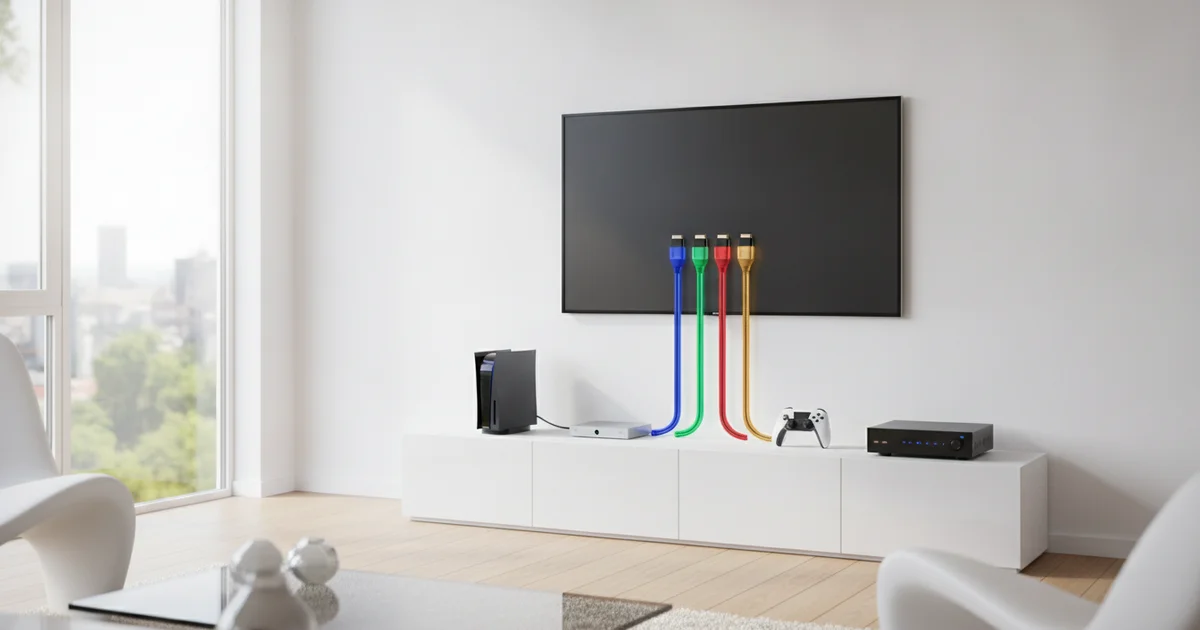
Most TVs competing at the RM9L’s price point ship with one, sometimes two HDMI 2.1 ports. The rest of the inputs are HDMI 2.0, which caps bandwidth and locks out high-refresh-rate performance for anything plugged into those secondary slots. That forces a real choice: the PlayStation 5 gets the good port, the Xbox Series X gets the bottlenecked one, and the gaming PC sits on a switcher.
TCL built the RM9L with four full HDMI 2.1 ports, and every single one supports 144Hz refresh rates. There is no hierarchy among the inputs. An Xbox Series X, a high-refresh-rate gaming PC, a streaming device, and a soundbar or AV receiver can all connect simultaneously without any device drawing the short straw. One port carries eARC for audio passthrough to powered speakers or a receiver — TCL’s own reviewer connected Klipsch The Nines II speakers through it — and that port still maintains full HDMI 2.1 bandwidth for video.
That 144Hz ceiling across all four ports matters beyond raw frame rates. Variable refresh rate technology, auto low-latency mode, and 4K high-frame-rate content all depend on HDMI 2.1’s 48Gbps bandwidth pipeline. When only one port on a TV supports that spec, the feature set is theoretical for most setups. On the RM9L, it is practical for every device in the entertainment stack.
The broader signal here is significant. TV manufacturers have spent years treating gaming features as a checkbox — one premium port buried in the spec sheet to attract buyers, with the rest of the panel optimized for passive viewing. TCL’s decision to equip all four inputs with identical high-bandwidth, high-refresh-rate capability reflects a genuine rethinking of how living rooms actually function. The modern home theater is not a single-source setup. It is a multi-device ecosystem where a 4K Blu-ray player, a current-gen console, a gaming PC, and a media streamer all compete for the same screen. Four HDMI 2.1 ports at 144Hz is the first connectivity spec on a consumer TV that honestly acknowledges that reality.
eARC and the Case for Ditching the Soundbar
The TCL RM9L dedicates one of its four HDMI 2.1 ports exclusively to eARC passthrough, and that single design decision changes what a living-room audio setup can look like in 2025. Enhanced Audio Return Channel carries lossless formats — Dolby TrueHD, DTS:X, Atmos object-based audio — back through the same cable delivering video to your display. No separate audio extractor, no optical cable choking bitrates down to lossy Dolby Digital 5.1, no splitter box cluttering the cabinet.
The practical proof came from pairing the RM9L with Klipsch The Nines II powered speakers. The Nines II are self-amplified studio monitors built around a 150-watt Class D amplifier per speaker, and they accept a direct HDMI eARC connection without any AV receiver sitting in the signal chain. The result is full-resolution audio routed from every source plugged into the TV — Xbox Series X, streaming apps, Blu-ray players — straight to speakers capable of resolving the difference. That’s a two-component system — display plus powered speakers — delivering what used to require a five-figure rack of gear.
Most TV spec sheets list eARC the same way they list Ethernet: present, accounted for, move on. That framing misses what eARC actually gates. Standard ARC, the older implementation, tops out at compressed audio. eARC raises the bandwidth ceiling to 37 Mbps, enough for uncompressed multichannel PCM and every lossless codec in current use. A TV without eARC forces any high-fidelity home theater system to route audio around the display entirely, adding complexity and often introducing sync problems. A TV with a properly implemented eARC port becomes the hub.
For anyone building a dual-purpose gaming and home theater setup around the RM9L, this matters beyond the spec sheet. The same HDMI 2.1 infrastructure that pushes 4K at 144Hz to a PC or console also carries the audio signal back out at full fidelity. The living room stops requiring separate video and audio routing strategies. One TV, one cable run to powered speakers, and every source connected to that panel benefits automatically — no manual switching, no compromises on audio format support.
The Connectivity Stack Nobody Is Talking About
Most TV reviews spend their word count on peak brightness numbers and local dimming zone counts. The port layout on the back of the RM9L deserves equal attention, because TCL made deliberate choices here that competitors have quietly stopped making.
The full rundown: four HDMI 2.1 ports, two USB ports (one coaxial), a wired Ethernet port, and a digital optical output. One of the HDMI 2.1 ports handles eARC passthrough, so audio routing to a receiver or powered speakers like the Klipsch The Nines II happens without a separate optical cable. That is already a strong foundation for a consolidated living-room setup.
The wired Ethernet port is the quiet MVP for anyone running a gaming or home theater configuration that demands consistency. Wi-Fi 6 is fast on paper, but a shared wireless channel introduces jitter, packet loss, and latency spikes that show up precisely when they hurt most — a competitive multiplayer match, a 4K HDR stream pushing 80 Mbps. A hardwired connection to a router eliminates that variable entirely. Fewer TVs at this price tier include Ethernet than they did five years ago, making its presence on the RM9L a functional advantage rather than a checkbox feature.
The digital optical output serves a different but equally practical purpose. Millions of home theater receivers, soundbars, and DACs manufactured before HDMI ARC became standard rely on optical connections. Dropping that port, as several major TV manufacturers have done across recent model lines, forces owners of older audio gear to buy adapters or replace equipment entirely. TCL kept it, which means the RM9L integrates into a wider range of existing home audio setups without additional hardware.
Together, these ports reflect a design philosophy that treats the television as a hub rather than a wireless endpoint. For gamers who prioritize low-latency display performance and streamers who run dedicated media server setups, the RM9L’s connectivity stack removes friction that premium rivals reintroduce through deliberate omission.
Real-World Testing Setup: What the Review Conditions Tell Us
The test rig built around the TCL RM9L tells you more about the TV’s real capabilities than any single-source benchmark ever could. The reviewer ran an Xbox Series X and a Google TV dongle simultaneously — two devices that represent exactly how most people actually use a living-room display. With four HDMI 2.1 ports, each rated for 144Hz, the RM9L had no trouble accommodating both without sacrificing bandwidth or forcing a compromise on refresh rate. That port count matters: most competing panels at this price tier reserve full HDMI 2.1 throughput for only one or two inputs, turning every additional device into a performance trade-off.
The audio chain is where the setup gets genuinely interesting. Klipsch The Nines II — powered studio monitors that most listeners associate with desktop high-fidelity rigs, not living-room AV systems — served as the output endpoint via the RM9L’s eARC-enabled HDMI port. Routing audiophile-grade powered monitors through a television’s eARC passthrough is a scenario that collapses the traditional boundary between gaming setups, home theater systems, and desktop listening environments. The RM9L handled it without a separate receiver or audio processor in the chain.
That choice of speakers also stress-tests the TV’s role as a system hub. A display passing audio to The Nines II needs clean eARC implementation — any signal degradation or handshake inconsistency shows up immediately on monitors that transparent. Testing against that standard is more demanding than pairing the set with a mid-range soundbar.
The rest of the connectivity profile rounds out the picture: two USB ports, one of which is coaxial, a dedicated Ethernet port for wired network stability, a digital optical output, and Wi-Fi 6 for wireless throughput. This is the port layout of a device designed to sit at the center of a converged entertainment and gaming system, not just a screen waiting for a single HDMI source. Testing it with multiple active inputs and a high-resolution audio endpoint is the only honest way to evaluate whether the RM9L actually delivers on that design intent.
What the RM9L’s Spec Sheet Means for Buyers in 2026
Four full-bandwidth HDMI 2.1 ports, each running at 144Hz, resets the baseline for what buyers in this price tier should demand from a television going into 2026. Most competitors at comparable price points either limit full HDMI 2.1 bandwidth to one or two ports, or cap refresh rates on secondary inputs. TCL gives every port the same capability, which means an Xbox Series X, a gaming PC, a streaming device, and a home theater receiver can all stay plugged in simultaneously — no cable swapping, no priority decisions about which device earns the premium connection.
That practical reality compounds across an entire household’s entertainment setup. The dedicated eARC port handles lossless audio passthrough to a receiver or powered speakers without sacrificing one of the gaming inputs. The Ethernet port delivers a stable wired connection alongside Wi-Fi 6 for devices that prefer wireless. Two USB ports, including one coaxial, handle peripherals and storage. A digital optical output covers soundbars and legacy audio equipment that predate HDMI audio standards.
That last detail signals something deliberate in TCL’s engineering approach. Including optical audio and a coaxial USB alongside the RM9L’s RGB Mini LED panel and high-refresh HDMI suite suggests TCL designed this TV to work with what buyers already own, not just what they might buy next. Households with older receivers, existing soundbars, or non-HDMI audio chains don’t face a forced upgrade to unlock the TV’s full potential.
For buyers evaluating 4K gaming televisions, home theater displays, or living room convergence setups in 2026, the RM9L’s connectivity stack removes the friction that usually forces compromise. The spec sheet doesn’t require a buyer to choose between a great gaming display and a great home theater hub — the port layout and refresh rate consistency across all inputs make both possible at once.