Gaming Desks Have Quietly Become a Serious Product Category
Gaming peripherals have always been built around one obsession: maximizing performance. A gaming mouse tracks at higher DPI than a standard office mouse. A gaming keyboard registers keystrokes faster. A gaming headset isolates audio that a standard pair of headphones would blur. None of these products won design awards, but that was never the point. The point was to remove every obstacle between the player and the win.
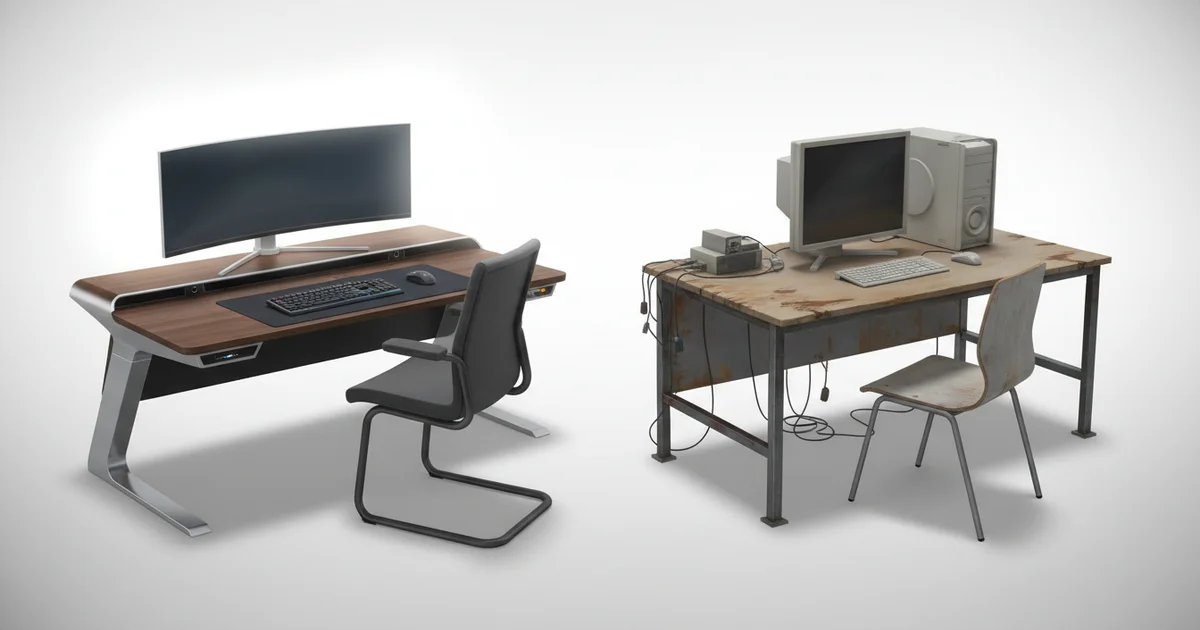
Desks are the next product in that arms race — and the category is growing fast. Companies like Secretlab, Corsair, and even IKEA now sell sit-to-stand desks built specifically for gaming setups. These aren’t rebranded office furniture pieces with RGB strips bolted on. They’re designed around the reality that competitive and enthusiast gamers routinely log six, eight, or more hours at their stations in a single session — durations that expose every ergonomic flaw in a generic desk.
Standard office furniture was engineered for the eight-hour workday, with periodic breaks, movement, and position changes built into the assumption. Gaming sessions don’t follow that pattern. Players stay seated and locked into a fixed posture for stretches that office ergonomics never accounted for. The physical consequences — wrist strain, neck compression, back problems — are the same ones that drove the standing desk market into the mainstream office world over the past decade.
What’s happening now is a convergence. The office ergonomics industry and the gaming gear industry developed separately, serving different customers with different aesthetics and different price sensitivities. Gaming desks are where those two markets meet. Herman Miller entering this space with the Coyl isn’t just a product launch — it signals that the convergence has reached the point where a company synonymous with serious workplace ergonomics sees a real market on the other side. That’s a meaningful shift in how the category gets defined, and who defines it.
Why Herman Miller — and Why Now?
Herman Miller built its reputation on one premise: that the human body performs better when furniture is designed around it, not the other way around. That premise drove the Aeron chair into corporate offices, hospitals, and design studios — environments where long hours at a desk are the job, not a choice. Entering the gaming desk market isn’t a departure from that mission. It’s an application of it to a new class of long-duration user.
The timing is deliberate. Herman Miller didn’t arrive in gaming overnight. Its partnership with Logitech G, which produced the Embody Gaming Chair, was the first move — a product that adapted the company’s flagship seating technology specifically for gaming posture and extended session play. The gaming desk follows that same logic. Herman Miller is building a complete ecosystem at the premium end of the market, piece by piece.
What most coverage treats as a lifestyle or luxury story is actually a market positioning play with long-term consequences. The gaming furniture category is expanding fast, with companies like Secretlab and Corsair already competing for the sit-stand desk segment, and even Ikea entering the space. Herman Miller isn’t chasing that volume market. It’s targeting the buyer who will spend more because they know what evidence-based ergonomics actually delivers — and it’s betting that buyer is increasingly a gamer first, an office worker second.
That bet carries a specific logic. The generation currently spending four, six, eight hours a day at a gaming setup is the same generation that will furnish their first home offices, negotiate their remote work stipends, and decide which brands they trust with their bodies. Herman Miller is not trying to sell a desk to today’s gamer. It’s trying to be the brand that tomorrow’s professional already knows.
What the Coyl Actually Offers Gamers That Generic Standing Desks Don’t
The Herman Miller Coyl targets a specific problem that a standard sit-stand desk ignores: the full physical environment of someone who games for three, four, or six hours at a stretch. Height adjustment alone doesn’t solve that problem.
Generic standing desks are built around a single user behavior — alternating between sitting and standing during a workday. Gaming setups demand more. A competitive or long-session gamer typically runs multiple monitors, several peripherals, a headset stand, and a dense cable network behind the surface. The Coyl addresses this with a wider surface footprint and integrated cable management designed to handle that kind of rig without forcing the user to route cables manually around desk legs or rely on aftermarket clips. Secretlab and Corsair have built similar feature sets into their sit-stand offerings, and Ikea has entered the category with budget-friendly options. Herman Miller is now competing directly on that terrain, but with its own ergonomic credibility attached.
What separates the gaming framing from standard ergonomic desk design is the posture problem specific to gaming. Office workers shift tasks constantly — typing, reading, phone calls — which naturally breaks up static posture. Gamers sustain the same position for long intervals, arms forward, eyes fixed at a narrow focal point. The Coyl is tuned to support that sustained posture, not just periodic height changes.
The honest gap in evaluating the Coyl is the absence of independent ergonomic testing. Herman Miller carries real authority in this space — the Aeron chair has decades of research behind it — but the Coyl has not yet been subjected to published third-party ergonomic assessment. That matters because the gaming label in this product category has historically functioned as a pricing mechanism as much as a functional descriptor. Whether the Coyl’s specific feature set produces measurably better posture outcomes for gamers than a well-configured standard standing desk remains an open question. Herman Miller’s brand suggests the intention is genuine. The evidence to confirm it doesn’t exist yet.
The Elephant in the Room: Price and Access
Herman Miller’s Aeron chair starts at $1,795. The Embody gaming chair — built in partnership with Logitech G — retails for $1,745. The Coyl desk will almost certainly land in the same territory. For context, Secretlab’s Magnus Pro sit-stand desk costs $649. The Ikea Uppspel, built in collaboration with Asus ROG, runs $449. Herman Miller is not competing in that market. It is building for a different buyer entirely.
That creates an obvious problem. Gaming skews young. It skews budget-conscious. The average gamer is not a finance professional furnishing a home office — they are a teenager or a twenty-something logging five, six, eight hours a day on hardware they saved up for. Those are exactly the people who need ergonomic intervention the most. Sustained poor posture in adolescence and early adulthood causes lasting damage. The stakes are real, and the price point puts the solution out of reach for the people most exposed to the risk.
The coverage of Herman Miller’s gaming push has largely celebrated the technical ambition while glossing over this gap. Outlets treat the Coyl as an exciting category disruption rather than asking who actually benefits. Better sit-stand mechanics, smarter height adjustment, and genuine lumbar support are not luxury features — they are health features. Framing them as premium goods restricts access to the people who can already afford to absorb the cost of bad ergonomics through physical therapy or replacement equipment.
The irony is that companies like Secretlab and Corsair have pushed quality sit-stand desks into the mid-range market, proving that thoughtful ergonomic design does not require four-figure pricing. Herman Miller entering the gaming space does not raise the floor for everyday gamers. It raises the ceiling for buyers who were already comfortable — and calls it progress.
The Broader Shift: Ergonomics Is Becoming a Performance Category
Gaming accessories have always sold one thing above everything else: competitive edge. A 1ms response rate monitor, a mechanical keyboard with actuation tuned to the millisecond, a headset with positional audio that lets you hear footsteps before your opponent does — every product in the category earns its price tag by promising measurable performance gains. Herman Miller is now inserting spinal health into that same equation, and that framing matters more than the desk itself.
The Coyl isn’t being marketed as a wellness product or an office upgrade. It’s a gaming peripheral. That distinction changes who buys it and, more importantly, why. A 25-year-old who spends six hours a day at a setup optimized for frames per second has never had a reason to think about lumbar support. But if proper desk height and sit-stand movement get coded as inputs that affect reaction time, endurance, and sustained focus — the same way a high-refresh monitor affects visual clarity — that same person now has a framework for caring about posture that didn’t exist before.
Companies like Secretlab and Corsair built the gaming desk category on aesthetics and cable management. RGB lighting, aggressive angular design, race car chair compatibility. Herman Miller is entering with an entirely different premise: that physical setup is part of performance infrastructure, not just decoration.
The broader implication is cultural adoption. Ergonomics has historically been a corporate HR category — something your employer buys for the office, not something you choose for yourself. The gaming market bypasses that entirely. Gamers buy hardware upgrades voluntarily, enthusiastically, and often at prices that would be hard to justify on paper. If Herman Miller successfully repositions back health as a performance variable, it pulls ergonomics out of the HR catalog and into the same consumer mindset that drives GPU upgrade cycles.
That’s the real story behind the Coyl. Not a desk. A category reframe — one that could normalize ergonomic investment among a demographic that has spent years hunched over setups they optimized for everything except their own bodies.
What to Watch: Will the Market Follow Herman Miller Upmarket?
Herman Miller entering a product category has historically functioned as a starting gun for mid-market manufacturers. When Herman Miller and Logitech G partnered to bring ergonomic gaming chairs to market, competitors like Secretlab and Razer followed within roughly 12 to 18 months with lower-priced alternatives that borrowed the same language — lumbar support, posture alignment, extended session comfort — at half the price. The gaming desk market will follow the same pattern. Secretlab and Corsair already sell sit-to-stand gaming desks, and Ikea has made moves in the category. Expect those brands and others to respond to the Coyl by closing the feature gap faster than Herman Miller would prefer.
The more consequential question is whether the Coyl sets ergonomic benchmarks that actually improve the category, not just the expensive end of it. Herman Miller’s standing desks carry decades of biomechanical research behind their height ranges, surface depths, and adjustment mechanics. If that research becomes the implicit standard — the thing every gaming desk review eventually measures against — the whole category gets better by default.
Watch one specific indicator to track whether this shift is happening: gaming desk marketing copy. Right now, brands in this space lean on RGB lighting, cable management channels, and load capacity numbers. When those same brands start citing ergonomic studies, referencing proper monitor distance, or advertising tested height ranges for seated and standing postures, Herman Miller’s entry will have done its real work. That shift in marketing language is how you know a premium entrant has successfully moved category expectations rather than just captured the top of the market.
The risk is that Herman Miller’s price point — the Coyl sits in premium territory — creates a ceiling that keeps genuine ergonomic access out of reach for most gamers. A better gaming desk market that only the top 5% of buyers can afford is a narrow win. The trickle-down only matters if it actually reaches the mid-market price bands where the majority of gaming desks are sold.