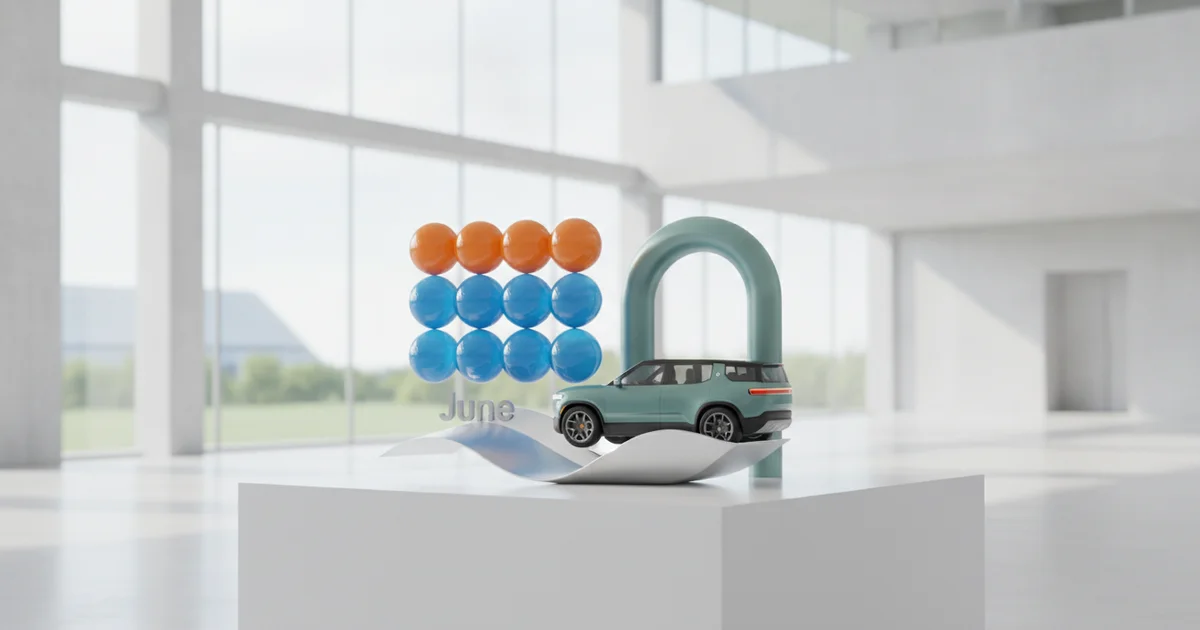
The Headline: First R2s Hit the Road June 9
Rivian confirmed June 9 as the delivery date for its first R2 SUVs, ending months of ramp-up speculation and marking the company’s most significant product launch since the R1 truck and SUV debuted years earlier. CEO RJ Scaringe called the R2 “maybe the most important thing we’ve launched to date” — a statement that reflects how much is riding on this vehicle for the company’s future.
The R2 is a deliberate departure from Rivian’s existing lineup. The R1T and R1S built the brand on premium, adventure-focused hardware that commands prices well above $70,000. The R2 targets a different buyer entirely: someone who wants an electric SUV without a luxury price tag attached.
The initial trim launching June 9 starts just under $60,000. That’s the entry point for now, but Rivian has already mapped out a more aggressive pricing runway. A standard version priced at $48,490 is planned for 2027, and the company has been promoting a trim “starting around $45,000” for late next year — a figure Rivian first floated at the R2’s reveal in 2024.
That pricing ladder tells a clear story. Rivian isn’t treating the R2 as a single product but as a platform designed to reach deeper into the mainstream market over time. The June 9 deliveries are the first step in that strategy, but the sub-$50,000 versions are where Rivian’s volume ambitions actually live. The gap between the launch trim and those future configurations is wide enough that how the company executes the ramp-down in price matters just as much as hitting the initial delivery date.
The Price Problem Nobody Is Talking About
Rivian positioned the R2 as its affordable vehicle for everyday buyers. The actual launch price tells a different story.
The first R2 SUVs hit customer driveways on June 9, starting just under $60,000. That is not a mass-market price point. The median new car transaction in the U.S. currently sits around $48,000, and the median household income hovers near $80,000. A $60,000 SUV — before taxes, destination fees, or any add-ons — sits firmly in premium territory, accessible to a narrow slice of American buyers regardless of how Rivian markets it.
The genuinely more accessible version exists, but not yet. Rivian announced a standard R2 starting at $48,490, a price that at least enters the conversation for middle-income households. That version arrives in 2027. An even cheaper trim “starting around $45,000” is slated for late next year, a figure Rivian has dangled since the original R2 reveal in 2024. So the version of the R2 that matches the affordable narrative is either one or two years away, depending on which price point you treat as the real target.
Most launch coverage celebrated the R2 as Rivian’s democratizing move without flagging this gap. CEO RJ Scaringe called the R2 “maybe the most important thing we’ve launched to date,” and the company is betting its future on the model reaching scale. But scale requires buyers, and buyers need prices they can actually reach. A $59,000 launch trim does not unlock that market — it delays the test of whether Rivian’s affordability bet actually works until the standard model lands.
The R2 may eventually fulfill its promise. Right now, the version customers can buy today is a premium vehicle with a lower-premium reputation attached to it.
The Competitive Landscape: Why Timing Matters Now
Rivian chose June 9 to begin R2 deliveries at a moment when the sub-$60K EV SUV segment is more crowded than it has ever been. Tesla continues to dominate mainstream EV sales with the Model Y. Hyundai’s Ioniq 5 and Ioniq 6 compete directly on range and value. Ford’s Mustang Mach-E has been repositioned with repeated price cuts to stay relevant. Every one of these brands is chasing the same buyer — someone willing to go electric but unwilling or unable to spend six figures to do it.
That pressure makes the R2 launch something larger than a product reveal. Rivian is entering this fight with an opening trim priced just under $60,000, a standard version at $48,490 arriving in 2027, and an entry-level configuration targeting around $45,000 expected late next year. The staggered rollout means Rivian is asking buyers to measure the brand’s promise against competitors who have vehicles on lots right now.
The federal EV tax credit situation adds another layer of real financial complexity. Under current rules, buyers of qualifying vehicles can claim up to $7,500 at point of sale, which could bring the R2’s effective cost into genuinely competitive territory. But eligibility requirements tied to battery sourcing, vehicle assembly, and buyer income limits remain subject to ongoing policy changes in Washington. Whether the R2 qualifies — and whether that credit survives in its current form — will directly shape how competitive Rivian’s pricing actually is in practice, not just on paper.
CEO RJ Scaringe has called the R2 “maybe the most important thing we’ve launched to date.” That framing is accurate, but the market will judge it against a specific number: what a buyer actually pays on signing day, after credits, compared to what a Hyundai dealer is offering down the street. Rivian’s timing is deliberate. Whether it is good enough depends on factors the company does not fully control.
Rivian’s Survival Math: Volume Is Everything
Rivian needs the R2 to succeed in a way that goes far beyond adding another model to a lineup. CEO RJ Scaringe has called it “maybe the most important thing we’ve launched to date” — a rare admission from a founder that one product carries the weight of the entire company’s future.
The logic is straightforward. Rivian’s R1T truck and R1S SUV carved out a loyal customer base, but those vehicles target a premium segment that limits how many units Rivian can realistically sell. The R2, priced just under $60,000 at launch, opens the door to a significantly larger pool of buyers. Without that volume, Rivian cannot generate the revenue needed to cover its manufacturing costs and move toward profitability. Scale is not a growth strategy here — it is a survival requirement.
The months of ramp-up activity leading into the June 9 first-delivery date reflect how much pressure Rivian is under to get this right. The company’s production history with the R1 line was rough, marked by supply chain disruptions and output shortfalls that burned through cash and tested investor patience. A stumbling R2 launch is not an option Rivian can absorb.
Rivian has already signaled it understands the affordability ceiling on the current configuration. The launch trim sits just under $60,000, but the company has committed to a standard version starting at $48,490 arriving in 2027, with an even more stripped-down variant targeting around $45,000 after that. Those lower price points are where the real volume potential lives. The June 9 launch is the first step, but the production numbers Rivian achieves over the next 18 months will determine whether the R2 becomes the foundation of a viable business or another expensive lesson in how hard it is to scale an EV startup.
What’s Still Unknown: The Teased Cheaper Model
Rivian has dangled a third pricing tier that sits below both the launch trim and the $48,490 standard version: a model “starting around $45,000,” a figure the company has repeated since the original R2 reveal in 2024. Beyond that number, Rivian has disclosed almost nothing — no confirmed trim name, no feature list, no production timeline beyond a vague reference to late next year.
That gap between promise and detail is a deliberate holding pattern. Rivian keeps aspirational buyers in its orbit without requiring the company to commit to specifications, supply chain decisions, or margin targets it may not yet be able to defend. The strategy works on the consumer side — a $45,000 Rivian sounds compelling enough to keep shoppers from signing with a competitor — but it asks a lot of both buyers and investors. They are being asked to trust a product roadmap that now stretches across multiple years and multiple price points, with the most accessible option sitting furthest from delivery.
That distance matters in a market moving fast. Tesla, GM, and Hyundai are all pushing aggressively on price. A $45,000 Rivian arriving in late 2026 competes against vehicles that do not exist yet, built on cost structures that are still shifting. Rivian’s own standard R2 doesn’t arrive until 2027, meaning the company is stacking promises on top of promises.
RJ Scaringe has called the R2 program “maybe the most important thing we’ve launched to date.” If the launch trim at just under $60,000 proves that Rivian can execute, the lower tiers gain credibility. If production stumbles or pricing drifts upward — a pattern the EV industry knows well — the teased $45,000 model becomes a liability rather than a marketing asset. Right now, it is a number without a vehicle behind it.
What June 9 Actually Proves — And What It Doesn’t
June 9 settles one question definitively: Rivian can bring a new vehicle platform to market. After the painful production stumbles that plagued the R1T and R1S launches, getting R2s into the hands of first-wave reservation holders on a publicly announced date is a real operational win. RJ Scaringe called the R2 “maybe the most important thing we’ve launched to date,” and the company has now backed that claim with an actual delivery event, not another delay.
That’s where the proof stops.
Early deliveries to reservation holders bear almost no resemblance to the sustained, high-volume manufacturing Rivian needs to make the R2 financially meaningful. The company’s history on the R1 line showed that shipping the first units and consistently building thousands of units per month are entirely different problems. June 9 solves the first one. The second one plays out over the rest of 2025 and into 2026 — and that’s the data that will actually matter to investors and to the broader EV market.
For consumers, the date is a signal to pay attention, not a reason to act. The R2 launching just under $60,000 serves early adopters and reservation holders who locked in their spots during the 2024 reveal. Most buyers are waiting for something else entirely. Rivian has confirmed a standard version priced at $48,490 arriving in 2027, along with a trim targeting around $45,000 sometime late next year. Those are the price points that put the R2 in genuine competition for the mainstream market — not the near-$60K launch configuration rolling out this summer.
June 9 tells you Rivian is executing. It doesn’t tell you whether Rivian can scale, hold those lower price points without sacrificing margin, or move enough volume to stabilize the business. Watch the production numbers that follow. Those will tell you whether the R2 is a turning point or just a well-managed debut.