The Hidden Cost Nobody Talks About: The Pre-Business-Logic Tax
Every backend project starts the same way: not with the product, but with the scaffolding around it. Before a single line of business logic ships, a developer must wire together a message queue, a cron scheduler, an HTTP layer, a state management solution, and observability tooling. Each one arrives with its own SDK, its own configuration format, and its own distinct failure modes. The actual work — the code that creates value — waits behind all of it.
This is the pre-business-logic tax, and it is not a small line item. It is the default opening cost of every backend, paid in full before the project has done anything useful.
What makes this cost particularly damaging is how it scales. Adding a second service type to a stack does not double the integration burden — it multiplies it. Each new component must be connected to every existing one. The mental overhead of managing five different SDKs, reconciling five different logging conventions, and debugging failures that live in the gaps between systems grows faster than the systems themselves. Teams normalize this friction because they have always paid it, not because it is inevitable.
iii names this problem directly. Its premise is that queues, cron, HTTP, state, observability, agents, and sandboxes each carrying their own integration story is a structural failure of how backends are assembled — not an acceptable baseline. The project collapses that fragmentation into one live system surface. A developer runs a single command to add a worker, and that worker immediately joins a live catalog where every other worker can discover and call it. No additional wiring. No separate configuration pass. No integration ceremony.
The implication is straightforward: the pre-logic tax is not a solved problem that the industry quietly handled — it is a recurring cost that compounds silently on every project. iii treats the elimination of that cost as a first-order design goal, not an afterthought.
One Catalog to Rule Them All: How iii’s Worker Model Actually Works
The entire surface area of iii’s infrastructure model fits into one command shape: iii worker add <anything>. Whether the primitive is a queue, a cron job, an HTTP endpoint, an AI agent, or a sandbox, the invocation pattern is identical. Developers don’t learn a separate onboarding ritual for each service type — they learn one interface, and every new capability slots into it. That uniformity isn’t cosmetic. It eliminates the per-primitive integration tax that typically accumulates as a backend grows.
The mechanics behind that command are where the architectural choice becomes visible. When a worker joins the system, it is automatically registered in a live catalog. Every other worker in the system receives immediate notification of the new addition and can call its functions right away. The system maintains a continuously accurate map of its own topology without any manual registration step, config file update, or environment variable injection from the developer.
This stands in direct contrast to how most backends handle service discovery today. Static registries require a deploy cycle or a manual update to reflect new services. Environment-variable-based approaches push the coordination burden onto the developer — someone has to know which variables to set, in which services, before a new primitive is reachable. iii’s catalog is event-driven by default: the act of adding a worker is the registration event, and the propagation is automatic.
That design has a consequence that extends beyond developer ergonomics. Agents running inside iii operate against the same catalog interface that a human developer uses. When an agent encounters a task that requires a capability the system doesn’t currently have, it can run iii worker add, discover the new worker’s functions, call them, and trace the execution — all programmatically, all through the same surface. The catalog isn’t a read-only index; it’s a live, writable map of what the system can do. Browsable workers are listed at workers.iii.dev. For AI-native systems where the runtime topology needs to change in response to what an agent is doing, that property isn’t a convenience — it’s a foundational requirement.
The AI-Native Angle Most Coverage Is Missing: Agents and Sandboxes as First-Class Citizens
Most coverage of iii focuses on its unified observability and real-time service composition. That framing undersells the more consequential design choice buried in the CLI.
iii worker add queue, iii worker add agent, iii worker add sandbox. Three commands, same syntax, same catalog registration, same discovery mechanism. Agents and sandboxes are not plugins bolted onto a framework built for HTTP and queues. They are first-class worker types from day one, structurally identical to the primitives that have anchored backend infrastructure for two decades.
That symmetry is an architectural argument, not a convenience feature. Every existing framework that has tried to accommodate AI agents has done so through orchestration layers, separate SDKs, or integration middleware that sits outside the core runtime. The seam shows. Developers maintain two mental models — one for classical services, one for AI workloads — and the operational surface doubles accordingly.
iii erases that seam at the type level. When a worker joins the live catalog, every other worker in the system is notified and can call it immediately. That applies equally to a queue processor and to an agent. An agent that needs a capability the system does not yet have can execute iii worker add <anything>, discover the new worker’s functions, call them, and trace the full execution — using the same interface a human developer uses. There is no separate agent runtime. There is no special-casing.
The sandbox worker follows the same logic. Sandboxed execution — isolated environments for running untrusted or autonomous code — is treated as infrastructure, not as a security afterthought grafted onto a pipeline that was never designed for it.
This matters disproportionately as agentic pipelines scale. Hybrid workflows that mix human-triggered services with autonomous agents are not a future edge case; they are the direction autonomous coding tools and AI-native products are already moving toward. Infrastructure designed around that reality from the ground up behaves differently under load, under extension, and under debugging than infrastructure retrofitted for it. iii is built on the premise that the boundary between classical and AI services is already obsolete. The CLI makes that premise operational.
Real-Time Observability as a Design Principle, Not a Feature Add-On
Observability in traditional backend stacks arrives late. Teams bolt on Datadog after deployment, wire up OpenTelemetry weeks into a project, and build custom dashboards to stitch together logs from queues, cron jobs, HTTP services, and state managers that were never designed to speak the same language. The instrumentation budget is a second project hidden inside the first one.
iii takes a different position. Every worker — queue, agent, sandbox, HTTP handler, or anything else added via iii worker add — joins what iii calls the “live system surface” the moment it registers. Visibility is not configured; it is structural. A developer does not decide to observe a worker. The worker is observable by definition, from the first second it exists in the catalog.
This matters architecturally because unified composition and unified observability are the same problem solved once. When every worker shares the same registration layer and the same discovery mechanism — where every other worker is notified and can call a new addition immediately — the system already holds the graph of what talks to what. Tracing a call chain requires no separate pipeline because the composition layer is the trace. iii collapses logging pipelines, tracing infrastructure, and state inspection into a single live view rather than three separate operational investments.
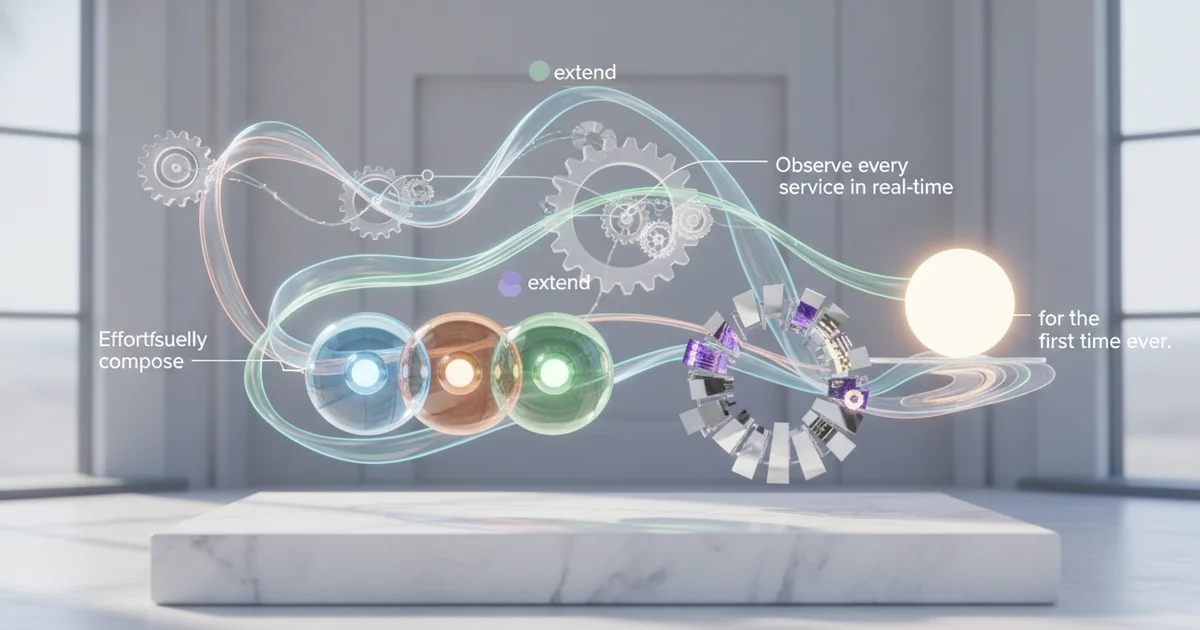
iii’s own documentation uses the phrase “for the first time ever” when describing real-time observation of every service in a stack. That phrasing is a direct challenge to Temporal, Inngest, and Cloudflare Workers. Each of those platforms offers observability tooling, but none frames it as a structural guarantee of the composition model itself. Temporal requires separate visibility infrastructure. Inngest surfaces run history but scopes it to its own execution model. Cloudflare Workers leans on third-party logging integrations. In each case, observability is additive.
For AI-native development specifically, structural observability changes what agents can do. An agent in iii can add a worker, discover its functions, call them, and trace what happened — using the same interface a developer uses. The system is self-documenting in real time. That is not a monitoring feature. It is the architecture.
What the Open-Source Release Tells Us About Timing and Market Context
The decision to publish iii under the iii-hq organization on GitHub as a fully open-source project is not incidental — it is the first move in a recognizable playbook. Transparency precedes monetization. Developers inspect the code, build trust in the primitives, and embed the tool into their workflows before any commercial layer appears. By the time a paid tier surfaces, the switching cost has already been constructed by the developers themselves.
The timing is precise. AI code generation has crossed a threshold where backends are being assembled faster than the integration tooling surrounding them can absorb. A model can scaffold an HTTP service, a job queue, and a cron scheduler in minutes. What it cannot do is wire those components into a coherent, observable runtime — that work still falls to the developer, and it still takes the same amount of time it always did. iii targets exactly that gap. Its unified surface — one live catalog where every worker registers, every function is discoverable, and every trigger is traceable — is designed to be the connective tissue that makes AI-generated services actually operable rather than merely compilable.
The <anything> worker slot is the most strategically significant detail in the project. Every named worker type — queue, cron, HTTP, state, agent, sandbox — is a solved category. The <anything> slot is a claim on every category that does not yet have a name. By making iii the canonical registration point for any new service primitive, the project builds a structural moat: future infrastructure components, whatever form they take, have a natural home inside iii’s catalog. The workers.iii.dev registry extends this further by creating a public, browsable index that makes the ecosystem legible and encourages contribution before any proprietary directory could compete.
The agent behavior described in the project documentation makes the strategic logic explicit. When an agent needs a capability, it adds a worker, discovers that worker’s functions, calls them, and traces the result — using the same interface a human developer uses. That symmetry is not a coincidence. It means iii is architected from the start for a development environment where human and automated actors share the same toolchain.
The Open Questions: What iii Still Needs to Prove
The GitHub repository for iii offers a compelling pitch and almost nothing else. No documentation on supported languages. No stated deployment targets — bare metal, Kubernetes, managed cloud, or otherwise. No versioning information, no changelog, no explicit production stability status. Developers evaluating iii as a serious infrastructure layer have no published benchmarks, no SLA guidance, and no migration path documentation to work from. That is not a minor gap. That is the entire checklist that separates an interesting prototype from something an engineering team can justify putting behind a production workload.
The live catalog mechanism raises harder questions. Every worker that joins the system triggers a notification to every other worker. At a dozen workers, that fan-out is trivial. At hundreds of workers in a high-churn environment — services scaling up and down, agents dynamically adding capabilities mid-task — that same mechanism becomes a broadcast storm waiting for a bad network moment to expose it. iii has published no public design document addressing catalog consistency during a network partition, no explanation of how stale catalog state is detected or reconciled, and no guidance on back-pressure or notification throttling under load. These are not hypothetical concerns. They are the standard failure conditions that distributed systems teams hit within the first six months of real production traffic.
The word “effortlessly” in the repository headline is the sharpest liability of all. The developer community has a long, documented memory for tools that led with frictionless promises and buried the friction in their GitHub issues two years later. “Effortlessly” is a claim that invites exactly that kind of retrospective. iii’s credibility past the early-adopter window will not come from the elegance of its core abstraction — which is genuinely interesting — but from whether it publishes honest documentation about what breaks, under what conditions, and what operators are expected to do about it. The abstraction earns trust. The failure mode documentation keeps it.