The rugged device promise vs. the field worker reality
Manufacturers selling rugged tablets lead every product page with MIL-STD-810H certifications and IP67 or IP68 ratings. The pitch is straightforward: this device survives a 4-foot drop, a dust storm, and a rain-soaked job site. For logistics coordinators tracking shipments, construction supervisors managing punch lists, and healthcare aides updating patient records, that pitch misses the actual work entirely.
Surviving a drop test is now the price of entry in this category. Every serious rugged tablet ships with some combination of military-spec certification and ingress protection. Panasonic, Getac, and Samsung DeX-capable devices all clear that bar. The question field workers actually need answered is whether the device runs a spreadsheet without lag, submits a digital form without crashing, and holds a 4G LTE or Wi-Fi connection in a warehouse or on a concrete subfloor. Those are the moments that kill productivity — not a splash of rainwater.
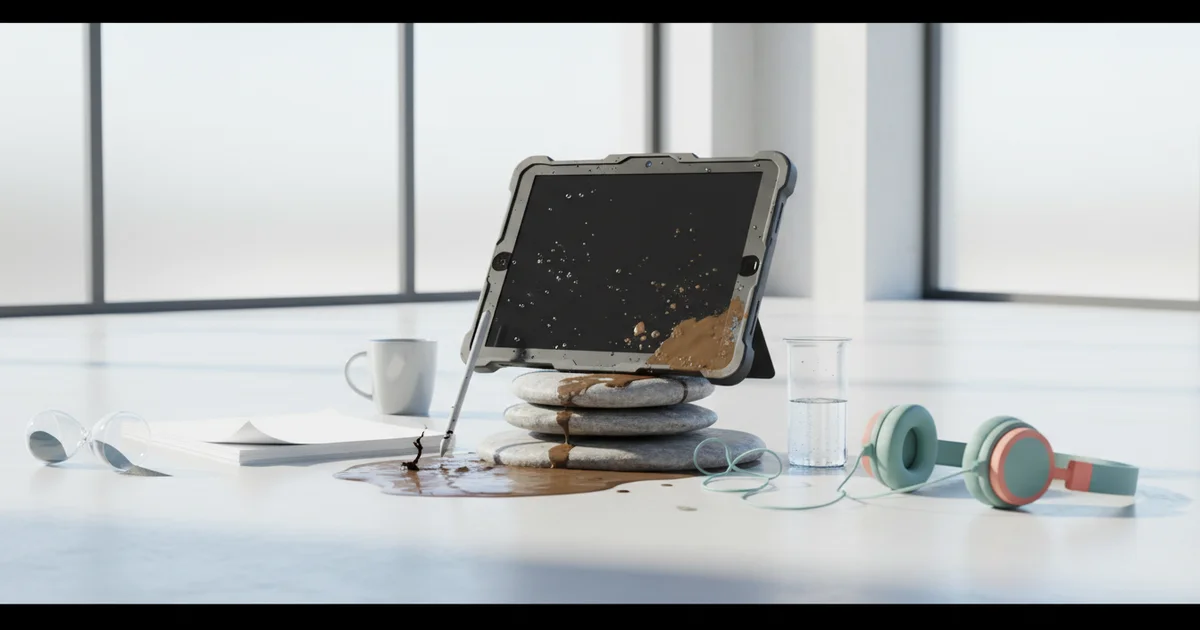
ZDNET’s hands-on review of a rugged Windows tablet captured this gap directly. The device performed exactly as advertised in mud and rain, but the reviewer found the core computing experience — the part workers use for eight hours straight — fell short of expectations. That finding landed deep in the review, well after the drop-test footage and waterproofing demonstrations.
That sequencing reflects a broader editorial habit in rugged device coverage. Durability tests make compelling video. A reviewer splashing water on a tablet generates more engagement than documenting whether the touchscreen responds accurately while wearing work gloves or whether the on-screen keyboard works fast enough to enter 30 line items before a delivery window closes. The result is a category where marketing and media both optimize for the least important differentiator.
Field workers carry these devices through entire shifts. The mud resistance matters once. The performance gap matters every hour.
Where this tablet specifically fell short on the basics
The rugged certification on this tablet checks the boxes procurement teams care about, but the real-world performance tells a different story. In benchmark testing, the device delivered results that a mid-range consumer tablet costing a fraction of the price routinely beats. Workers running field service software, asset management platforms, or even moderately complex data entry applications hit lag and responsiveness issues that slow down workflows rather than supporting them.
The display presents a similar problem. Outdoor readability improves in certain lighting conditions, but workers doing sustained data entry or navigating multi-layer software interfaces face a frustrating experience. Screen responsiveness and the practical usability of the touch interface under working conditions — with gloves, in direct sunlight, or while managing other tools — falls short of what the industrial price tag implies.
Battery life and thermal management are where the gap between marketing and reality becomes most costly for field teams. Workers on long shifts in remote locations, construction sites, or utility infrastructure cannot rely on a device that requires babysitting around power access. This tablet did not stand out in either category during testing. Thermal performance under sustained load raised concerns, and battery endurance did not clear the bar that workers covering a full shift away from a charging source need cleared.
The core issue is that rugged certifications measure survival, not productivity. A device that survives a drop or a rainstorm but runs slow, frustrates users on complex interfaces, and drains its battery before the shift ends has failed the actual job requirement. Field workers do not need a tablet that can handle mud. They need one that can handle mud and keep pace with the work they are paid to do.
The Windows OS question: right platform, wrong execution?
Windows dominates the rugged tablet market for one straightforward reason: IT departments already run Microsoft environments, and legacy enterprise software built on Windows doesn’t port cleanly to other platforms. For procurement teams, that compatibility argument closes the deal before usability enters the conversation.
The problem surfaces the moment a field worker actually picks the device up. Running a full Windows stack — with its background processes, update cycles, and memory overhead — on hardware engineered around MIL-STD-810 certification and thick rubberized chassis means the processor and RAM are doing double duty. The result is lag. Boot times stretch. Applications stutter when switching between tasks. ZDNET’s hands-on review of the Getac UX10 captured this tension directly: a tablet that survived mud and rain in testing but drew criticism for sluggish basic performance during everyday use. Durability passed; responsiveness failed.
Android-based competitors have made a different bet. Zebra Technologies, one of the largest players in enterprise mobility hardware, has built its rugged handheld and tablet lines heavily around Android, prioritizing the kind of fluid, touch-native experience that workers already know from consumer devices. The trade-off is real — legacy Windows applications don’t run, and organizations dependent on older software face retraining or replatforming costs. But for companies building new workflows from scratch, Android’s lighter resource demands on equivalent hardware translate directly into faster response times and shorter learning curves.
The core issue isn’t that Windows is wrong for enterprise environments — it’s that optimizing a hardware platform for physical punishment while simultaneously asking it to run a full desktop OS creates a performance ceiling that ruggedization specs never mention. A tablet rated IP65 for dust and water resistance tells a buyer exactly how much abuse the shell can absorb. No spec sheet lists how long a worker waits for a signature capture app to load on a job site. That gap between certified toughness and actual daily usability is where field workers lose time, and where the Windows rugged tablet proposition starts to crack.
Who actually buys rugged tablets — and what they really need
Procurement officers at utility companies, logistics operators, and municipal emergency services are the real buyers of rugged tablets — not individual workers shopping for themselves. A fleet deployment of 50 or 500 devices means the per-unit spec sheet matters far less than total cost of ownership, warranty terms, enterprise device management compatibility, and whether the vendor answers the phone when something breaks in the field.
Those workers also arrive with non-negotiable software dependencies. A warehouse crew running a Zebra-based inventory system or a utility technician tied to GIS diagnostic software on Windows doesn’t get to choose a different platform because the hardware feels nicer. The OS is locked before the hardware conversation even starts. That reality makes “rugged tablet” a nearly meaningless category until you know the operating environment and the software stack running on it.
The actual use cases split into meaningfully different requirements. Scan-heavy warehouse work demands fast barcode and RFID reads, comfortable one-handed grip for workers pulling 10-hour shifts, and a screen that responds accurately through warehouse-grade gloves. Field diagnostics for utilities or telecom requires Windows compatibility, enough processing power to run legacy enterprise software, and readable displays under direct sunlight. Emergency services navigation and incident reporting need cellular reliability, GPS precision, and form factors that mount cleanly in vehicles.
A single device cannot optimize for all three. A tablet that earns strong marks for mud and rain resistance can still fail the basic responsiveness and ergonomics tests that determine whether a worker can actually do the job faster with it than without it. Durability certifications like MIL-STD-810 and IP67 ratings are entry requirements, not differentiators. The procurement officer who buys on those specs alone — without mapping the device to a specific workflow — ends up with hardware that survives a drop but slows down every shift.
The premium price problem: what you’re really paying for
Rugged tablets routinely carry price tags two to three times higher than comparable consumer-grade hardware. A ruggedized Windows tablet from a tier-one vendor can run $1,500 to $2,500 or more, while a consumer tablet delivering similar processing power sits closer to $600 to $800. Vendors justify that gap with MIL-SPEC certifications, IP ratings, and enterprise support agreements. On paper, the math works. In practice, it depends entirely on whether the hardware delivers on the fundamentals.
When a device struggles with basic performance — sluggish app response, subpar display visibility in direct sunlight, awkward input under gloves — the premium starts looking like a tax on a certification rather than payment for capability. Field workers don’t care about drop-test ratings when the software they depend on lags or the screen washes out at noon. The durability argument collapses the moment usability becomes the bottleneck.
Consumer tablets are closing the gap faster than rugged device makers want to admit. Samsung’s Galaxy Tab S series and Apple’s iPad now support major mobile device management platforms, including Microsoft Intune and Jamf. Some models carry meaningful water and dust resistance. IT departments can lock them down, push apps, and enforce policies with the same tools they use on rugged hardware. The durability ceiling has risen, and the enterprise feature floor has dropped.
Buyers negotiating rugged tablet contracts need to move past the spec sheet and interrogate three things directly: the full support contract terms, the repair turnaround time, and the replacement policy when a device fails. A rugged tablet with a 30-day depot repair window is a liability for a crew running daily field operations. A vendor that charges for advance replacement or caps warranty service at one incident per year is shifting real cost back onto the buyer. Those terms determine whether the premium delivers value — the hardware certification alone does not.
The missing conversation: redefining what ‘rugged’ should mean in 2025
The rugged device industry runs on a comfortable fiction: survive the drop test, earn the badge, ship the product. IP68 and MIL-STD-810 ratings dominate spec sheets and marketing copy, but those certifications say nothing about whether a device can run a real workload without throttling, freezing, or forcing a field technician to restart mid-task. That gap between survival and usability is where field workers actually lose time and money.
The certification framework needs a second column. Environmental toughness ratings should be paired with mandatory performance benchmarks tied to field computing workloads — sustained CPU throughput under thermal load, touch input latency in gloved operation, display legibility at 1,000 nits in direct sunlight, and minimum RAM thresholds for running concurrent enterprise applications. Right now, none of those requirements exist in any standardized form. Buyers are left comparing IP ratings against IP ratings while ignoring whether the processor inside can handle more than a spreadsheet.
The urgency is growing. AI-assisted diagnostics, real-time asset tracking, and edge data processing are no longer pilot programs — they are standard operating requirements on job sites, in utility fleets, and across logistics networks. Those applications demand processing headroom that entry-level and mid-range rugged tablets simply do not provide. A device that earns its MIL-STD-810H certification on an Intel Celeron-class chip and 4GB of RAM is not equipped for 2025 field operations, regardless of how many times reviewers drop it onto concrete.
The review ecosystem shares responsibility for the distortion. Coverage that leads with dunking a tablet in a bucket or running it over with a forklift treats durability as the product’s primary value proposition. It is not. Durability is the minimum entry requirement. Reviewers should weight usability, sustained performance, and software experience at least equally with physical resilience — and buyers should demand that weighting before signing procurement contracts. The devices that field workers actually need are not the ones that survive the stunt. They are the ones that work without friction every hour of a ten-hour shift.