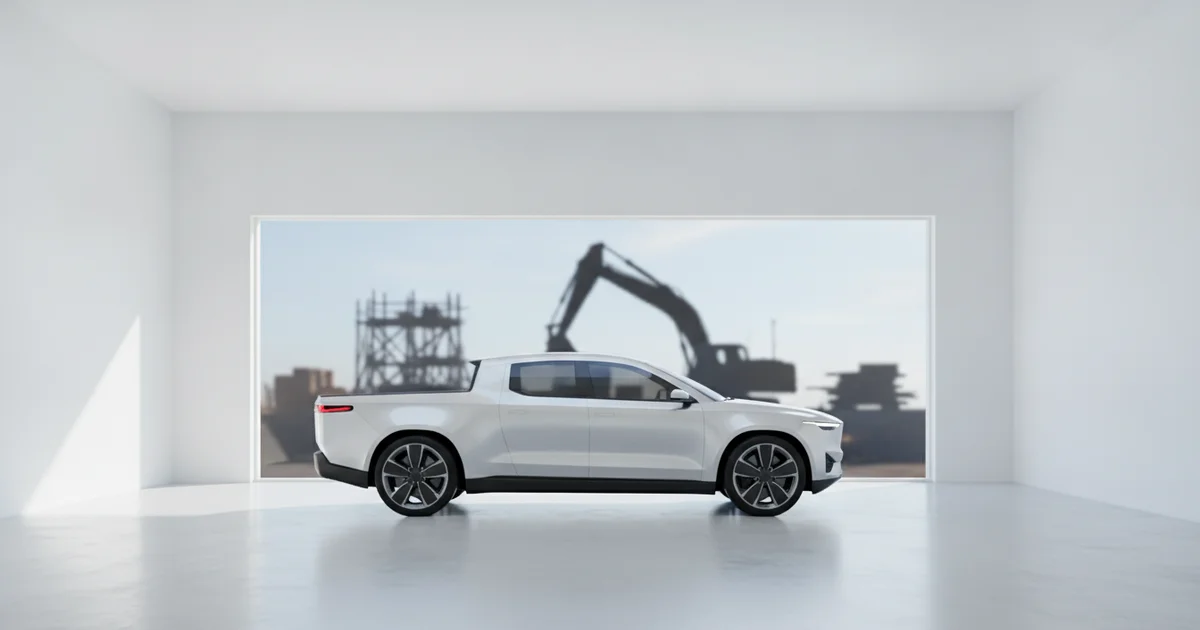
A genuinely impressive truck that almost nobody asked for
The TechCrunch reviewer who tested the Silverado EV admits upfront she’s a hatchback person, not a truck person. She came away wanting one anyway. That reaction keeps showing up in reviews of Chevy‘s electric pickup — people who have no particular loyalty to the segment drive it and find themselves converted.
The reasons aren’t hard to understand. The Silverado EV’s bed is genuinely large, not a compromised version of a truck bed that battery packaging quietly ate. The front trunk is cavernous enough to be useful rather than decorative. The rear cabin has real legroom. Road and wind noise are minimal in a way that gas-powered full-size trucks — even expensive ones — rarely achieve. The electric drivetrain delivers the kind of smooth, effortless acceleration that makes driving feel less like an act of mechanical negotiation and more like a request being instantly granted.
Then there’s vehicle-to-home charging. The Silverado EV can power a house during an outage, turning the truck from a transportation appliance into a backup generator on wheels. That’s not a gimmick feature buried in a spec sheet — it’s a practical utility that reframes what a work truck can be. In hurricane country or fire season territory, that capability is genuinely useful in ways a leather interior upgrade never could be.
The truck also offers over 400 miles of range and hands-free highway driving capability. On paper, these specs read like a product designed to win over the skeptical American truck buyer.
But the sales numbers don’t reflect the review scores. GM moved roughly 14,000 Silverado EVs in a recent reporting period — a modest figure for a brand that sells hundreds of thousands of traditional Silverados annually. The electric Chevy truck isn’t failing because it’s a bad truck. Reviewers with no skin in the game consistently say it’s excellent. The gap between critical reception and consumer demand points to something GM can’t fix with a better spec sheet or a quieter cabin. The problem lives somewhere between the product and the buyer — in assumptions, perceptions, and priorities that the truck itself, however impressive, cannot resolve on its own.
The missing context: who GM actually built this truck for
GM made a deliberate choice when it launched the Silverado EV: lead with the RST trim, priced at around $75,000 at launch. That decision alone told traditional truck buyers — the contractors, ranchers, and tradespeople who represent the backbone of Chevy’s customer base — that this electric pickup wasn’t built for them. A working-class buyer who hauls lumber or pulls a horse trailer on a budget doesn’t start a conversation at $75,000. They walk away before it starts.
The marketing compounded the problem. GM positioned the Silverado EV around its 17.7-inch diagonal touchscreen, its Super Cruise hands-free driving system, and its ability to power a home during a blackout. Those are legitimate selling points — but they speak the language of tech enthusiasts in suburban California, not the language of someone who needs a truck that earns its keep every day in rural Texas or Ohio. Electrification became culturally coded as a coastal product, and GM’s own promotional choices reinforced that perception rather than challenged it.
The sharpest proof of the targeting misfire comes from the reviewers GM has successfully won over. A TechCrunch writer who drove the Silverado EV around Detroit openly admitted, “I’m not exactly Chevy’s target market” — someone who prefers hatchbacks to cargo beds, not a lifelong truck owner. Yet that writer came away impressed. The electric Silverado converted someone who never needed a full-size pickup truck in the first place, while the actual American truck buyer — the person who already owns a gas-powered Silverado or F-150 — remains largely unmoved.
That inversion reveals the core miscalculation. GM built an electric truck capable enough to satisfy traditional truck demands: a massive bed, serious towing capacity, and a range exceeding 400 miles. The hardware isn’t the obstacle. The price point, the trim strategy, and the marketing voice all aimed at an audience that was already open to EVs. The Chevy Silverado EV needed to persuade skeptics. Instead, it preached to converts.
The political and cultural headwinds GM didn’t fully price in
Pickup trucks don’t just haul lumber — they carry identity. The core American truck buyer skews rural, male, and politically conservative, exactly the demographic that has shown the most consistent resistance to electric vehicles. That’s not a stereotype; it’s a purchasing pattern. EV adoption has concentrated heavily in urban and suburban coastal markets, while the F-150 and Silverado heartland — Texas, the Mountain West, the rural Midwest — remains firmly gasoline country.
In those regions, anti-EV sentiment has hardened into something that marketing budgets can’t easily crack. Opposition to electric vehicles has become a cultural signal, a way of pushing back against mandates, against California, against what many truck buyers read as government telling them what to drive. When politicians hold rallies mocking EVs and governors sign legislation blocking EV-only sales requirements, they’re not talking to no one. They’re talking directly to the Silverado EV’s target customer — and winning that conversation.
GM tried to counter this with a made-in-America narrative. The Silverado EV rolls out of the Factory ZERO plant in Detroit, a facility GM rebranded specifically to carry patriotic weight. The argument: this isn’t a foreign-born green-agenda vehicle, it’s an American-built truck. That pitch has not moved the needle in the way GM needed. When your buyer already believes the entire EV push is a federal imposition — tied to emissions regulations, IRA tax credits, and EPA mandates — the assembly zip code doesn’t change the political calculus.
The deeper problem is that no spec sheet fixes a tribal rejection. The electric Silverado can tow, it can deliver 400-plus miles of range, it can power a home during an outage. Those are real capabilities. But truck buyers in resistant markets aren’t declining the Silverado EV because they’ve tested it and found it lacking. They’re declining it before that conversation even starts. GM engineered its way around nearly every practical objection to an electric pickup truck and still ran headlong into a wall that engineering was never going to solve.
What most coverage gets wrong: this isn’t a Tesla problem, it’s a dealer problem
Most truck reviews frame the Silverado EV’s slow sales as a product problem — wrong price, wrong range anxiety, wrong moment in the EV adoption curve. That framing misses the actual bottleneck sitting between GM’s factories and American driveways: the franchised dealership network.
Tesla sells directly to buyers. No middleman, no commission structure pulling a salesperson toward a higher-margin vehicle sitting three rows back in the lot. When a Tesla customer walks in, every person in that showroom is incentivized to close an EV sale. That’s the only sale available.
Walk into a Chevy dealership and the math runs differently. A gasoline-powered Silverado 1500 is a product the sales staff knows cold — financing options, trim packages, towing specs, trade-in value. They’ve sold hundreds of them. The Silverado EV is newer territory, and for many dealers, unfamiliar territory means uncomfortable territory. Buyers consistently report being steered toward ICE trucks by salespeople who either don’t understand the electric powertrain or quietly doubt their customers want one. Some dealers have invested minimally in EV-specific training. Others have simply deprioritized floor space and sales energy for electric inventory.
GM sold roughly 14,000 Silverado EVs in 2024 — a number that reveals the gap between manufacturing ambition and retail execution. The truck itself earned strong reviews. The distribution system surrounding it did not perform at the same level.
This is the structural disadvantage that almost never appears in a road test. GM cannot simply retrain 3,000 dealers overnight or override decades of franchised sales culture with a corporate memo. The incentive misalignment runs deep. An ICE Silverado generates more predictable revenue across service departments too — oil changes, transmission work, exhaust repairs. An electric truck threatens that downstream income, and dealers know it.
The Silverado EV’s real competition isn’t just the F-150 Lightning or the Rivian R1T. It’s the institutional inertia baked into the very network GM depends on to sell it.
The charging gap: range anxiety is real, but it’s worse for truck use cases
The Silverado EV’s 400-plus mile range rating sounds impressive until you remember how GM measures it — unloaded, on flat terrain, under controlled conditions. Hook up a 10,000-pound trailer and that number collapses by 40 to 50 percent, a drop that transforms a capable electric pickup into a truck with genuine operational limits.
This isn’t a Silverado-specific flaw. Towing and hauling are aerodynamic and energy-consumption nightmares for any battery-electric vehicle. But the problem cuts deeper for truck buyers specifically because towing and hauling aren’t edge cases for them — they’re the point. A contractor running materials between job sites, a rancher pulling a horse trailer across the Texas Hill Country, or a weekend warrior towing a boat to a lake in rural Montana isn’t doing something unusual. They’re doing exactly what they bought a full-size truck to do.
The charging infrastructure problem compounds this directly. DC fast chargers cluster around urban corridors and interstate hubs. The rural routes and small-town highways where working trucks actually work remain sparsely covered. A Chevy Silverado EV owner in suburban Phoenix has a fundamentally different charging reality than one based outside Billings. GM designed a truck that performs well in the first scenario and struggles structurally in the second — and the second scenario describes a significant slice of core truck-buying America.
Range anxiety in an EV sedan is a minor inconvenience. In a heavy-duty work truck context, it becomes a business risk. A tradesperson who loses two hours to an unplanned charging stop doesn’t just experience frustration — they miss jobs, blow schedules, and damage client relationships. That asymmetry is what makes the EV truck’s charging gap qualitatively different from the same gap in a consumer commuter vehicle.
Until rural fast-charging density catches up to the actual geographic footprint of American truck use, the Silverado EV’s real-world range limitations function as a hard ceiling on adoption. Better battery chemistry and smarter thermal management will help. A nationwide charging network built for the places trucks actually go would help more.
What needs to change — and whether GM has time to change it
GM’s clearest path to meaningful Silverado EV volume runs through fleets and work-truck buyers, not luxury early adopters. A contractor running ten trucks logs predictable daily miles, charges at a central depot, and calculates fuel and maintenance savings over a five-year ownership cycle. For that buyer, the EV economics are compelling — lower operating costs, reduced brake wear from regenerative braking, and federal commercial clean vehicle incentives that can cut purchase costs significantly. The problem is that the Silverado EV’s entry price, hovering around $75,000 for the Work Truck trim, still places it out of reach for small and mid-sized fleet operators who need the numbers to work on day one. GM has to find a way to push a base electric pickup truck price below $60,000 to unlock that segment, or watch it default to whichever competitor gets there first.
The showroom problem is just as urgent. Dealers built their entire sales process around internal combustion — financing structures, service revenue models, and sales staff compensation all assume a gas-powered truck with a traditional ownership arc. An EV disrupts every one of those assumptions. Chevrolet dealers need specific training on charging infrastructure, total cost of ownership conversations, and fleet procurement cycles. Without that, a motivated fleet buyer walks in and walks out without a purchase order.
The competitive window is compressing. Ford has iterated the F-150 Lightning through multiple model years, sharpening its pricing and expanding trim options based on direct customer feedback. Newer entrants are targeting the commercial electric truck market with purpose-built platforms rather than adapted consumer vehicles. Every quarter GM spends without a lower-priced Silverado EV trim and a retrained dealer network is a quarter Ford or a challenger uses to deepen customer relationships in exactly the fleet segment GM needs most.
The Silverado EV is a capable electric pickup. That capability means nothing if the price structure locks out the buyers for whom an electric work truck makes the most financial sense, and if the people selling it can’t explain why.