The core problem most coverage glosses over: eyes die fast
Most transplant coverage fixates on surgical complexity — the delicate reconnection of nerves, blood vessels, the precise alignment of ocular tissue. That framing misses the more fundamental obstacle: a donor eye begins dying the moment it leaves the body.
Hearts and kidneys tolerate removal far better than eyes do. The retina, optic nerve, and surrounding ocular tissue are metabolically demanding structures. Without continuous oxygen and nutrients, cellular degradation starts almost immediately after a whole eye is harvested from a deceased donor. That narrow window — far tighter than what surgeons face with other solid organs — has made functional whole-eye transplantation effectively impossible, regardless of how skilled the surgical team is.
The real-world evidence for this is hard to ignore. When surgeons performed a whole-eye transplant in recent years, the procedure itself was completed. The transplanted eye, however, never produced vision. The surgical technique existed. The organ viability did not. That outcome made clear that transplant medicine had been solving the wrong problem, or at least an incomplete one. Perfecting the procedure in the operating room means nothing if the donor eye arrives already too compromised to function.
This is the distinction that separates whole-eye transplantation from corneal transplantation, which has succeeded for decades. A corneal graft involves transferring a thin, relatively simple layer of tissue. A full ocular transplant requires the entire eye — retinal cells, photoreceptors, the vitreous body, the intricate neural connections feeding into the optic nerve — to survive procurement, preservation, and surgical implantation while remaining capable of transmitting visual signals. None of that happens if ischemic damage has already set in at the cellular level.
Organ preservation technology, not surgical innovation alone, is what determines whether whole-eye transplantation becomes a viable treatment for blindness. That realization shifts where researchers need to focus — and it’s exactly what the new perfusion device addresses directly.
What the device actually does — and what ‘reviving’ really means
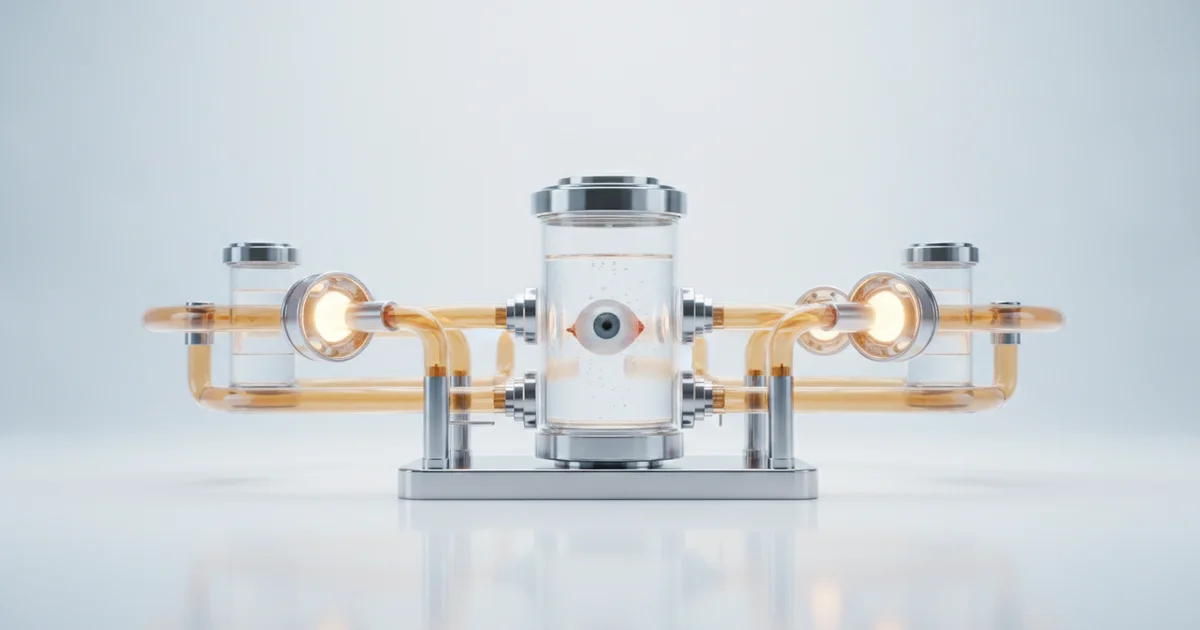
The device works through a process called perfusion — pumping oxygen and nutrients directly into a freshly removed donor eye to mimic the supply it would normally receive inside a living body. Without this intervention, a removed eye begins degrading almost immediately. Cells starve, tissue breaks down, and the biological machinery responsible for vision starts shutting down within minutes. Perfusion slows or halts that process, giving surgeons a viable organ to work with rather than a rapidly deteriorating one.
Researchers behind the device say treated eyes not only degrade more slowly but appear to retain the biological capacity for sight — meaning the photoreceptors, retinal cells, and supporting tissue remain functional enough that, in theory, they could still process light after transplantation. That claim puts this technology in a different category from conventional eye preservation methods, which focus narrowly on keeping tissue alive for corneal grafts rather than maintaining whole-eye function.
But “biologically viable” and “functionally seeing” are not the same thing, and that distinction matters enormously. A donor eye preserved through perfusion may arrive at the point of transplant with its cellular machinery intact. Whether that eye will actually restore a recipient’s vision depends on a separate and still-unsolved problem: getting the transplanted eye’s optic nerve to reconnect with the recipient’s brain. Neural integration — the process by which the visual cortex learns to interpret signals from a new eye — remains one of the hardest challenges in whole-eye transplantation. The 2023 surgery that first successfully transplanted a whole human eye achieved vascular connection but did not restore sight, precisely because that neural bridge did not form.
This device addresses the preservation side of the equation. It gives surgeons a better donor eye to work with. It does not, on its own, solve optic nerve regeneration or cortical adaptation. What it changes is the starting point — transplant teams working on whole-eye procedures now have a tool that keeps the donor organ in transplant-ready condition, removing one of the key barriers that has made functional whole-eye transplantation impossible until now.
The missing context: what restored vision from a whole-eye transplant would actually require
Even if the perfusion device delivers a donor eye to a surgical team in perfect biological condition, that eye still faces a problem no preservation technology can fix: it has to talk to a brain it has never met.
The optic nerve is not a simple cable you plug in and switch on. It contains over a million individual nerve fibers, each one carrying a specific signal from a specific region of the retina to a specific region of the visual cortex. Reconnecting those fibers after transplant requires those axons to regenerate across a severed junction — a process the adult human central nervous system does not reliably perform. When surgeons completed the first reported whole-eye transplant alongside a partial face transplant in 2023, the transplanted eye showed blood flow and tissue survival, but the recipient did not regain functional vision through it. The eye was alive. The recipient still could not see.
This distinction is the gap that most coverage skips. A transplanted eye retaining electrical activity in its retinal cells — which the perfusion research demonstrates is possible — is a preservation milestone. It is not the same as optic nerve integration, and it is not the same as the visual cortex learning to interpret signals from a new organ. Those are separate neurological problems requiring separate solutions, likely involving nerve growth factors, targeted axon guidance, and years of further research.
Immune rejection adds another layer. The eye was historically considered immune-privileged, meaning the body tolerates it better than most foreign tissue. Whole-eye transplantation breaks that privilege. Once the eye connects to the systemic bloodstream and lymphatic system, the recipient’s immune response can identify and attack donor tissue. Lifelong immunosuppression becomes necessary, carrying its own risks: infection vulnerability, organ toxicity, increased cancer rates.
Preservation science solves one piece of a multi-piece problem. A viable donor eye is the starting point, not the finish line. Restored sight from whole-eye transplantation requires optic nerve regeneration, cortical adaptation, and immune management — three challenges that remain open and active across ophthalmology, neuroscience, and transplant medicine simultaneously.
Why this matters now: the moment whole-eye transplants become plausible
For decades, the central obstacle to whole-eye transplantation appeared insurmountable: donor eyes deteriorate within minutes of leaving the body, and no surgical team could work fast enough to outrun that biological clock. The perfusion device changes that equation. By keeping a harvested eye oxygenated and metabolically stable, it removes organ degradation from the list of hard blockers — and that shift matters enormously. The field’s remaining challenges, surgical reconnection of the optic nerve and achieving functional vision after transplant, are difficult problems, but they are the kind of problems that research programs can systematically attack. A decaying organ is not.
That distinction reshapes the realistic roadmap for ocular transplantation. When surgeons performed a whole-eye transplant in 2023, the transplanted eye did not achieve sight. Investigators traced a significant part of that failure to the condition of the donor eye itself. A viable preservation method means future attempts start from a fundamentally stronger position — the transplanted eye arrives at the surgical table with its photoreceptors and retinal architecture intact and functional.
For patients who have lost an eye to trauma, cancer, or severe infection, the difference between a cosmetic prosthesis and a sight-restoring transplant is not incremental. It is total. A prosthetic eye addresses appearance; a functioning transplanted eye addresses lived experience. The patient population that stands to benefit — people blinded by injury rather than by degenerative retinal disease — includes many who retain an otherwise healthy visual cortex capable of processing signals, provided those signals can reach it.
This development lands at a moment when adjacent fields are accelerating. Microsurgical techniques have grown precise enough to reconnect small-diameter blood vessels and nerve bundles with a consistency that was not available a generation ago. Nerve regeneration research, including work on optic nerve repair after injury, has produced early results in animal models that suggest some axonal regrowth is achievable under the right biochemical conditions. No single breakthrough solves whole-eye transplantation alone, but the convergence of preserved organ viability, improved microsurgery, and advancing neuro-regenerative science compresses what once looked like a fifty-year timeline into something the next decade could credibly test.
Realistic timeline and what comes next
The perfusion device represents a proof of concept, not a finished surgical protocol. Human clinical trials for functional whole-eye transplantation — meaning a transplanted eye that actually restores vision — remain years away. Researchers still need to solve the optic nerve reconnection problem, demonstrate consistent results across larger sample sizes, and satisfy regulatory bodies that the procedure is both safe and reproducible before a single patient enters a trial.
The more immediate impact will likely land in eye banks and operating rooms already performing partial procedures. Corneal transplants, retinal grafts, and other partial ocular surgeries depend on donor tissue quality, and that quality degrades fast after death. A perfusion device that keeps harvested eyes metabolically stable for longer could directly expand the usable donor pool and improve graft outcomes for the tens of thousands of patients who receive corneal transplants each year in the United States alone. That near-term application requires far less regulatory lift than full whole-eye surgery and could reach clinical use considerably sooner.
The longer path — complete ocular transplantation with restored sight — faces layered obstacles beyond the laboratory. Regulatory agencies will demand rigorous safety data covering immune rejection, infection risk, and long-term neurological integration. Ethical questions around donor consent and the psychological weight of receiving another person’s eye will require frameworks that medicine has only begun to develop. Donor supply itself presents a structural ceiling; eyes suitable for whole-eye transplantation must be harvested quickly and handled precisely, which limits how many procedures could realistically occur even if the surgery becomes standard.
The realistic window for whole-eye transplantation moving from experimental surgery to an established vision-restoration procedure is measured in decades, not years. What shifts now is the underlying assumption. Before this device, the degradation problem made the entire concept of sight-restoring ocular transplantation appear biologically intractable. That assumption no longer holds.