What Changed — and What Didn’t
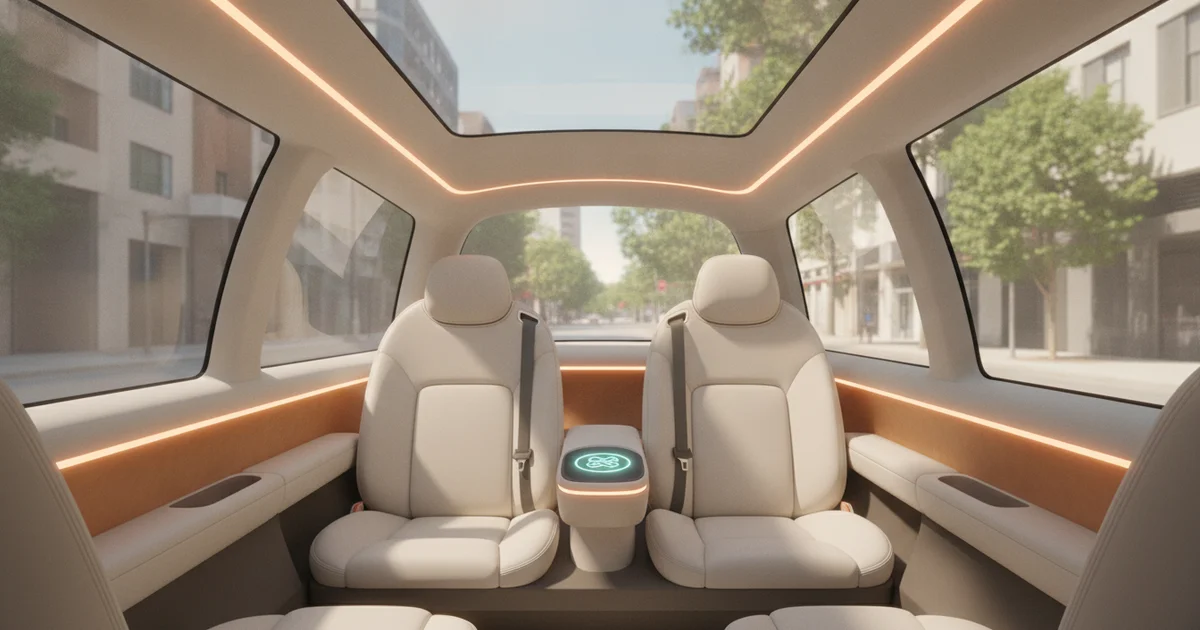
Zoox didn’t tear up its blueprints. The Amazon-owned autonomous vehicle company unveiled a round of upgrades to its cube-shaped robotaxi that refine the experience without abandoning what made the original design distinctive. The vehicle still has no steering wheel, no driver controls, and no forward-facing orientation — it travels bidirectionally, uses four-wheel steering, and carries up to four passengers at speeds reaching 75 miles per hour.
What Zoox kept is as revealing as what it changed. The moonroof stays. The starry night interior lighting stays. The sensor array — 40 cameras, radars, lidars, and infrared sensors — stays. These aren’t compromises or oversights. They’re signals that Zoox’s foundational design decisions have survived contact with actual riders and come out intact. When a company iterates rather than rebuilds, it means the core architecture is working.
The upgrades themselves target comfort and functionality, and they came directly from rider feedback. That last part matters more than the headlines usually let on. Real people have been riding inside this vehicle. Not engineers running controlled tests, not demo passengers on a closed lot — riders generating the kind of qualitative data that no simulation produces. Zoox is already learning from human beings sitting in seats, traveling through real environments, and forming real opinions about what autonomous passenger vehicles need to feel trustworthy and usable.
This is where the gap between robotaxi technology and robotaxi adoption gets visible. The self-driving system can navigate a city street. The harder problem is making a person feel comfortable enough to stop gripping the door handle. Zoox’s decision to let rider experience drive product iteration — rather than engineering benchmarks alone — reflects a clearer understanding of what commercial launch actually requires. Getting a driverless vehicle to its destination safely is one challenge. Getting passengers to book a second ride is another one entirely.
The Missing Context: Zoox Has Been Quietly Testing on Real Riders
Most robotaxi coverage reads like science fiction previews — breathless speculation about a driverless future that always seems five years away. Zoox is already past that point. The Amazon-owned company has accumulated enough real passenger data from actual riders to make specific, granular design decisions about its autonomous vehicle. That’s not a concept phase. That’s an operational feedback loop.
The significance of this gets buried in typical coverage. Zoox’s recent redesign wasn’t driven by engineers hitting performance ceilings on the autonomous driving stack. The vehicle still runs the same core hardware — 40 cameras, radars, lidars, and infrared sensors, bidirectional driving capability, four-wheel steering, and a top speed of 75 mph. The fundamental autonomous system stayed intact. What changed came directly from rider experience: comfort, cabin feel, the small details that determine whether a passenger feels safe or unsettled during a driverless trip. When human comfort replaces engineering bottlenecks as the primary design variable, it signals that the underlying autonomous technology has crossed a maturity threshold.
That shift reframes who Zoox is actually competing against. Miles driven is the metric the autonomous vehicle industry obsesses over publicly — Waymo regularly publishes its cumulative figures as proof of progress. But passenger experience design operates on a different scorecard, one that rarely gets tracked or compared across companies. Zoox is actively optimizing for it anyway. The moonroof, the starry night lighting, the cabin layout — these aren’t marketing flourishes. They’re responses to what riders reported feeling inside the vehicle during real trips. That feedback-driven iteration process puts Zoox in a competitive dimension that most industry analysis ignores entirely.
Commercial robotaxi adoption won’t stall because the software can’t navigate an intersection. It will stall if passengers find the experience disorienting, uncomfortable, or anxiety-inducing. Zoox is treating that problem as an engineering challenge with the same seriousness it applies to the autonomous driving system itself.
Why Amazon’s Ownership Makes This Moment Strategically Significant
Amazon acquired Zoox in 2020 for more than $1 billion, and for five years that investment existed largely in the background — a bet on autonomous vehicle technology with no consumer-facing product to show for it. A commercial robotaxi launch in 2025 changes that equation entirely.
For the first time, Amazon would operate a passenger mobility service on public roads. That’s a different category from delivery drones or warehouse automation robots. It puts Amazon’s name directly in front of riders making real-time decisions about whether to trust a driverless car with their safety.
What most coverage of the Zoox upgrade misses is the infrastructural advantage Amazon brings to the mobility-as-a-service space. Amazon holds one of the largest consumer data and logistics networks ever built. That infrastructure enables demand prediction at a granularity that pure-play autonomous vehicle companies like Waymo simply don’t possess. Zoox could theoretically anticipate ride demand by neighborhood, time of day, and local event schedules using behavioral data Amazon already collects across its retail, streaming, and delivery platforms. Routing efficiency in a robotaxi fleet isn’t just a mapping problem — it’s a demand forecasting problem, and Amazon has spent two decades building the tools to solve it.
Analysts currently position Amazon in the autonomous vehicle conversation primarily through its acquisition of self-driving truck company Aurora and its investments in delivery robotics. A Zoox launch forces a direct reassessment. Amazon would become a named competitor in urban passenger transportation, competing against Waymo’s expanding robotaxi operations in San Francisco, Los Angeles, and Phoenix, and against Tesla’s promised autonomous ride-hailing network.
The strategic pressure runs in both directions. Waymo has years of operational data and public trust built through millions of driverless rides. Tesla has brand loyalty and a massive existing vehicle fleet. Amazon counters with distribution scale, consumer relationships, and the ability to bundle autonomous ride services into Prime or other subscription products in ways neither rival can easily replicate. The Zoox commercial launch isn’t just a product debut — it marks Amazon’s entry into a mobility market that could reshape how cities and consumers think about transportation infrastructure.
The Trust Design Problem Nobody Is Talking About
Zoox made a deliberate choice when it stripped the steering wheel from its robotaxi cabin — and that choice carries psychological weight far beyond aesthetics. For most riders, a steering wheel represents a last resort, a physical object that signals someone could theoretically intervene. Remove it, and you remove the illusion of control entirely. Research on human-automation interaction consistently shows that perceived control — even illusory control — directly reduces anxiety in high-stakes situations. Zoox isn’t just designing a vehicle. It’s designing a psychological environment where passengers must fully surrender to the machine.
That surrender is harder than it sounds, which is why the comfort-focused upgrades in Zoox’s latest redesign deserve serious attention. Improved seating and cabin environment aren’t amenity upgrades — they’re trust engineering. When an autonomous vehicle brakes sharply, takes an unexpected turn, or accelerates without warning, a passenger’s nervous system registers threat. A calm, well-designed interior environment actively dampens that stress response. Zoox is essentially building a space that keeps riders physiologically composed during the moments autonomous driving feels most alien.
The decision to retain the moonroof tells the same story from a different angle. Enclosed cabins without external visual reference create disorientation and heighten claustrophobia — both documented responses that early robotaxi test riders have flagged across multiple autonomous vehicle programs. Skyward visibility gives passengers a spatial anchor. The Zoox vehicle also keeps its starry night interior lighting, another deliberate cue designed to soften what could otherwise feel like a sealed, machine-controlled box moving through traffic at up to 75 miles per hour.
Together, these design choices reveal what the autonomous vehicle industry rarely discusses openly: the technology barrier to commercial robotaxi adoption has largely been cleared. The remaining barrier is human trust calibration — convincing riders that surrendering physical control inside a driverless car is safe, comfortable, and repeatable. Zoox’s rider-feedback-driven redesign is a direct acknowledgment that deploying a robotaxi fleet at commercial scale requires solving that psychological problem with the same rigor applied to sensor arrays and navigation software.
What a Commercial Launch Actually Requires Beyond the Vehicle
Perfecting the cabin gets Zoox nowhere without regulatory clearance. Before a single paying passenger boards, Zoox must secure operating permits in every target market — a process that moves on government timelines, not product roadmaps. Insurance frameworks for fully driverless commercial vehicles remain underdeveloped across most U.S. jurisdictions, and public incident response protocols, the procedures that activate when an autonomous vehicle is involved in a collision or breakdown, are still being written in real time by regulators and municipalities. A redesigned headrest does not accelerate any of that.
The Amazon ownership structure introduces a pricing variable that competitors should watch closely. Amazon has a documented history of subsidizing services to capture market share before optimizing for profit. If Zoox applies that same playbook to autonomous ride-hailing, it could price rides below cost during launch, undercutting Waymo and putting serious pressure on Uber and Lyft in whatever cities Zoox enters first. That kind of pricing aggression would reshape the robotaxi competitive landscape faster than any sensor upgrade.
Then there is the timeline itself. Zoox says it “hopes to launch” commercial service later this year. That phrasing deserves scrutiny. Cruise targeted commercial expansion across multiple cities before a 2023 pedestrian incident triggered a national permit suspension. Waymo spent years in a perpetual “imminent launch” phase before its San Francisco service stabilized. Autonomous vehicle companies consistently announce commercial windows that slip — not because engineers are incompetent, but because the gap between impressive demos and repeatable, insurable, regulatorily approved operations is enormous.
Treat Zoox’s 2025 commercial target as a directional signal, not a delivery date. Track the specific regulatory filings, the insurance partnerships, and the city-by-city permit approvals. Those are the real milestones. When those materialize, the commercial robotaxi launch becomes real. Until then, the upgraded vehicle is a proof of intent, and the autonomous mobility race remains very much open.
The Bigger Picture: Robotaxis Are Entering Their ‘iPhone Moment’ — But for Passengers, Not Engineers
The robotaxi industry is living through its own iPhone moment — not the 2007 version that amazed engineers, but the 2010 version that had to convince ordinary people to reorganize their lives around a new device. Zoox’s rider-feedback-driven redesign signals that autonomous vehicle companies have crossed the first threshold. The harder work starts now.
For years, the central question in self-driving car development was technical: can the system navigate a city without human intervention? Zoox, Waymo, and their competitors have largely answered yes. The question that determines commercial success is different — do passengers actually want to ride in these vehicles again? That shift from engineering feasibility to consumer product refinement is historically where promising technologies either achieve mass adoption or calcify into expensive curiosities used by early adopters and no one else.
Zoox’s decision to rebuild comfort and interface features around direct rider input, rather than internal assumptions, creates something more durable than any lidar array or perception software update. A systematic feedback loop between passengers and engineers compounds over time. Each iteration produces a vehicle that better matches real human expectations — how people want to enter, sit, orient themselves, and feel during an autonomous ride. Competitors can replicate sensors. Replicating months or years of structured rider data, embedded into product decisions, takes much longer.
The stakes extend beyond Zoox’s commercial launch timeline. Public perception of autonomous passenger vehicles is still largely unformed. A majority of Americans have never ridden in a robotaxi. The experiences that early commercial riders have in Las Vegas, San Francisco, and other initial markets will shape whether autonomous ride-hailing enters mainstream transportation or remains a technology demonstration. Negative word-of-mouth from uncomfortable, confusing, or anxiety-inducing rides travels fast. So does genuine enthusiasm.
The autonomous vehicle industry spent over a decade proving its technology could handle the road. Now it has to prove the ride is worth taking.