The Canvas TV Market Was Basically a Samsung Monopoly — Until Now
For years, Samsung’s The Frame held an unchallenged grip on the canvas TV category. Samsung didn’t just dominate this niche — it invented it as a consumer product, training buyers to treat art-mode TVs as a Samsung-exclusive concept. Shoppers who wanted a TV that displayed museum artwork on the wall when not in use had exactly one credible option, and it carried a premium price tag to match that monopoly position.
That dynamic is now shifting. A QLED canvas-style TV from a non-Samsung manufacturer entered the market at $650 less than a comparable Frame model, a price gap wide enough to signal genuine competition rather than a token challenger. That kind of discount doesn’t just attract bargain hunters — it forces the entire category to justify its pricing structure.
The timing is deliberate. Memorial Day 2025 is one of the highest-traffic TV shopping windows of the year. Retailers push aggressive deals, consumers actively comparison shop, and a new product gets maximum exposure against established names. Launching a direct Frame competitor into that environment is a calculated move to capture buyers who had already decided to purchase a canvas TV but assumed Samsung was their only serious choice.
The broader implication is that the canvas TV category has reached a maturity threshold. When a single brand defines a product category for years, competitors stay away because the pioneer holds all the brand equity. Once a well-specified challenger enters at a meaningfully lower price, the category has crossed from novelty into mainstream. Budget buyers now have a real decision to make — and Samsung has a real reason to respond.
What ‘QLED Canvas Art TV’ Actually Means — Cutting Through the Jargon
When you see “QLED Canvas Art TV” on a product listing, two separate features are bundled into one phrase, and understanding each one independently saves you money.
QLED stands for Quantum Light Emitting Diode. The technology uses microscopic semiconductor particles — quantum dots — layered within the display to expand color volume and push peak brightness higher than standard LED panels achieve. Samsung did not invent quantum dot technology, but the company aggressively marketed the QLED label starting in 2017, burning it into consumer consciousness as if it were proprietary hardware. It is not. Any TV manufacturer can build a quantum dot display and legitimately call it QLED. Hisense, TCL, and other brands already do.
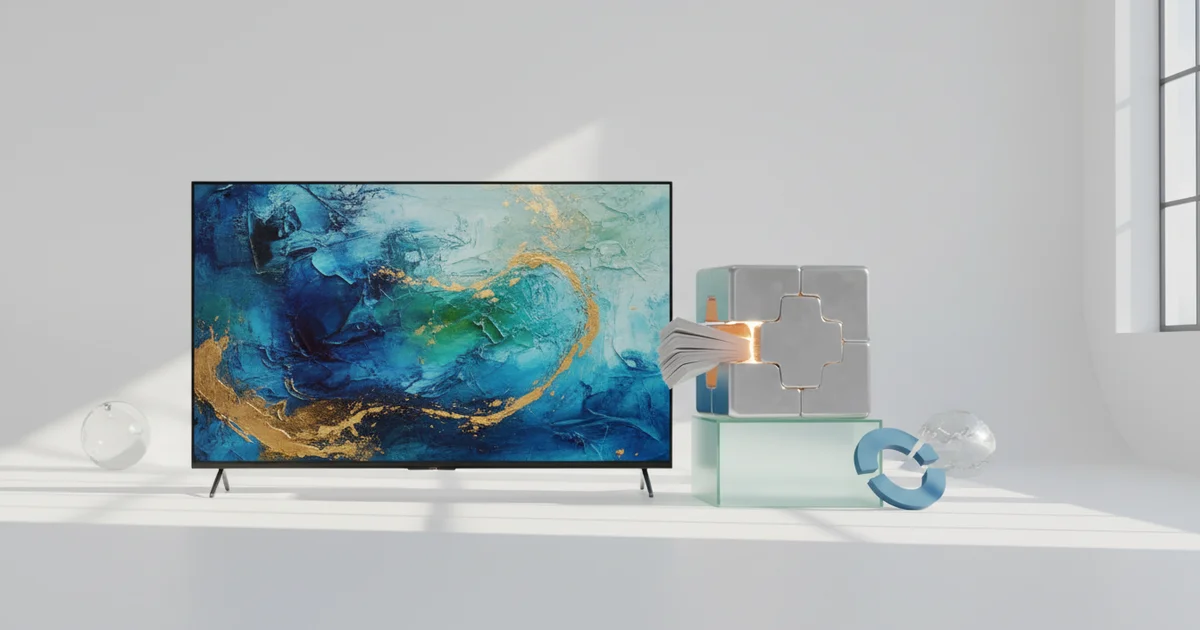
Canvas art mode is the second feature. When the TV sits idle, instead of going black, it displays a rotating gallery of paintings, photographs, or personal images — functioning as a framed artwork piece on your wall. Samsung commercialized this concept with its Frame TV lineup and set premium prices accordingly. Again, this is a software and hardware design choice, not a patented Samsung exclusive. A TV from any brand can ship with an art display mode built in.
The practical takeaway is direct: QLED and canvas art mode are features defined by specifications and software implementation, not by the manufacturer’s logo. A buyer paying a $650 premium for Samsung’s version of this product is largely paying for brand recognition and Samsung’s ecosystem, not for underlying technology unavailable elsewhere. Competing TVs running quantum dot panels with idle art display modes exist at significantly lower price points and clear the same technical bar. Knowing what each term actually describes strips away the marketing layer and lets you evaluate whether the premium reflects genuine capability or simply years of successful brand positioning.
The $650 Gap: Where the Savings Come From and What the Real Cost Might Be
A $650 price difference is not a rounding error — it’s a mortgage payment, a plane ticket, or three months of streaming subscriptions. That gap demands a direct explanation, and the answer typically lives in three places: the software platform, the long-term firmware support, and the brand ecosystem surrounding the product.
Samsung’s The Frame runs on Tizen OS, a proprietary platform Samsung has refined since 2015. Tizen supports over 2,000 apps, integrates natively with Bixby and Alexa, and has a proven track record of receiving software updates four to five years post-purchase. Budget canvas TV alternatives frequently run on Google TV or a lesser-known fork of Android TV — platforms that are functional but carry no guarantee of the same update cadence or voice assistant depth that Samsung delivers out of the box.
The décor angle sharpens the stakes. A canvas-style TV is explicitly designed to disappear into a room permanently — mounted on a wall, paired with custom bezels, treated more like furniture than electronics. Buyers who commit to that installation philosophy are effectively locking in a software experience for the life of the room’s design. If a non-Samsung alternative stops receiving firmware updates in year three, the TV doesn’t stop working, but it starts falling behind on codec support, streaming app compatibility, and security patches.
The $650 savings also reflects real differences in panel sourcing, build finish, and after-sales support infrastructure. Samsung operates service centers across the country with standardized parts availability. Challenger brands often route warranty claims through third-party repair networks with longer turnaround times and less consistent outcomes.
None of this makes the alternative a bad purchase. A $650 discount is genuinely meaningful, and for buyers who stream from a single app or use an external device like a Roku or Apple TV for content, the underlying smart TV platform becomes nearly irrelevant. The calculus shifts entirely for buyers who rely on native apps, smart home integration, or expect the TV to function as a hub rather than a display.
What Most Deal Coverage Is Missing: The Art Mode Experience Isn’t Just Hardware
Price tags dominate the Memorial Day deal coverage. A rival canvas TV sitting $650 below Samsung’s The Frame makes for a clean headline, but the comparison stops exactly where it should start.
Samsung’s Art Mode runs on a proprietary content ecosystem called the Art Store, which carries thousands of licensed works spanning classical paintings, photography, and contemporary pieces. Subscribers pay roughly $6.99 per month to access the full rotating catalog. That subscription funds ongoing licensing deals with museums and artists — infrastructure a hardware manufacturer entering the canvas TV category cannot replicate by shipping a product with a competitive panel spec.
Competing canvas TVs frequently launch with stripped-down art libraries. Some ship with fewer than 100 default images. Owners who want genuine variety then face a patchwork of workarounds: sideloading image files through USB, using Google Photos integrations, or running third-party digital art apps that were never designed to mimic the passive, painting-like experience The Frame delivers natively. For a TV whose entire identity is built around looking like art when you’re not watching it, a clunky slideshow interface defeats the purpose.
The hardware details compound the gap. Samsung’s no-gap wall mount and Slim Fit cable system are engineered specifically to make The Frame sit flush against a wall with a single cable running out of sight. The matte display coating reduces glare in ways that matter enormously when a TV needs to pass as framed artwork under ambient lighting. Competing models may offer standard VESA mounting patterns and glossy panels, which means the TV hangs on the wall like a TV — not a canvas.
None of these differences show up in a side-by-side price comparison. Buyers chasing the lower sticker absorb real trade-offs: a thinner content library, mounting hardware that requires separate purchases or compromises, and display surfaces that reflect rather than absorb light. The savings are real. So are the limitations.
Who Should Actually Buy This, and Who Should Wait
Budget-first buyers get the most out of this deal. If you want a solid QLED panel with motion smoothing, HDR support, and a canvas art mode you’ll flip on occasionally when guests come over, the $650 savings over a comparable Samsung Frame TV is real money that justifies the tradeoff. You’re getting the core TV experience with the art display as a bonus feature, not the centerpiece.
The calculus shifts for buyers who plan to run art mode eight or more hours a day as a design element in a living room or bedroom. Samsung’s Frame TV ecosystem includes a curated Art Store with thousands of licensed works, a matte anti-glare display specifically engineered to mimic framed canvas texture, and years of software refinement around ambient detection and automatic brightness adjustment. That infrastructure has a price, and for daily art-display users, it may be worth paying.
Impulse buyers should ignore the Memorial Day deadline. Canvas-style QLED TVs from non-Samsung brands have appeared at similar discounts during Black Friday, Labor Day, and post-holiday sale windows. The $650 gap between competing canvas TVs and Samsung’s Frame lineup is a structural pricing difference, not a one-week anomaly. If you miss this weekend’s sale, a comparable offer will surface within a few months.
The short version: buy now if you prioritize TV performance and see the canvas feature as a pleasant extra. Wait or pay the premium if art display is the primary reason you’re buying the TV at all. Neither choice is wrong — they just reflect different definitions of what this product is actually for.
The Bigger Picture: What This Signals for the Premium TV Market
The canvas TV category is following a well-worn path. Samsung established the concept, charged a premium to early adopters, and held near-total ownership of the market for years. Then a credible alternative arrived at a significantly lower price — in this case, $650 less for a comparable QLED model — and the monopoly started cracking. This is exactly what happened in the soundbar market, where Samsung’s early dominance eventually gave way to serious competition from Sony, Sonos, and budget-focused brands, driving prices down and forcing faster feature development across the board. The smart-display category followed the same arc. Samsung won’t be exempt from that pattern here.
For consumers, the timing is good. When a second manufacturer proves the canvas TV concept is viable at a lower price point, it signals that a third and fourth will follow. That competitive pressure typically compresses prices and accelerates feature rollouts within two to three years. Buyers who wait can reasonably expect better ambient display capabilities, improved art libraries, and smarter integration with home ecosystems — all at prices closer to what a standard premium TV costs today.
For Samsung, the calculus is urgent. The Frame has always leaned on brand cachet and ecosystem lock-in — Tizen OS, SmartThings compatibility, Art Store subscriptions — to justify its price. Those advantages still exist, but they shrink in value the moment a buyer realizes they can spend $650 less on a QLED canvas TV that handles the core use case without the Samsung tax. Samsung now has to demonstrate that its ecosystem depth, picture calibration, and software updates are genuinely worth the gap, not just assumed to be.
The premium TV market is entering a phase where the category pioneer has to earn its premium every year, not just collect it. Samsung built the canvas TV segment. Keeping it means competing on merit.