The graphene buzzword problem: hype meets hardware
Graphene is real. The hype around it in consumer electronics is not.
Since Andre Geim and Konstantin Novoselov won the 2010 Nobel Prize in Physics for isolating graphene, the material has carried genuine scientific credibility. It conducts heat better than any known material, carries electrical current with minimal resistance, and is stronger than steel at a fraction of the weight. Battery manufacturers know consumers have absorbed enough of this reputation to make “graphene” a compelling word on a box — and they exploit that knowledge aggressively.
Walk through any major retailer’s portable charger section and you will find “graphene battery,” “graphene tech,” and “graphene-enhanced” used interchangeably across products with wildly different internal architectures. These terms describe three distinct things. A true graphene cell uses graphene as a core electrode material. A graphene-enhanced composite blends small quantities of graphene into a conventional lithium-ion electrode, typically to marginally improve conductivity. A graphene coating applies a thin layer of graphene-derived material to battery cells or internal components purely for heat dissipation. The performance difference between these approaches is significant. The marketing language treats them as identical.
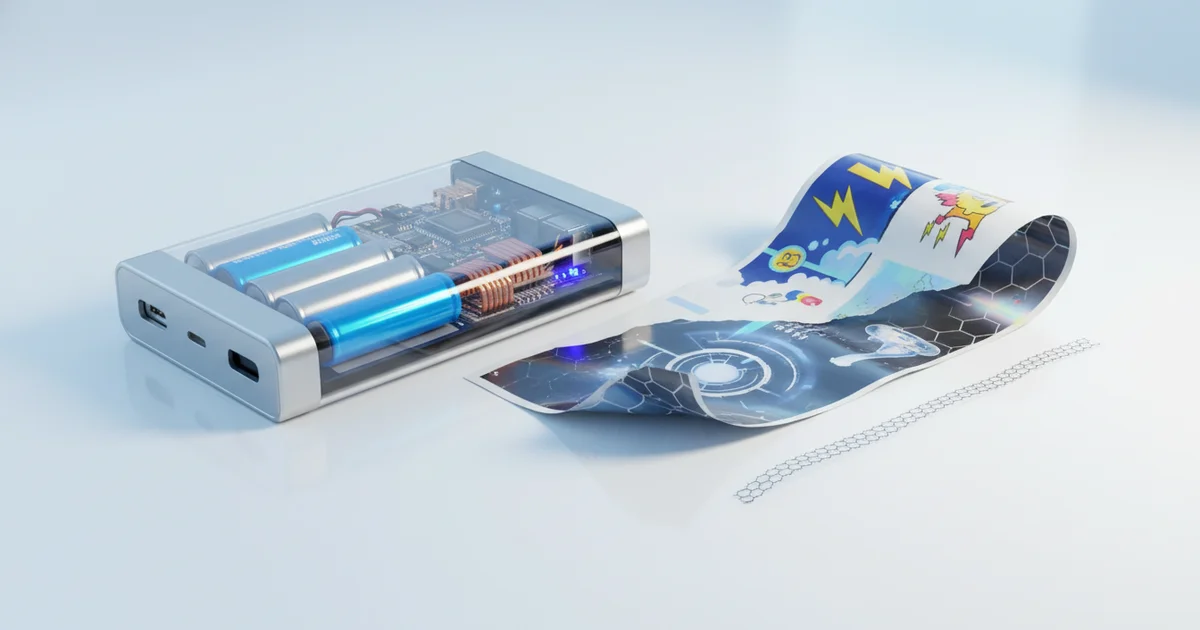
Brands selling graphene power banks rarely specify which category their product falls into. Packaging lists graphene as a feature without disclosing whether it appears in the cell chemistry, the casing, or a thermal pad sandwiched between components. When ZDNET teardown reporting examined a commercially available “graphene” power bank, the internal construction raised direct questions about whether the graphene branding reflected the cell itself or simply a heat-management layer — a much cheaper and less transformative application of the material.
This ambiguity is not accidental. Consumer protection law in most markets requires that performance claims be substantiated, but listing a material by name without attaching a specific performance claim creates a legal grey zone that marketers navigate deliberately. No brand has to prove that its graphene battery charges faster or lasts longer if it never formally claims those outcomes. The word does the work instead, borrowing legitimacy from peer-reviewed physics while committing to nothing measurable.
What cracking one open actually revealed
Cracking open a commercially available graphene power bank is the most direct audit a consumer or reviewer can perform, and what the internal architecture reveals is damning for the marketing claims printed on the box.
Physical teardowns of units sold under prominent graphene branding show battery cells that are visually and structurally indistinguishable from standard lithium-polymer cells found in conventional power banks at half the price. The graphene, if present at all, does not appear integrated into the electrode structure or the cell chemistry — the locations where it would actually need to be to influence thermal conductivity or charge rates in any meaningful way.
Thermal imaging during charge cycles tells the same story. Hot spots appear at the same locations they do in non-graphene competitors: around the charge controller IC, along the battery cell’s midsection, and near the output ports. A material with graphene’s thermal conductivity — theoretically around 5,000 watts per meter-kelvin — would redistribute heat across the cell surface and suppress those concentrated hot spots. It does not. The heat maps look routine.
What some teardowns do find is a thin graphene-oxide coating applied to the outer casing or to a secondary heat spreader layer positioned between the cells and the shell. That placement has cosmetic value at best. It does nothing to address heat generated inside the cell, which is where charge-rate limitations and degradation actually originate.
The internal architecture of many of these units — the cell count, the battery management system, the PCB layout — matches generic lithium-polymer designs sold under no-name branding on wholesale platforms. The graphene label is the differentiator on paper. Inside the housing, it is nearly invisible, and in the battery cells themselves, there is no verified evidence it is present at all in concentrations that would alter electrochemical performance.
Consumers paying a premium for graphene thermal management are, in a significant number of cases, paying for a material that exists on the surface of a product rather than inside it.
The real science of heat dissipation in portable batteries
Graphene’s thermal conductivity reaches up to 5,000 W/m·K in controlled laboratory conditions — a figure that genuinely dwarfs copper at around 400 W/m·K and aluminum at roughly 200 W/m·K. That number is real. The problem is what happens to it outside the lab.
Translating graphene’s thermal properties into a consumer power bank requires binding graphene to other materials. The moment manufacturers mix graphene flakes with polymers to create a workable composite — one that can actually be shaped into a battery casing or internal layer — thermal conductivity drops dramatically. A graphene-polymer composite routinely performs at a fraction of pure graphene’s theoretical ceiling, often landing closer to 5–10 W/m·K depending on graphene concentration and layer thickness. That is still a modest improvement over standard plastics, but it is nowhere near the exotic performance the marketing copy suggests.
The deeper issue is that heat dissipation in a portable charger is a system-level problem. The lithium-ion cells generate heat during charge and discharge cycles. That heat travels through the circuit board, across any thermal interface materials, and finally out through the casing. Every layer in that chain has its own thermal resistance. Optimizing one thin graphene film on the interior casing does nothing meaningful if the cell chemistry, PCB layout, and external shell are not engineered around heat management as a unified priority.
A reviewer at ZDNET physically disassembled a power bank marketed on graphene heat dissipation and found a conventional lithium-ion cell inside with a thin graphene-composite sheet applied near the casing — a configuration that functions primarily as a heat spreader, not a fundamental thermal redesign. The shell still got warm under load. Charging speeds remained comparable to non-graphene competitors in the same wattage class.
Graphene can contribute to thermal management when applied correctly in a purpose-built system. Used as a thin marketing film on an otherwise standard product, it contributes very little. Consumers buying on the basis of thermal claims deserve to know which situation they are actually paying for.
What most tech coverage gets wrong about graphene batteries
Most tech reviewers treat “graphene battery” as a specification, the same way they treat battery capacity or USB-C wattage. They measure surface temperature during a charge cycle, confirm the numbers land near what the manufacturer promised, and publish. What they don’t do is verify whether graphene is structurally present in the cell itself or doing anything functionally meaningful inside the product.
That gap matters because the label carries zero regulatory weight. No consumer-facing certification body — not UL, not the FCC, not any international battery standards organization — currently defines what qualifies a power bank to carry the word “graphene” on its packaging. A manufacturer can apply graphene oxide to an exterior heat-dissipation layer, describe the entire product as a “graphene battery,” and face no legal challenge for doing so. One teardown published by ZDNET found exactly this situation: a power bank marketed on graphene’s thermal and charging properties contained conventional lithium-ion cells with what appeared to be a graphene-adjacent coating on external components rather than any graphene-integrated electrode chemistry.
That distinction is not a technicality. Graphene incorporated into an anode material changes how ions move during charge and discharge. A graphene coating on a plastic housing does not. Conflating the two is the core of the problem, and mainstream coverage repeats the conflation constantly because journalists and influencers source their technical claims directly from manufacturer spec sheets.
When a publication runs a headline like “graphene power bank charges 30% faster” without materials verification, it converts marketing copy into apparent fact. Readers have no reason to doubt it. The publication has a track record. The numbers seem plausible. What’s missing is the one step that would actually answer the question: independent confirmation that graphene is present where the manufacturer claims it is, in a concentration and configuration that produces the stated effect.
That step is not being taken. The absence of regulation makes it optional. The affiliate-commission structure of most consumer tech publishing makes it inconvenient. Consumers absorb the cost.
When graphene heat dissipation is legitimate — and how to spot it
Legitimate graphene use in batteries exists — it’s just rare, specific, and verifiable. Companies like Skeleton Technologies and GAC Group (which debuted a graphene-enhanced EV battery in 2023 claiming 1,000-kilometer range and 8-minute fast charging) work with peer-reviewed electrode formulations where graphene additives are incorporated directly into anode materials. This approach reduces internal resistance and supports faster ion transport, outcomes that published electrochemistry research backs with measurable data. The distinction matters: graphene doing real work lives inside the cell, not wrapped around the outside of a plastic casing.
For consumer power banks, the red flags are consistent. A product labeled “graphene-enhanced” with no datasheet, no disclosed graphene concentration, and no third-party lab certification is making a marketing claim, not a materials science one. Vague language like “graphene technology inside” with no explanation of whether that means anode doping, a thermal interface pad, or a graphene-coated heat spreader tells you nothing useful. Any manufacturer serious about graphene content can specify the percentage by weight, the supplier, and the location within the cell architecture.
Green flags look different. Legitimate products publish material composition data, reference independent testing from accredited labs, and clearly separate two distinct use cases: graphene-anode cells (where graphene modifies electrochemical performance) versus graphene thermal pads in the casing (which improve heat dissipation but do nothing to charge speed or cycle life). These are not interchangeable benefits, and conflating them is a reliable sign of misleading marketing.
Consumers should ask three direct questions before buying: Where exactly is the graphene? What concentration? Who tested it? If a manufacturer cannot answer all three with documented evidence, the “graphene” label is a selling point, not a specification.
What this means for buyers right now
The word “graphene” on a power bank box tells you exactly as much as “AI-powered” on a $30 blender — that a marketing team made a decision, not that an engineer made a materials choice. Until regulatory bodies or industry groups establish enforceable labeling standards for graphene content in consumer electronics, shoppers have no reliable way to distinguish a product containing actual graphene-enhanced components from one with a graphene-themed paint job on a standard lithium-polymer cell.
The most direct protection buyers have right now is skepticism calibrated to the price point. Genuine graphene integration in battery thermal management adds manufacturing cost. A power bank retailing for $25 and claiming graphene heat dissipation is making a claim that its own price tag contradicts.
Tech reviewers need to change what they measure. Performance benchmarks — charge speed, capacity retention, temperature readings on the exterior case — cannot confirm what materials are inside the device. Physical teardowns, combined with accessible analytical tools, are the only method that can. ZDNet’s investigation into graphene power bank claims demonstrated this directly: cracking open the hardware produced evidence that box copy could not. That methodology should be the floor for any review making or evaluating a materials claim, not a novelty approach reserved for deep-dive investigations.
The fastest near-term lever for cleaning this up sits with retailers and platforms. Amazon, Best Buy, and similar marketplaces already require seller compliance with various product safety disclosures. Extending that framework to require substantiated materials claims — documentation that a product actually contains what its marketing says it contains — would force manufacturers to either back up graphene labeling or drop it. Consumer electronics brands respond to listing requirements because delisting is an existential commercial threat.
Buyers who want to protect themselves now should demand teardown coverage before purchasing, ignore surface-level thermal benchmarks as materials proof, and treat any graphene claim without third-party verification the same way they treat any other unaudited marketing assertion: with nothing.