What the Viper V4 Pro Actually Is (And Isn’t)
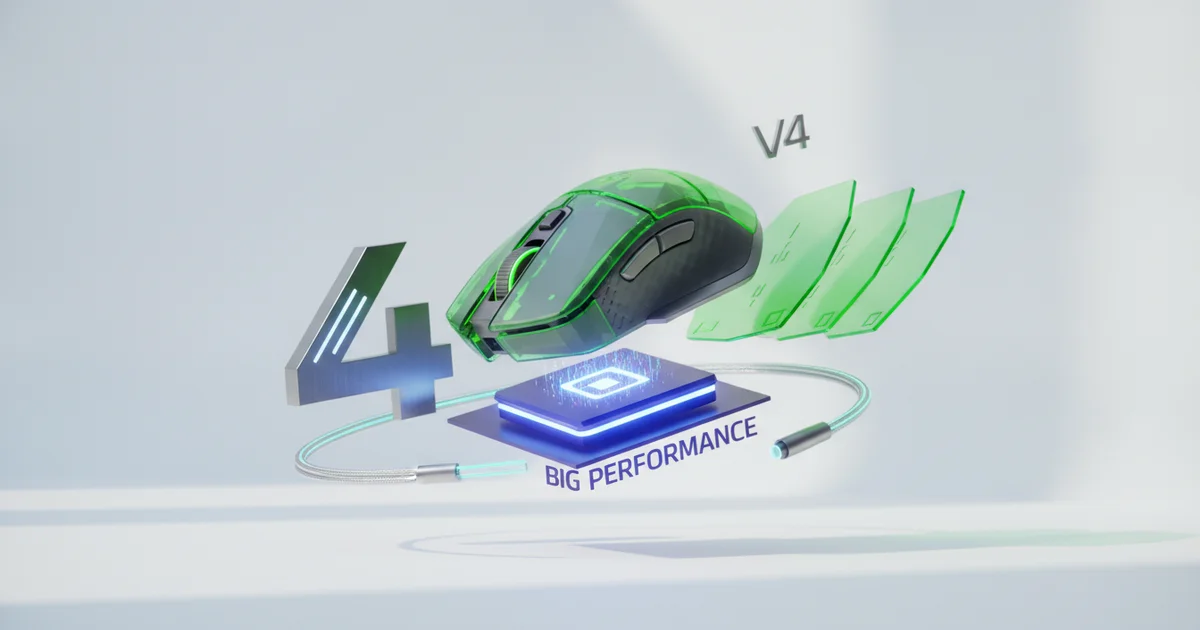
The Viper V4 Pro is a 50-gram ambidextrous wireless mouse built for competitive gaming. Razer positions it at the top of a product line that began with the original Viper V1 in 2019, which means the core design philosophy — lightweight, symmetrical, performance-first — is now six years old and on its fourth major iteration.
On paper, the headline specs hold up. The V4 Pro runs at an 8,000 Hz polling rate, meaning it reports its position to your PC 8,000 times per second. The wireless dongle received a tangible upgrade: three LED indicators now communicate connection status and battery level directly on the receiver itself, eliminating the need to glance at software. Razer also focused engineering effort on extracting more consistency from the existing polling rate rather than chasing a higher number, which tells you something about where the ceiling currently sits.
What the V4 Pro is not, however, is a reinvention. The sensor category stays consistent with the V3, and the physical shape carries forward the same ambidextrous form that Razer has refined — but not fundamentally reconsidered — across multiple generations. The “Pro” label implies a premium tier, but the mouse ships without Bluetooth connectivity. That omission matters because competitors at this price point now include Bluetooth as a baseline feature, not a differentiator. It gives users the flexibility to connect to laptops, tablets, and secondary devices without carrying a dongle.
The V4 Pro is a very good mouse. The question the product raises is a different one entirely: how much of what makes it good was already present in the V3, and whether incremental refinement at a premium price constitutes a compelling reason to upgrade.
The Upgrade Problem: Who Is This Actually For?
Reviewers writing up the Viper V4 Pro land on the same conclusion: it is not a significant upgrade over the V3. That verdict matters, because it forces an honest question about who Razer actually built this mouse for.
The answer splits cleanly into two groups. New buyers entering the market get a legitimately excellent product — a 50-gram ambidextrous mouse with an 8,000 Hz polling rate, a refined dongle featuring three LED indicators, and top-tier sensor performance. For that buyer, the V4 Pro earns its price without apology. Existing V3 owners face a different calculation entirely, and the hardware does not resolve it in Razer’s favor.
The 8,000 Hz polling rate is the headline spec separating the two generations. On paper, doubling the input reporting frequency from 4,000 Hz to 8,000 Hz sounds like a measurable leap. In practice, the difference falls below the threshold of human perception for the overwhelming majority of players, competitive or otherwise. Razer’s own engineering approach reinforces this: the V4 Pro focused on incremental improvements to extract more performance from the same polling rate rather than delivering a fundamental architectural change. The spec went up; the felt experience did not follow.
That gap between specification and sensation is where the upgrade cycle starts looking less like product development and more like shelf rotation. Semi-annual and annual refresh cycles generate new SKUs, sustain retail presence, and keep a brand visible in a crowded peripheral market. They do not always generate a reason to buy. When reviewers flag “not a significant upgrade” as a listed weakness alongside the absence of Bluetooth, the manufacturer has effectively handed consumers the argument against spending again.
The Viper line has maintained a strong position in competitive gaming since the original V1 launched in 2019. That reputation carries the V4 Pro further than the specs alone would. But reputation borrowed from previous generations is not the same as earning the upgrade, and for anyone already holding a V3, the V4 Pro does not earn it.
What the Coverage Is Missing: The Dongle as a Quiet Innovation
Most reviews of the Razer Viper V4 Pro mention the upgraded dongle in roughly the same breath as the box contents — technically present, functionally dismissed. That’s a mistake.
The redesigned HyperSpeed dongle ships with three LED indicators that display connection status and battery level in real time. For a mouse running at 8,000 Hz polling, where the entire value proposition depends on a clean, uninterrupted wireless signal, that feedback loop is not decorative. A competitive player who drops signal mid-match and has no immediate way to diagnose whether the problem is battery, interference, or hardware has already lost something more valuable than a sensor spec race. The LEDs solve a real problem that high polling rates create: the more you depend on signal consistency, the more you need to actually see that consistency confirmed.
Yet hardware reviewers continue to treat sensor figures and weight measurements as the primary axes of evaluation. The Viper V4 Pro weighs 50 grams, matches the V3’s 8,000 Hz polling rate, and makes no dramatic leap in DPI ceiling. By spec-sheet logic, the upgrade argument collapses. But that framing misses where the actual engineering effort went.
The dongle improvement reflects a broader migration happening across the peripheral industry. Innovation is moving away from the device itself — where sensor technology and polling rates have largely plateaued for practical purposes — and toward the connectivity and software layers that govern how the device behaves in real conditions. Razer’s Synapse software already handles profile management, sensitivity tuning, and lighting customization. The dongle’s LED system extends that logic into physical hardware: giving players observable, immediate data about the one variable that wireless performance actually depends on.
That shift deserves serious analytical attention, not a footnote. When the headline specs stop differentiating products, the infrastructure holding those specs together becomes the real story.
Software and Customization: The Underreported Competitive Edge
Razer Synapse appears on the Viper V4 Pro’s spec sheet as a bullet point, but it functions as something more strategic: a retention mechanism. Once a competitive player builds out their configuration—custom polling rate profiles, lift-off distance calibration, button remapping across multiple games—switching to a competing mouse means rebuilding that entire setup from scratch inside unfamiliar software. That friction is deliberate, and it compounds over time.
For players competing at a serious level, the hardware ceiling between top-tier mice has effectively collapsed. The sensor performance gap between a Razer Focus Pro and a comparable PixArt optical sensor is negligible in real-world play. What Synapse offers instead is granular, centralized control over the variables that actually separate configurations: 8,000 Hz polling rate adjustments, per-application button remapping, and lift-off distance tuning that can be locked to within fractions of a millimeter. These are the levers competitive players pull repeatedly, and having them inside a single unified suite reduces cognitive overhead during setup and mid-session adjustments.
The absence of Bluetooth is a direct signal about who this mouse is built for. Razer could have included it—the technology is standard across their productivity-oriented peripherals. Leaving it out strips the Viper V4 Pro of any ambiguity about its purpose. This is not a mouse that travels between a work laptop and a gaming PC. It connects via USB-C cable or the HyperSpeed Wireless dongle, and the upgraded dongle with three LED indicators reinforces that wireless competitive use is the intended secondary mode, not a feature layered in for convenience.
The result is a product where the software ecosystem carries a disproportionate share of the long-term value. A competitive player invested in Synapse, with profiles tuned across dozens of hours, faces a real switching cost that has nothing to do with hardware specs. That lock-in doesn’t show up in benchmark comparisons, but it shapes purchasing decisions far more than an incremental DPI increase does.
The Bigger Picture: Iterative Releases and the Gaming Mouse Market
The Viper V4 Pro does not exist in a vacuum. It represents a pattern that defines the premium gaming peripheral market: incremental specifications packaged as generational upgrades, released on a cadence that pressures consumers to spend before genuine need arises.
Razer’s Viper line launched in 2019 with the V1, and each subsequent release has followed the same formula — refine the ambidextrous shell, bump the specs, keep the competitive positioning intact. The V4 Pro lands at 50 grams with 8,000-Hz polling and a redesigned dongle featuring three LED indicators. These are real improvements. Reviewers acknowledge them directly. But those same reviewers flag the uncomfortable truth: the V4 Pro is not a significant upgrade over the V3 Pro for anyone already holding that mouse.
That tension is the point. Razer’s decision to preserve the ambidextrous form factor across generations is rational from a business standpoint. A proven shape carries no ergonomic R&D risk. It retains brand recognition among esports players who trust the Viper silhouette. Iterating on internals while keeping the exterior stable reduces manufacturing complexity and shortens development cycles. The business logic is sound. The cost lands on the consumer.
The deeper question the V4 Pro forces is whether the peripheral industry’s refresh cadence has outrun the pace of meaningful innovation. Polling rates already sit at 8,000 Hz. Sensors already track movement at resolutions human hands cannot meaningfully exploit. Weight reduction past 50 grams produces diminishing competitive returns for the overwhelming majority of players. The hardware ceiling is visible, and the industry knows it.
What fills that gap is marketing. New generation numbers, upgraded dongle LEDs, and minor efficiency improvements become the headline features — real enough to justify a product cycle, not substantial enough to justify an upgrade for existing owners. The Viper V4 Pro is an excellent mouse. The question buyers need to answer is not whether it performs, but whether the performance gap between it and whatever they already own justifies the price. For most Viper V3 Pro owners, the honest answer is no.