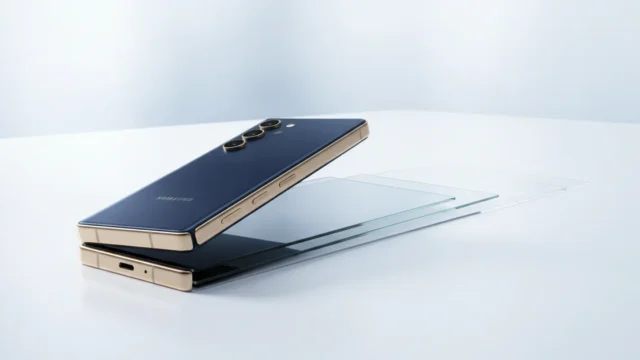
What the X4 actually is — and what it deliberately isn’t
The Xteink X4 is a 4.3-inch e-ink reader that weighs 77 grams, costs £40, and fits in a shirt pocket. Its 220 PPI display is sharp enough for comfortable reading. It runs on an ESP32 processor, carries a 16GB microSD card, connects over Wi-Fi and Bluetooth, and charges via USB-C. That is the complete feature list, and the gaps in it are the point.
There is no touchscreen. There is no front light. On a modern e-reader, both absences read as strange — almost aggressive. Every Kindle and Kobo at twice the price includes both as standard. On the X4, they look like cost-cutting until you sit with the device long enough to wonder whether they are something closer to a design decision. A physical button interface removes one layer of interaction between a reader and a page. No front light means no temptation to dial brightness settings at midnight. The device does less, and that reduction is load-bearing.
The physical dimensions — 114 x 69 x 5.9mm — collapse the usual argument between dedicated e-ink readers and phone-based reading apps. The X4 is small enough to attach to the back of a smartphone, which makes it a companion to a phone rather than a replacement for one. That positioning sidesteps the standard objection to buying a separate reading device: that carrying two screens is redundant. Here, the second screen adds almost no bulk.
Pricing does the rest of the work. Free reading apps cover one end of the market. A Kindle Paperwhite or Kobo Clara covers the other, starting around £130. The X4 at £40 occupies the space between them — cheaper than a budget Kindle, more purposeful than a phone app, and light enough, at 77 grams, that users report forgetting it is in their pocket. For anyone curious about e-ink reading but unwilling to commit to a premium e-reader price, the X4 is the most direct entry point currently available.
The missing context: e-reader feature creep has quietly priced out casual readers
Most e-reader coverage fixates on flagship devices — the Kindle Paperwhite, the Kobo Libra, the Onyx Boox Tab — while the sub-£50 segment gets treated as a footnote. That bias skews the conversation. Occasional readers, people who finish three or four books a year and carry a device on holiday rather than on a daily commute, have no particular need for a £130 premium e-ink display. They are, quietly, the majority of the market.
The features that now ship as standard on mid-range e-readers were once genuine selling points. Front-lit displays, capacitive touchscreens, adjustable warm-tone lighting — each addition solved a real problem for a specific kind of reader. But each addition also pushed up the unit cost, increased battery draw, and introduced new layers of software complexity. A reader who sits under a lamp in the evening and wants nothing more than a clean page of text is paying for engineering they will never use.
Cloud-dependent ecosystems compound the problem. Kindle locks purchases to Amazon. Kobo ties content to its own storefront. Neither approach is neutral — both create ongoing dependency on a retailer’s continued goodwill and infrastructure. The Xteink X4 ships with a 16GB microSD card and accepts cards up to 256GB. The reader owns the storage, physically, and can load it with DRM-free EPUB files without asking permission from a platform. At 77 grams and 5.9mm thin, the device itself is small enough to slip behind a phone case.
The X4 costs £40. That price is not incidental — it is the point. Budget e-ink readers are not a compromise category waiting to be upgraded. For a large portion of casual readers, the stripped-back e-ink experience, no touchscreen, no front light, local file storage, two weeks of battery life — describes exactly what they wanted before the market decided to sell them something more expensive instead.
Battery life as a feature, not a footnote
The Xteink X4 runs for up to 14 days on one to three hours of daily reading from a 650mAh battery. That number lands differently when the device is designed to live on the back of your phone rather than sit in a drawer waiting for a holiday. A reader that travels with you every day needs a battery that keeps pace, and the X4 delivers that without demanding a charging cable every few nights.
The absence of a front light is central to that longevity. Most e-reader comparisons treat a built-in light as a baseline requirement, something a device either has or is penalized for lacking. The X4 reframes that logic. No front light means the battery powering this e-ink display has less work to do, which directly extends the time between charges. That is a deliberate engineering trade-off, not an oversight from a budget manufacturer cutting corners.
Mainstream Kindle reviews and Kobo comparisons typically mention battery life in a spec table and move on. It rarely shapes the narrative around whether a device is worth buying. The X4 inverts that priority. For a pocket e-reader built around passive, ambient reading habits — the kind where you pull it out between tasks rather than settling in for a dedicated session — stamina is the feature that makes daily use practical.
A two-week battery on an e-ink reading device that weighs 77 grams and measures roughly the size of a credit card in height changes the psychological relationship you have with the gadget. You stop managing it. The X4 becomes a background object in your routine, present when you want it, invisible when you don’t, and never demanding attention with a low-battery warning at an inconvenient moment. For a device whose entire purpose is to reduce friction around reading, that kind of endurance is the spec that matters most.
The grassroots discovery loop — and what it tells us about niche hardware
The Xteink X4 didn’t reach readers through a coordinated launch campaign or a wave of sponsored reviews. It spread the way genuinely useful things tend to spread — one person told another. Blogger Khairul Selamat wrote about it, Neil Brown picked it up from there, then joelchrono, then moddedbear. Max Glenister saw those posts accumulating and ordered one himself. A £40 e-ink device with no PR budget found its audience anyway, moving through personal blogs and social shares rather than press releases.
That chain matters beyond the anecdote. Cult hardware almost always surfaces this way — through people who bought something with their own money, used it, and wrote honestly about it. There’s no affiliate commission shaping the conclusion, no review unit creating an implicit obligation. The Xteink X4 e-ink reader is a small, buttonless slate running on an ESP32 processor, and the people who found it weren’t looking for the next big thing in dedicated e-readers. They were looking for something that worked.
The structural problem this exposes is real. Tech media coverage clusters around devices with marketing infrastructure behind them. A Kindle gets reviewed everywhere because Amazon makes sure it does. A £40 budget e-ink reader from a small manufacturer gets reviewed by people who happened to stumble across a blog post at the right moment. The gap between those two paths isn’t quality — it’s budget.
How many affordable e-reader alternatives sit in the same blind spot? Devices that solve the reading experience problem without the price inflation that comes with brand recognition, retail partnerships, and influencer outreach. The e-ink display market has room for more than the handful of names that dominate search results, but discovery depends almost entirely on whether someone with a blog decides to write 500 words.
The grassroots loop that surfaced the X4 is fragile and accidental. It worked this time. Most comparable devices never get that first post that starts the chain.
Who this actually makes sense for — and who it doesn’t
The X4’s most obvious buyer already carries a smartphone and resents the idea of adding a dedicated Kindle or Kobo to their bag. At 77 grams and 114 x 69 x 5.9mm, the X4 slips into a pocket or clips to the back of a phone case without registering as a second device. That friction point — the bulk and redundancy of a traditional e-reader — disappears entirely. If your complaint about e-ink reading has always been the carrying, this device removes that complaint at the hardware level.
The gaps matter just as much as the strengths. The X4 has no front light. Full stop. Reading in a dark commuter train or in bed after your partner falls asleep requires an external lamp, which reintroduces exactly the kind of inconvenience the device otherwise eliminates. Commuters who read on lit platforms or in daylight are fine. Bedtime readers are not.
The device also ships with no storefront, no cloud sync, and no account to log into. Loading books means sideloading files directly — transferring EPUBs or other formats via the microSD card or USB-C connection. For readers comfortable with file management, that’s a feature: no subscription, no walled garden, no platform deciding what format your library lives in. For readers who buy from Amazon or Kobo specifically because it handles all of that automatically, the X4 creates a genuine technical barrier. The learning curve is not steep, but it exists.
The sweet spot is a reader who consumes books in natural light, already manages their own digital library in formats like EPUB or PDF, and wants a compact e-ink display without paying Kindle Paperwhite or Kobo Libra prices. At £40, the X4 costs less than most mainstream e-readers charge for a protective case. That price is only a good deal if the missing features — front light, touchscreen, ecosystem integration — are features you did not want in the first place.
What the X4 really signals for the broader e-reader market
The X4 arriving at £40 with a two-week battery life is not just a product story — it’s a stress test for an entire market segment. Consumer electronics follows a familiar arc: a category starts lean, accumulates features across successive generations, and eventually prices out the people who wanted the original thing. E-readers have followed that arc precisely. The Kindle Paperwhite now starts at £149.99. The Kobo Libra Colour sits above £200. Both devices do more than most readers need, and the pricing reflects that.
What the X4 demonstrates is that demand exists on the other side of that curve. A 4.3-inch e-ink display at 220 PPI, open microSD storage expandable to 256GB, and a 650mAh battery capable of fourteen days of daily reading — none of that requires a £150 price point. The hardware is simple by design, not by accident. There is no front light, no touchscreen, no proprietary storefront baked into the operating system. Those omissions are the product.
That matters to established brands because it makes their premium justification harder to sustain. When a £40 e-ink device handles sideloaded EPUBs and lasts two weeks between charges, a manufacturer selling a £150 reader has to work harder to explain what the extra £110 buys. For readers who don’t want audiobook integration, colour displays, or cloud sync tied to a retail ecosystem, the answer may be: not enough.
The broader signal here extends past dedicated e-readers. Minimalist digital hardware — devices that do one thing well, ship without subscription hooks, and keep the battery life long — is appearing across multiple categories. E-ink notepads, basic MP3 players, and distraction-free writing tools are all drawing renewed attention from people fatigued by feature density. The X4 fits that pattern. It is a pocket-sized e-ink reader that costs less than a hardback box set, and the fact that it has built an audience through word-of-mouth recommendations rather than marketing spend suggests the appetite for stripped-back hardware is larger than mainstream product roadmaps currently acknowledge.